
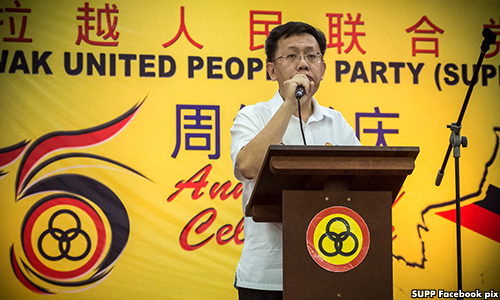
Left in the lurch, SUPP now at the crossroads
The party's central working committee members hurried out, rushing past the photographers that had been waiting for nearly four hours.
The president of the Sarawak United People's Party (SUPP) himself, Dr Sim Kui Hian, politely told reporters he would have a statement ready, before disappearing.
The party's central working committee members hurried out, rushing past the photographers who had been waiting for nearly four hours.
The president of the Sarawak United People's Party (SUPP) himself, Dr Sim Kui Hian, politely told reporters he would have a statement ready, before disappearing.
Reporters would learn hours later that the party had lost Pelawan to United People's Party (UPP), and its choice candidate, Sibu lawyer Michael Tiang, would have to sit yet again on the sidelines.
SUPP, Sarawak's oldest party, had been embarrassed a second time this week after losing Pujut to its splinter rival.
And chiefly shouldering the party's legacy was an already harried president. Standing under five feet five inches, Sim, a cardiac surgeon, did not cut an imposing figure.
However, supporters speak of the calmness about him, as he spoke to, and nodded at remarks party members made, appearing more a pediatrician than politician.
It was not difficult to come across the thankful testimonials of people whose friends or family members' lifespans were extended by Sim's surgical abilities.
Respect for Sim's reputation, at least as a doctor, crosses the political divide.
Last year, state DAP leader Chong Chieng Jien had said, perhaps without cynicism, that it was the medical community's loss that Sim had chosen to enter politics full time.
Such lulls in verbal attacks are fading fast as opposition parties seek to take advantage of rising voter anger, at least in the urban centres.
There, food and other living costs are not buffered by supplementary crop planting and animal rearing as done by rural residents, who make up less than half of the state's population.
There is also the public shock over the financial scandal surrounding 1MDB that the BN component has to contend with.
Senior SUPP leadership said the party risks disappearing from the state's political landscape altogether, unless it can find its footing quickly.
Losing relevance
Kuching branch chairperson Lily Yong last week called for a CWC meeting to discuss allotment of seats, which was lower than the 19 it usually got, and had publicly voiced concerns that the party may be losing its relevance.
The opposition said SUPP must shoulder the blame for policies enacted by the state government and BN at large.
Supporters said the party was a victim of guilt by association and that voters had lashed out at the party on issues it said it has no control over.
SUPP currently controls one parliamentary and two state seats after an internal squabble gutted the party.
Former party president and Sarawak deputy chief minister George Chan Hong Nam was unseated from Piasau by a DAP unknown in the 2011 election. He was asked to delay his resignation until the triennial delegates convention and presidential election in December 2011.
His successor, Peter Chin Fah Kui (
photo
) defeated Wong Soon Koh in the party polls, but only after half of the delegates boycotted the election. Wong's supporters felt that with more seats on their side, Chin should not lead the party.
Wong ultimately left with three assemblypersons, all of whom are Dayak, to UPP. One such leader was three-term assemblyman Dr Jerip Susil.
After choosing not to contest his parliamentary seat of Miri, Chin witnessed the loss of the seat to PKR's Dr Michael Teo Yu Keng. Chin offered to resign but was asked to serve until 2014.
In 2011, Sim contested against DAP's Violet Yong for Pending, losing by 7,595 votes. In the coming election, he will contest for Batu Kawah, facing incumbent Christina Chiew Wang See. Chiew, 30, is the former party assistant of Violet Yong.
While Kuching serves as the political capital, Sibu - the state's hub for timber conglomerates - is a major financial source for the party. Sibu-based Wong had taken with him much of the party's support in the state's central region.
The infighting extended to the courts, when Wong had to sue over ownership of three shophouses in Sibu. In March, the Sibu High Court confirmed that the offices belonged to SUPP.
Government crackdowns
The capitalistic nature of the fight is a far cry from its communistic roots in the early 1960s, when the federal government was worried, with justification, that the party was filled with leftist guerrilla sympathisers that resisted the formation of Malaysia.
Following government crackdowns, the party reorganised and joined the Alliance party, BN's predecessor, partnering with Parti Pesaka Bumiputera Bersatu (PBB) to win the 1970 election.
SUPP took 12 seats while PBB won 15 seats. With exception of Sarawak Chinese Association (SCA), which won one seat, the two parties were the components that formed the state government.
In more recent years, SUPP is seen as the layman's go-between, where the politically unconnected may seek redress of grievances they feel the opposition has no power to resolve.
Similar to the Peninsula-based MCA, SUPP plays such roles as resolving cheating cases, helping parents appeal rejections of their children's scholarship applications, or troubleshoot municipal problems.
Sometimes strings are pulled, for example, to ensure that married government-employed teachers do not get transferred apart, sparing years of separation.
Such influence, however, comes only with sufficient representation in the state government, the party admitted. Its representation has been chipped away since the 2001 election when it won 16 seats.
Losses accelerated in 2006 when SUPP lost eight of the 19 seats it contested. The party's worst showing was in 2011 when it lost 13 of the 19 seats it contested.
Risk of no representation
Coalition partners have recognised this. On Monday, Abang Johari had said the state cabinet risked having no representation from the Chinese community after the state election.
SUPP has called on voter support, but party loyalties may shift due to rising living costs, which the opposition said have been exacerbated by the goods and services tax (GST), passed by a BN-controlled Parliament in 2013 and implemented last April.
And unlike the rural-based Dayak parties, the BN component would have to placate a particular type of support base - the owners of small businesses who could never hope to receive government bailouts should their businesses fail - that may balk at the magnitude of the 1MDB scandal.
In previous years, the party could count on the unfettered support of the community's temenggongs and kapitans, business leaders and former presidents. In the run-up to this coming state election, the appearance of public support has been lacking for Chan and Chin.
Delays in announcing the candidates have also publicly left the party leadership in a lurch. Sim had publicly expressed disappointment when Adenan announced four more seats were to be allotted to UPP. Pujut, which the party had lobbied for, went to UPP.
What remains to be announced is the Meradong seat, which, if SUPP does not receive, would make the party 9 seats short of the 21 it had initially negotiated for.
This morning, in a statement, Sibu SUPP chief of publicity Wong Ching Yong criticised the chief minister for appointing non-BN parties and BN candidates, urging the president to lodge a complaint with the Registrar of Societies.
Wong said the party, which had participated in 11 elections, had already lost six seats when the war bugle was blown. Today, the figure is seven seats.


Are you sure you want to delete this comment?
This action cannot be undone.