


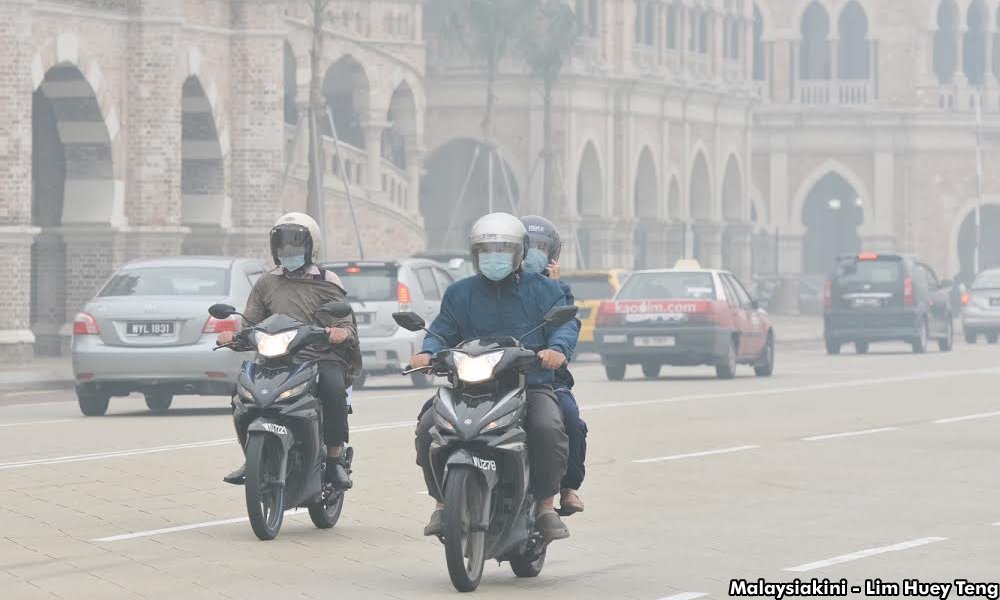

Minister: Local fires fuelling Klang Valley haze situation
The haze plaguing the Klang Valley since Wednesday is due to the smoke from fires which occurred in several areas in the Peninsula, including peat fires in Kuala Langat and Sepang, Selangor.
Natural Resources and Environment Minister Wan Junaidi Tuanku Jaafar in a statement last night said the situation was aggravated by the hot and dry weather, causing the air pollutants to float in the air.
"Currently, there is no influence of transboundary haze because the country is still in the inter-monsoon season which is expected to last until mid-May.
"Fires are actively being doused by the Fire and Rescue Department, and it is under control," he said.
In the meantime, Wan Junaidi said as at 3pm Wednesday, several areas around the Klang Valley recorded unhealthy levels of Air Pollutant Index (API) due to ground-level ozone pollution.
Wan Junaidi said the sweltering weather conditions and an increase in nitrogen dioxides (NOx) and Volatile Organic Compounds (VOC) has contributed to the rise in the API.
He said based on a report by the Malaysian Meteorological Department (MMD), as of Wednesday, Klang and Kuala Selangor had no rainfall for eight consecutive days.
Klang unhealthy
This morning, Port Klang registered API readings at unhealthy (114) at 6am.
Meanwhile, Bernama reported MMD's website as at 9pm last night showed that the APIs in several areas hit by the haze this afternoon, had returned to moderate levels.
Among the areas affected were Shah Alam (API reading from 122 to 86), Batu Muda (106 to 77), Cheras (131 to 78) and Petaling Jaya (103 to 73).
An API reading of between 0 and 50 is considered good, 51 to 100 (moderate), 101 and 200 (unhealthy), 201 to 300 (very unhealthy) and 300 and above (hazardous).
The public can refer to http://apims.doe.gov.my/v2/ for the latest API readings.
El Nino hits water plants
Fifteen water treatment plants (LRA) in five states are affected by the El Nino phenomenon involving 27,000 accounts in peninsular Malaysia and 1,200 accounts in Sabah.
The Energy, Green Technology and Water Ministry said in a statement today that the five states were Pahang, Kedah, Johor, Perlis and Sabah where the production of treated water was reduced because of the drop in the supply of raw water sources.
"The extremely hot weather resulted in several rivers and dams supplying raw water to the public recording a drop in water levels," the ministry said.
According to the ministry, the El Nino phenomenon was projected to hit the country until June which will cause a reduction in the occurrence of rainfall between 20 and 60 percent.
- Bernama


Are you sure you want to delete this comment?
This action cannot be undone.