




Muslim group demands interfaith commission be rejected outright
The Allied Coordinating Committee of Islamic NGOs (Accin), a coalition of 13 Muslim groups, has demanded the government to reject the formation of a proposed interfaith commission in its totality, describing it as an initiative by "certain individuals and non-Islamic groups".
The Allied Coordinating Committee of Islamic NGOs (Accin), a coalition of 13 Muslim groups, has demanded the government to reject the formation of a proposed interfaith commission in its totality, describing it as an initiative by "certain individuals and non-Islamic groups".
The Malaysian Consultative Council for Buddhism, Christianity, Hinduism and Sikhism (MCCBCHS) and the Bar Council human rights sub-committee were specifically named in a memorandum to the government dated Feb 25.
The interfaith initiative is coordinated by a steering committee comprising lawyers, representatives from the different faith groups and individuals, including Muslims.
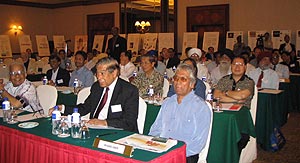 Accin is one of the detractors who have adopted a hardline stance against the proposed interfaith commission and boycotted last week's two-day national conference that was attended by over 200 individuals and representatives from more than 50 bodies (
photo
).
Accin is one of the detractors who have adopted a hardline stance against the proposed interfaith commission and boycotted last week's two-day national conference that was attended by over 200 individuals and representatives from more than 50 bodies (
photo
).
The document signed by Accin chairperson Mustapha Ma includes a seven-point summary of what is described as an anti-Islam memorandum submitted by the MCCBCHS to the Bar Council on Aug 22 2001.
The Accin memorandum contains key points largely reproduced from an earlier press statement released last year protesting the same.
Among others, Mustapha has accused non-Muslims of disputing certain Islamic teachings that are not only unrelated to them but were also beyond the questioning of Muslims themselves.
"The MCCBCHS memorandum is clearly a serious interference into Islamic teachings. Merely using a statutory body to achieve its objectives does not legitimise MCCBCHS' meddling.
"Instead, it could disrupt religious harmony in the country," he said in the five-page memorandum.
Deep-rooted hatred
He attributed the alleged deep-seated hatred against Islam among Bar members to the collaboration with MCCBCHS in ensuring the successful formation of the proposed commission regardless of the dissenting voices of fellow members in the syariah sub-committee.
 "It was said that Malaysia would have achieved Islamic state status if not for the interference of the colonial masters and the arrival of non-Muslims.
"Are we now witnessing the regression of our country into a secular state with Islam as a mere political ornament?" exclaimed Mustapha.
Repeating the point about deep-rooted hatred towards Islam among Bar members, he cited the previous controversy surrounding the azan (Muslim call to prayer) issue sparked off by an article penned by a senior lawyer.
He also expressed the fear that a basic form of an interfaith body, if allowed to be formed, would result in more attempts to strengthen it, which he said would effectively weaken Islam.
Asked for comments, steering committee member K Shanmuga said Muslim groups and individuals were involved, albeit briefly, during the early days of the interfaith initiative.
"For example, Accin was invited to participate in a pro-tem committee that was preparing for an interfaith workshop in 2003 (organised by the Bar Council), and they did come for several meetings.
"But in early 2002, Accin withdrew from the pro-tem after what appears to be one of the main reasons where the organisers' were unable to commit to gagging participants of the workshop.
"They wanted an assurance that intra-faith matters would not be discussed at all (at the workshop) but that was not possible because it was open to the public," he explained.
Liberal Muslim women's group Sisters in Islam, he said, had also pulled out initially but returned soon after the workshop and have since been supportive of the interfaith initiative.
Similar memorandum
Shanmuga, an exco member in the 10-member MCCBCHS representing the Hindu Sangam, said the MCCBCHS had submitted a similar memorandum to the Human Rights Commission (Suhakam) on April 8, 2002.
The MCCBCHS memorandum outlined the complaints and cases of non-Muslims facing problems with Islamic law administration pertaining to family matters and other aspects of daily life.
 Meanwhile, Opposition Leader Lim Kit Siang wants an all-party parliamentary select committee to be set up to study the interfaith commission draft bill when Parliament reconvenes next month.
Referring to the interfaith conference and proposed body, he said the flak and negative reaction to the "most important and commendable initiative to promote national unity in multi-religious Malaysia" was regrettable.
"It is regrettable and a most adverse reflection on the maturity of Malaysian nation-building and the success of national integration," he said.
Lim also described the objections and criticisms against the interfaith initiative as being "in complete variance with the spirit and message" delivered by Abdullah when opening the Conference of World Council of Churches (WCC) in Kuala Lumpur last August.
The prime minister is reportedly the first Muslim leader to open a WCC conference.
The veteran politician said that given the confluence of the world's greatest religions in the country, Malaysia should set an example of interfaith and inter-civilisational dialogue.
"But we seem to be retreating instead of boldly going forward to take up this challenge."
All are sensitive
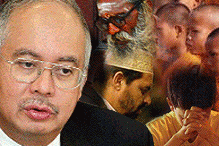 Commenting on Deputy Prime Minister Najib Abdul Razak's remarks yesterday of Islam being a sensitive matter, Lim felt that it was incomplete though pertinent.
"(The) religious rights of all Malaysians must equally be regarded as 'sensitive', and the country should not commit past errors of disregarding these sensitivities such as the unilateral, arbitrary and unconstitutional distortion of the Merdeka 'social contract' and the (Federal) constitution in the '929 declaration' that Malaysia is an Islamic state."
Lim acknowledged that 'sensitivities' in a plural society must be give proper regards but not at the expense of interreligious understanding.
"It should never be an excuse to impede or frustrate interfaith dialogue, which is the only viable basis for building a durable national unity in Malaysia."
He also questioned the stand taken by Suhakam chairperson Abu Talib Othman who reportedly rejected the formation of an interfaith commission.
"The statement is not only premature but most improper. Is it Suhakam's official stand or Abu Talib's personal view?"
Lim wanted an explanation if the views expressed was Suhakam's official stand.


Are you sure you want to delete this comment?
This action cannot be undone.