




Orang Asli seminar mulls drastic changes to law
Weaknesses in the Orang Asli Act of 1954 in recognising the Orang Asli's distinct identity is among the main factors causing that distinction to fade and threatening their eventual extinction as a group, says an indigenous peoples' association.
Weaknesses in the Orang Asli Act of 1954 in recognising the Orang Asli's distinct identity is among the main factors causing that distinction to fade and threatening their eventual extinction as a group, says an indigenous peoples' association.
As part of moves to amend the Act and halt the disappearance of their identity, the government should set up a peninsular Council for Indigenous Customary Law, said the group.
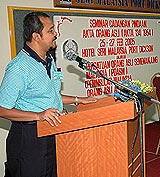 Universiti Malaya professor Dr Juli Edo said the proposed council can find a model in Sarawak's Council for Native Customary Law, and would function to record and codify Orang Asli customs in the peninsula.
This would in turn pave the way for the eventual drafting of indigenous customs into the legal framework of the country, Juli said at a recent seminar organised by the Association of Peninsular Malaysia Orang Asli (POASM) in Negri Sembilan to discuss proposed amendments to the Orang Asli Act.
"A detailed study (into codifying Orang Asli customs) would encompass Orang Asli civil and minor criminal laws, family, marriage and divorce, private ownership, property management and inheritance, as well as individual and communal rights," he said.
"Hopefully this proposal would serve as an annex to the (amended) Act because of its importance in developing our culture, determining our identity and strengthening the socio-political standing of the Orang Asli," he added.
A 'major' religion
J
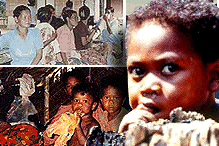 uli also called for the recognition of the Orang Asli's beliefs system as comparable to Islam, Christianity, and the other 'major' religions of the country, a call that sparked a lively discussion among seminar participants who supported his call.
"According to anthropological researches, Orang Asli beliefs made up a pre-Aryan religion that had spread wide over the Malay Archipelago and is recognised as one in India. In view of the universality of these beliefs, it should be officially recognised as a native religion," said Julian.
More than a few participants then spoke up to urge POASM to lobby the authorities towards demonstrating that recognition in the identity cards (IC) of Orang Aslis by indicating Agama Orang Asli (Orang Asli Religion).
Currently, the space indicating religion in ICs held by Orang Aslis state as 'none' ( tiada ) for those persons not professing the faith of the 'major' religions.
The discussion on identity received another boost when former POASM president Bah Tony William Hunt noted the outdated definition of Orang Asli as found in the present Act, and warned of the implications of maintaining a 'cultural' definition that increasingly alienated younger generations of Orang Asli.
He proposed that an Orang Asli be defined as a member of any of the 19 acknowledged indigenous groups found in Peninsular Malaysia, the offspring of a marriage involving an Orang Asli, or one who has been adopted and has been raised since childhood by Orang Asli and views him/herself as one.
"Any disputes concerning whether a person is or is not Orang Asli should be decided by a two-third majority of the village concerned and confirmed by the respective Rural and Regional Development Minister (who is in charge of the Orang Asli affairs)," said Bah Tony.
Mixed marriages
The issue of mixed marriages between Orang Asli and non-Orang Asli heated up when several participants called for legislation prohibiting marriages involving undocumented migrants.
Citing the incidence of foreigners who had returned to their home countries and left their wives and children to fend for themselves, the participants called for sanctions to prevent such things from occurring.
Orang Asli are the sole group in the country who are not required to register their marriages with the National Registration Department.
 Negri Sembilan delegate Amran Pudang, however, urged the participants to look beyond the misdeeds of a few unscrupulous illegals and address those women and children in need of laws to address and protect their welfare.
The input from the seminar will be fed into a national conference to be held March 10-12 by the Department of Orang Asli Affairs (JHEOA).
Malaysiakini had earlier reported criticisms of JHEOA on account of claims of under-representation at a conference purported to discuss amending legislation affecting the future of the indigenous community.


