




Seminar: Recognise Orang Asli leadership
In a bid to preserve the identity and culture of the Orang Asli community in peninsular Malaysia, certain quarters at a recent seminar in Port Dickson, Negeri Sembilan, called for the official recognition of indigenous leadership.
Presently, the Orang Asli Act of 1954 which governs the affairs of the indigenous community recognises the ketua kampung or village chief only.
Apart from the fact that the ketua kampung is appointed by the rural and regional minister, he is also overshadowed by the Department of Orang Asli Affairs (JHEOA) as the sole authority administering the welfare of the country's 147,000 Orang Asli.
Advocates now want other indigenous leadership positions such as penghulu , ketua kampung , datuk batin , bomoh , pawang , dukun , lembaga adat (board of traditions) and majlis orang-orang tua (council of elders) be brought into the administrative framework of local government.
However, there is concern that legal recognition of the Orang Asli's traditional leadership structures will lead to their co-optation into mainstream politics along with its many unsavory features.
In a bid to preserve the identity and culture of the Orang Asli community in peninsular Malaysia, certain quarters at a recent seminar in Port Dickson, Negeri Sembilan, called for the official recognition of indigenous leadership.
Presently, the Orang Asli Act of 1954 which governs the affairs of the indigenous community recognises the ketua kampung or village chief only.
Apart from the fact that the ketua kampung is appointed by the rural and regional minister, he is also overshadowed by the Department of Orang Asli Affairs (JHEOA) as the sole authority administering the welfare of the country's 147,000 Orang Asli.
Advocates now want other indigenous leadership positions such as penghulu , ketua kampung , datuk batin , bomoh , pawang , dukun , lembaga adat (board of traditions) and majlis orang-orang tua (council of elders) be brought into the administrative framework of local government.
However, there is concern that legal recognition of the Orang Asli's traditional leadership structures will lead to their co-optation into mainstream politics along with its many unsavory features.
Remote possibility
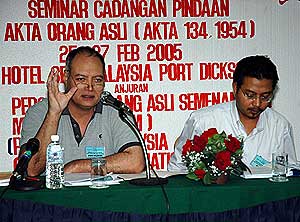 Dismissing this fear was the former president of the Association of Peninsular Malaysia Orang Asli (POASM) Bah Tony William Hunt (
photo, left
) who was one of the speakers at last week's three-day seminar.
Dismissing this fear was the former president of the Association of Peninsular Malaysia Orang Asli (POASM) Bah Tony William Hunt (
photo, left
) who was one of the speakers at last week's three-day seminar.
Contacted yesterday, he said the possibility of co-optation is remote because of the very reasons that have, until now, protected the Orang Asli from mainstream politics and prevented a split along political lines.
"It may perhaps be inevitable that the Orang Asli will be dragged into mainstream politics. We cannot rule out that possibility. There are already many Orang Asli who are Umno members and working closely with Umno.
"However, most Orang Asli would prefer not to be involved in politics. Their participation is only seasonal, such as during the general elections. They see Umno as a party for Malays, not one (that represents) the indigenous community," said the banker.
That reduces even more the chances of organisations such as the Islamic opposition party PAS from making any significant inroads into the Orang Asli community, he added.
Bah Tony said he had on occasion lamented the lack of ideological framework and objectives among Orang Asli leaders, but admits that this may be the indigenous community's 'saving grace' from partisan politics.
"Up until now, there's been a lack of ideology and (administrative leadership) has been pretty much a matter of crisis management. So the possibility (that they get dragged into partisan politics) is, in my opinion, far-fetched," he explained.
Traditional values
However, Centre for the Orang Asli Concerns director Colin Nicholas believes that the possibility of the Orang Asli falling into schisms along the lines of national politics is not as remote as some would wish.
The Orang Asli have in other cases been forced to adapt to the political system and the prevailing ways of doing things, and it does not look like they would be able to assimilate into politics without succumbing to some of its pitfalls, he said.
"Unfortunately, you have a situation where the Orang Asli have had to adapt themselves and their needs to the political system and its values instead of the political system adapting itself to the needs of the Orang Asli," he added when contacted later.
The only way to avoid this, according to him, is if Orang Asli leaders and communities maintain its appreciation for the traditional values pertaining to leadership and responsibility instead of adopting the current practice of going into politics for material advancement and social status.
"They can avoid (these pitfalls) if they recognise the traditional lifestyles and philosophy of leadership, in which leaders were chosen and respected because of their generosity and their knowledge. According to this tradition, almost nobody would want to be a leader," he said.
Limit terms
Proposals to amend the Orang Asli Act pertaining to the preservation of their cultural identity and ways to empower the community in face of disputes over land were discussed during the Feb 25-27 seminar organised by POASM.
The 50-odd participants also discussed ways to augment the Orang Asli community's socio-political role in the country.
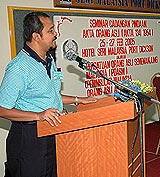 One of the speakers, Universiti Malaya Professor Dr Juli Edo (
photo
), proposed to limit the tenure of appointed village chiefs, such as
datuk batins
, to five-year terms similar to that imposed on state assemblypersons and parliamentarians.
One of the speakers, Universiti Malaya Professor Dr Juli Edo (
photo
), proposed to limit the tenure of appointed village chiefs, such as
datuk batins
, to five-year terms similar to that imposed on state assemblypersons and parliamentarians.
"According to modern developments, community leadership cannot be held for life. A term-system should be introduced in order for the people to choose leaders who are capable and outstanding," he said in his paper.
This led to a lively debate on the merits and demerits of abandoning the practice of 'inherited' datuk batin positions, with some defending it as one of the Orang Asli's cultural institutions that define their identity as a group.
One 'young' participant, in particular, called for the Orang Asli community to raise the esteem of the traditional leadership not merely by demanding official recognition but producing and demanding capable leadership.
"Let's not be overly sensitive about datuk batins. We young people do not disrespect them. The institution of datuk batin is honorable but it is human beings who destroy its nobility," he said.
The input from the seminar will be fed into a national conference to be held March 10-12 by the Department of Orang Asli Affairs (JHEOA) at the Awana Resort in Genting Highlands.
Malaysiakini had earlier reported criticisms of JHEOA on account of claims of under-representation at a conference purported to discuss amending legislation affecting the future of the indigenous community.


