
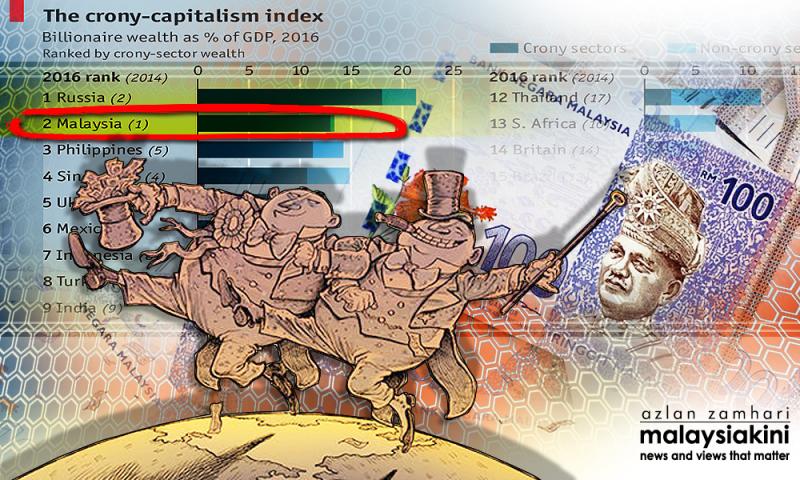
Anti-graft group Centre to Combat Corruption and Cronyism (C4) said while it is alarmed at Malaysia's rise to number two on a crony capitalism index, it is not surprised.

"While we're very alarmed, we're not surprised actually at this slide of Malaysia's performance in the index.

"We recommend for very urgent systematic and serious reforms in this direction, which will actually mean a real overhauling of the system.

"The way contracts are awarded, the procurement practices in the country; all these are policies which need urgent reform, if we are serious about plugging the danger of patronage politics," C4 executive director Cynthia Gabriel told Malaysiakini today.

Yesterday, The Economist published its second run of the index of crony capitalism, which saw Malaysia rising to number two, just behind Russia which clinched the crony capitalism crown.

This, stated the business publication, is against the backdrop of the global fraud investigations into the state-owned investment arm, 1MDB, that is answerable to Prime Minister Najib Abdul Razak.

Malaysia was number three in the index when it was first instituted two years ago in 2014, to test if the world was experiencing a global re-run of the late 19th century age of the American 'robber barons'.

Gabriel (photo) said that the result of the index did not augur well for the country.

"Fully knowing that patronage politics and cronyism has actually been at the centre of the administration of the BN government, it has actually now manifested in a real slide, in terms of competitiveness and ability to run businesses based on merit and quality performance.

"All these have been severely compromised over the years," she said.

Gabriel also said that crony politics can be evidently seen in government-linked companies where appointment of directors is done without prior appointment process and picked from persons close to the government, in return for financing of political activity.

Such conflict of interest erodes Malaysia's ability to provide essential quality services despite moving towards privatisation policy, she added.

"The ability of non-crony companies to bid for government tenders and projects has been severely limited as a result, keeping tight the network of companies linked to those in positions of power," she said.

Meanwhile, Bersih chairperson Maria Chin Abdullah pointed out that the wealth in Malaysia has always been held in the hands of a few, a process which was expedited with the implementation of the New Economic Policy (NEP) in 1971.

She said the downside of the NEP was that it has created the subsidy or dependency on the state mentality.

"Such privileges are seen as a birthright - easy credit, business licences, government contracts, and other preferential treatments - all these through political patronage," she said.

This sort of mentality has also reduced the competitiveness in the country's businesses, she added.