




Kohilals investments crashed due to bad luck, ex-director
A former director of Koperasi Al-Hilal (Kohilal), a co-operative closely linked to opposition party PAS, blamed ill luck for its botched multi-million ringgit business ventures.
A former director of Koperasi Al-Hilal (Kohilal), a co-operative closely linked to opposition party PAS, blamed ill luck for its botched multi-million ringgit business ventures.
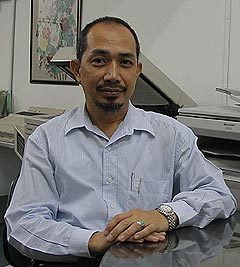 Dr Rayney Azmi Ali said the business ventures failed, resulting in losses amounting to RM45 million in the late 1990s, because of unforseen external factors and not poor management as alleged by some.
"Yes it was purely bad luck that all business projects ventured by Kohilal then failed. It was not because we managed the co-operative wrongly or that we did not do a proper study.
"Documents and minutes will prove that everything went by the book. There was no hanky-panky," he said when met at his office in Kuala Lumpur last week.
Recalling his days as a director between 1995 and 2001, he said Kohilal was initially doing well when its 'Project Star' - that involved trading gold in India - saw members rewarded up to 20 percent in annual dividends.
"In 1996 or 1997 we were offered to trade gold in India. So we bought gold from Singapore and sold them in India. It worked well. Everybody was happy because everyone got money. So when we made huge profits, membership grew as more people wanted to invest," he added.
Expansion plans
It was then when the former management - led by Senator Hassan Shukri (who is now PAS deputy president) - decided to expand because it felt that it would be unsafe to invest everything in a single project
"We felt that we couldn't be sending one container of gold and selling it to India. It wasn't practical, safe or feasible.
"So we decided to venture into other business opportunities. So the then treasurer Ali Maidin was asked to make the proposals," said Rayney, who is now a medical officer at Kohilal Medical Centre.
He said after looking at several proposals, the board decided that apart from continuing with the trading of gold in India, it would also invest the RM45 million collected by members in an ostrich farm in Australia, the Indonesian agriculture sector and a share-trading company, Perdana Technology Venture (PTV).
"Our ostrich farm business failed due to a bad flood which ruined the farm and killed all the birds. It was something beyond our control. To make matters worse, the insurance for the farm could not compensate the loss as the policy did not cover natural disasters," he explained.
Rayney said the investments in PTV - which forecasted a four-fold profit - also failed due to the recession in the late1990s .
"At that time PTV told us that an IT company in Canada was about to be listed at the main board. We were told that we buy shares at RM1 per unit and they expected the share price to go up till RM4 after listing. But then the recession set in and there were problems in listing the company. But when it was finally listed, the market was very bad and the price went down as low as 18 sen!"
He said they tried to salvage some funds from gold trading activities but failed when the Indian government changed the trading laws which made the competition among gold traders steep.
"We thought we could turn to our Indonesian project for help only to discover that we were cheated. What we thought were genuine documents, signed by our representative - the then vice chairperson Sheikh Bakar - turned out to be forged. We were cheated by the locals there."
Board was careful
Rayney denied that the board had failed to make proper studies before venturing into the business projects stating that every single project was adequately scrutinised by the board.
 "We looked at the figures, the investment, how many years we have to wait for the returns..everything was recorded, minute meetings, it's all there. Everything is on paper. The board looked at everything."
He said it was easy for members to criticise the decisions made then as he believed that the board had done everything within its power to protect the interests of the co-operative and its members.
"We carefully thought of the investment strategies. Ali Maidin had rightly pointed out that it was not safe to put the entire fund in one investment which was the trading of gold.
"He said there was a need to have back-up projects because if this fails, then we can rely on others. But when everything did not fall in place due to external factors, is that the board's fault? I think not! It was beyond our control."
Asked about Kohilal being investigated by the Co-Operative Development Department (JPK) and the Securities Commission (SC), Rayney said the then board members have given their statements to the authorities.
"JPK and SC are investigating because members had complained since they could not get back their money. Members are asking whether we did it (manage) the correct way.
"I think they (the authorities) are looking at the technicalities. If the SC and JPK are looking into anything hanky panky, Insya' Allah (God willing), I don't think any of us is worried.
"I have had interviews with the SC and JPK and I told them if they are looking for cheating offences, misappropriation, corruption, none of that took place," he said.
Rayney also dismissed allegations that the board had ignored the complaints and the plight of the members, saying that the directors had gone from state to state explaining the losses.
"But they just refused to accept that we suffered losses. They just wanted their money back although we pointed out that the investment was al-mudharabah - we share profits and losses," he added.
As for the mass resignation of Kohilal directors in 2002, he said it was not because they wanted to escape responsibilities as alleged.
"We wanted to improve things with other projects but members were questioning us, our capabilities, so we felt if people do not have confidence in us, then the only right thing to do is resign. If someone else thinks they can do better, they by all means are welcome to take over."
Don't involve party
Rayney is aware that certain leaders in PAS, including Hassan, are bearing the brunt of the problems surrounding Kohilal.
"I am aware that members are pushing the PAS leadership to step in and come out with solutions but I believe that it is the wrong approach.
"I believe that there is nothing the party can do...after all by law, they are two different entities. One a political party under the registrar of societies while another is a co-operative under JPK. The party should not interfere in Kohilal."
Asked why the issue is so sensitive, he replied: "It's all about money. They want their money back and that is all there is to it. Nothing else matters to them."
Issues linked to the co-operative have repeatedly been raised at various party meetings both at the state and federal levels including the recent special convention . Its expected to be raised again at the party's coming annual general assembly or muktamar in June.
The state leadership in Negri Sembilan and Selangor have since taken affirmative actions to get the PAS' top leadership actively involved in settling the issue.


Are you sure you want to delete this comment?
This action cannot be undone.