




No timeframe for settlement of border row with Indonesia: Syed Hamid
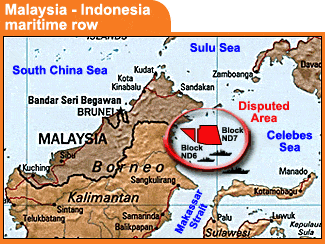
Foreign minister today said his government had agreed on talks with Indonesia over a border row that has seen a military escalation in the Sulawesi Sea but said there was no timeframe for a settlement.
Foreign minister today said his government had agreed on talks with Indonesia over a border row that has seen a military escalation in the Sulawesi Sea but said there was no timeframe for a settlement.
 "We hope this would be a begining of talking to each other on this issue, the Sulawesi Sea, and we wil see from then on," Syed Hamid Albar told reporters in Jakarta ahead of a meeting of Southeast Asian and European ministers.
He said that during a meeting with his Indonesian counterpart Hassan Wirayuda late Wednesday, both agreed on peaceful dialogue to end the dispute centring on Kuala Lumpur's granting of an oil concession in the contested area.
But when asked whether there was any schedule for the negotiations, Albar said: "I do not think we should give any timeframe."
A joint statement issued by the two ministers at the end of Wednesday's meeting said the two governments would "take necessary steps" to ease the recent tensions.
"The president of Indonesia and the prime minister of Malaysia have decided to use peaceful means in addressing the problem relating to the maritime border of the two countries particularly in the Sulawesi Sea," it said.
Warships from both countries have come into close contact in the area east of Borneo several times since Feb 16 when energy giant Shell was given a concession by Malaysia's state oil company Petronas.
Jakarta says the blocks awarded by Petronas are outside Kuala Lumpur's sovereignty.
Technical team
 According to the foreign ministers' joint statement, the two sides would organise a "technical team" with representatives from both sides to discuss the problem on a regular basis beginning March 22.
The two countries have locked horns over the territory before. A dispute over the ownership of two islands ended in December 2002 with an International Court of Justice ruling that the islands belong to Malaysia.
Indonesia declared war against Malaysia following sporadic tensions over the future of Borneo island in 1963 after the British relinquished control. The conflict ended three years later as Jakarta focused on internal problems.


