


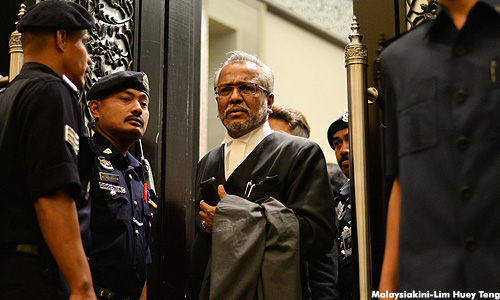

Shafee loses defamation suit against lawyer, ex-judge, Bar
Senior lawyer Muhammad Shafee Abdullah has failed in his defamaton suit against fellow lawyer Tommy Thomas, former Court of Appeal judge VC George and the Malaysian Bar after the court found it was improper to discuss 'in camera' evidence at a forum.
Senior lawyer Muhammad Shafee Abdullah has failed in his defamation suit against fellow lawyer Tommy Thomas, former Court of Appeal judge VC George and the Malaysian Bar after the court found it was improper for him discuss 'in camera' evidence at a forum.
Kuala Lumpur High Court judge Hanipah Farikullah, in dismissing the suit, ruled that the court has accepted the defence of justification, qualified privilege and fair comment.
She added that the court found it was improper for Shafee to discuss in camera evidence during the trial of Anwar Ibrahim's sodomy II case at a forum in Kelana Jaya after the Federal Court decision last year.
"The court hereby dismisses the case," Hanipah said. No order is made on costs.
'In camera' is a legal term that means in private - a process where the public and press are not allowed to observe the procedure or process in court.
Shafee filed the suit to stop Tommy and George from tabling a motion against him at the Malaysian Bar AGM last year. He obtained an ex-parte injunction a day before the AGM to stop the motion from being tabled.
The senior lawyer in his suit claimed that the defendants had defamed him by filing the motion to the AGM where they wanted to move him to see disciplinary action be taken.
Justice Hanipah, who delivered the oral decision by reading it for one hour, also ruled that former Malaysian Bar president Christopher Leong should not be a defendant in the suit.
In accepting the defence of justification on a balance of probabilities, the judge said the court found that the plaintiff (Shafee) had also spokes about in camera evidence at the High Court and the Federal Court had dealt with it at the proceeding.
“For this court, evidence involving in camera evidence is not proper for an advocate and solicitor to divulge it to the public. To my mind, there is some substantive truth for the first defendant (Tommy) and the second defendant (George) in the defence of justification,” she said.
Ruling in granting the defence of fair comment, Justice Hanipah said based on the circumstances of this case, it suffices at this stage that the comment made is of a public interest matter as it is published online and hard copies of it appeared in traditional newspapers.
“This case is of public interest. The defence of fair comment is available to the defendants,” she ruled.
“This is a public interest matter and to my mind Tommy and George had successfully proven defence of fair comment,” the judge added further.
Qualified privilege
All three defendants - Tommy, George and the Bar - claimed qualified privilege as a ground of defence and basically Justice Hanipah ruled in favour of the three as the court found there was no malice over their intention.
In claiming the defence of qualified privilege, all parties must show that there is no malice for them to prevent the defence and be saved from being sued for defamation.
The rationale that they argued, the judge said, is to protect the reputation and general principles of law and the question is whether the defendants has a legal duty to submit the motion to the AGM.
“In my view, the question is to the affirmative. The first and second defendant filed the motion to the Malaysian Bar as it alleged the conduct of one of its member who is also a senior member of the Malaysian Bar. The answer to this question is that they have the legal duty to submit to the AGM
“The motion was prepared and seconded based on newspaper reports and also from traditional news reports. Hence on the principle, Tommy and George has a duty to file and the Bar Council and the fourth defendant (Christopher Leong) to publish the motion to the members of the Bar on the Malaysian Bar website,” she said.
No malice
Justice Hanipah ruled that after perusing evidence, the plaintiff failed to produce any evidence of malice to put down the defence of qualified privilege.
She said the plaintiff has failed to prove who distribute the motion to the press and also failed to prove whether there was a conspiracy to defame as pleaded.
The judge said at the end of the trial during case management, she did persuade the plaintiff whether they wanted to continue on the conspiracy claim against the defendants.
Shafee, the court said, said the motion was to try and find him guilty of the charges.
“The AGM is not the disciplinary authority as the disciplinary authority is with the Advocates and Solicitors Disciplinary Board. It is pertinent to note that the motion was presented to the AGM not to discipline the plaintiff and the purpose of the Bar Council is to maintain the conduct of its members in the Malaysian Bar.
“To my mind, the parliament has given specific powers to the Bar Council and to make sure that it is not infringed. I am of the view given the powers by Parliament the Bar Council has the power to regulate the conduct of an advocate,” Justice Hanipah said, that she is guided by this following a Federal Court decision.
She said under Section 57 and 93 of the Legal Professions Act, the Bar has the power to discuss disciplinary matters or the conduct of its members.
The judge noted while Shafee complained that he was not given the right to be heard, the lawyer could have come to the AGM to clear his name by the fair process of speaking and defending himself at the AGM and he was not deprived of the fair process.
With this, the court ruled the defence of qualified privilege was available to all three.
In an immediate reaction, Shafee’s son Muhammad Farhan Shafee said his father will appeal against the whole decision.


Report this comment
Are you sure you want to delete this comment?
This action cannot be undone.