




Fair polls, free media - key ingredients for greater democracy
A fair electoral process and free media are two key factors that will lead to the further democratisation of Malaysia, said R Sivarasa, a lawyer who specialises in human rights cases.
A fair electoral process and free media are two key factors that will lead to the further democratisation of Malaysia, said R Sivarasa, a lawyer who specialises in human rights cases.
"Lack of integrity with the electoral roll and media control by ruling political parties in the country are two main obstacles to democratisation," he told participants of a regional workshop in Kuala Lumpur.
He cited the 'unscrutinised' postal voting process and the Election Commission's lack of independence as examples.
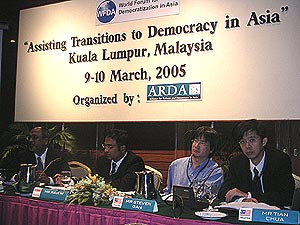 Sivarasa, who is also the vice-president of Parti Keadilan Rakyat (PKR), said the nation needs a strong viable opposition as it would give the people an alternate choice should the ruling government 'screw-up'.
He suggested that country-based workshops be held to formulate strategies towards this purpose.
The lawyer was one of the panelists invited to share their views at the two-day 'Assisting transitions to democracy in Asia' workshop sponsored by the Singapore-based Alliance for Reform and Democracy in Asia (Arda).
Participants of the workshop included representatives of leading regional non-governmental organisations from Hong Kong, Singapore, Thailand, Cambodia, Pakistan, Nepal and Malaysia.
The workshop is a series in similar events held in preparation for a major conference -'World Forum for Democratisation in Asia' - to be held this July.
Political competition vital
 Another panelist, Tian Chua, a labour activist and PKR information chief, was optimistic about the future of democracy in this country as the 1997 economic recession had created plenty of room for such opportunities.
He said prior to the recession people subscribed to the belief propagated by the government that they would have to sacrifice certain liberties in exchange for economic growth.
"The economic crisis however triggered people to question the theory, people then wondered whether sacrificing civil liberties could eventually secure employment" he added.
Chua argued that there will be no economic growth unless there is political change and together with it good governance and greater transparency.
He also pointed out that human rights issues could not be seen as an internal affair any longer.
For example, he said Malaysia has been vocal about the violence in Southern Thai while Indonesia expressed concern over the unfair treatment of illegal immigrants during the ongoing crackdown here.
Chua stressed that building a strong political party and healthy political competition are essential in moving towards democratisation in the country.
 Earlier,
malaysiakini
co-founder and editor-in-chief Steven Gan presented to the participants the overall state of the media in Malaysia, which he said is strongly controlled by repressive laws and media ownership.
Earlier,
malaysiakini
co-founder and editor-in-chief Steven Gan presented to the participants the overall state of the media in Malaysia, which he said is strongly controlled by repressive laws and media ownership.
According to him, there are more than 35 laws that impinge on press freedom such as the Official Secret Acts, Sedition Act, the Internal Security Act and the Printing Presses and Publications Act - which makes it mandatory for a publication to renew its license annually.
"The Internet, therefore is the only democratic space left. However, it is not completely free too because it must comply with many other laws," said Gan, adding that malaysiakini is "exploiting this loophole".


