


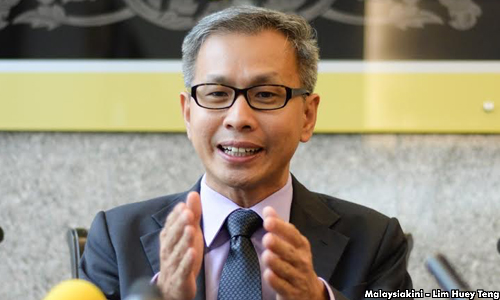

Has Bank Negara probed Najib for money-laundering, asks Pua
DAP lawmaker Tony Pua wants to know whether Bank Negara has investigated the US$1billion that was allegedly deposited into Prime Minister Najib Razak's personal bank accounts for possible money-laundering offence.
Pua posed this question in the wake of the actions of Switzerland's Office of the Attorney-General (OAG) and Monetary Authority of Singapore (MAS) in shutting down BSI Bank branch in the island nation.
"What has Bank Negara done to protect the integrity of our financial system?" he asked at a press conference at the Parliament lobby today.
DAP lawmaker Tony Pua wants to know whether Bank Negara has investigated the US$1billion that was allegedly deposited into Prime Minister Najib Razak's personal bank accounts for possible money-laundering offence.
Pua posed this question in the wake of the actions of Switzerland's Office of the Attorney-General (OAG) and Monetary Authority of Singapore (MAS) in shutting down BSI Bank branch in the island nation.
"What has Bank Negara done to protect the integrity of our financial system?" he asked at a press conference at the Parliament lobby today.
"Despite the fact that Malaysia is being ridiculed globally and cited as an example of a rogue state, Bank Negara has barely bared its purportedly powerful fangs to charge those who have been responsible.
"The central bank made a hue and cry over 1MDB, but ended up with a whimper when it agreed to close the chapter by slapping 1MDB on the wrist with a fine," Pua said.
"The quantum of the fine was undisclosed, but it could be a pitiful RM4,000, for all we know."
The central bank has brought shame to the country by allowing itself to be used by the alleged money-laundering suspect to acquit themselves, he claimed.
Pua asked if Najib had obtained the approval of the central bank to transfer RM2.6 billion into his personal accounts, as claimed by Department of Special Affairs (Jasa) director-general Puad Zarkashi.
"Najib has been accused of receiving more than US$1 billion (RM4.1 billion) in his personal account with AmBank, a sum which he hasnot denied," he said.
Bank Negara must confirm if the prime minister has been investigated under the Anti-Money Laundering and Anti-Terrorism Financing Act 2013, Pua added.
The so called donation Najib received does not absolve him from the purview of the Money Laundering Act, he said.
Any failure to investigate or confirm the matter would only mean that the central bank has abdicted its power.
"By failing to do so, Bank Negara has severely neglected its responsibility to protect the integrity of our financial system, especially when compared with the actions of foreign central banks to date," Pua noted.


