




Academic raps gender stereotyping in Malay movies
The stereotyping of women as meek sex objects in Malay movies influences society at large, said an academic at a seminar in Kuala Lumpur yesterday.
The stereotyping of women as meek sex objects in Malay movies influences society at large, said an academic at a seminar in Kuala Lumpur yesterday.
Professor Madya Fuziah Kartini Hassan Basri said movies act as a comprehensive medium which provides a lasting image in our minds and it is also a powerful tool for gender setting.
This, she added, is reflected in the increase of crimes and violence against women in this country.
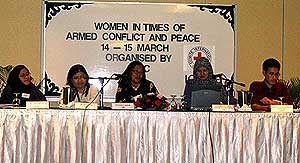 Fuziah was speaking at the two-day seminar entitled 'Women in times of armed conflict and peace' organised by the Kuala Lumpur Regional Delegation of the International Committee of the Red Cross (ICRC) in collaboration with the Southeast Asian Association for Gender Studies.
Attended by about 45 participants from non-governmental organisations, the media, government ministries and academicians, the seminar aims to promote discussion and awareness on issues affecting women in times of armed conflict and peace.
Held in conjunction with the recent International Women's Day, the seminar is part of ICRC's efforts to raising awareness of communities affected by armed conflict and to better assess and address their needs.
Influencing the audience
Meanwhile, Fuziah said the gender relationship portrayed in Malay movies has an implication on human security, which leads to the question of gender security - which is made up of gender justice, gender safety and respect as well as social security.
She added that gender security could be achieved if there is a dominant presence of both sexes, no violence, complementary relationships between men and women as well as a conducive and safe environment for women.
The academician presented her study on 10 Malay box-office movies, of which, comedies were the most popular choice among Malaysians.
According to her, in comedy-related movies "women are often seen as sex objects, seducers, unable to live alone, like to parade themselves, talk a lot, gossipers and busy bodies".
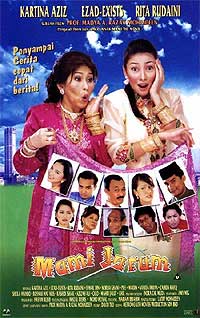 They included three top Malay films -
Lagi-lagi Senario, Anak Mami The Movie and Mami Jarum
.
They included three top Malay films -
Lagi-lagi Senario, Anak Mami The Movie and Mami Jarum
.
As for drama or action movies, which is the second most popular genre, women are portrayed as weak and jealous.
On the same note, Fuziah pointed out that in comedies, men are shown as philanderers, deceptive, dominant and crude whereas in dramas, they are chivalrous.
"These culturally detriment images may influence the audience who are mostly young," said the academic.
To remedy this situation, she suggested for constant dialogues between film makers and NGOs as well as the incorporation of more women-oriented storylines.
The proper role of men in society must also be portrayed, she added.
Fuziah said gender issues arise in movies due to the lack of respect, where women's rights are not recognised and the media publicises stereotyped roles.
Besides, she added that scripts are normally written by men and the movies directed by them and therefore their imaginations or reality are reproduced on the silver screen.
As for Malay women directors, she said they are not well received by the audience.
"Among film makers, they are being discredited. We have a long way to go. It's the issue that must be addressed, it doesn't matter whether or not if it (the script) is written by a man or woman." she added.
Enforce the laws
 Parliamentary Secretary of the Women, Family and Community Development Ministry, Chew Mei Fun, who launched the seminar, said there is a need to draw attention to the plight of women and children in armed conflict situations.
She also underlined the importance of addressing the issues and prevention of sexual violence.
"However, if women are suffering in situations of conflict and peacetime, it is not because of a lack of laws protecting them, but because these laws are not implemented or respected ..." she added.
Highlighting on the need to review and enforce the laws, ICRC communications officer Azrul Mohd Khalib said the problem lies in enforcement.
"It's not the time to look for more laws, maybe it's just looking at ways to enforce the laws," he added.


