



Analysts point fingers at the opposition for poor show
Pakatan Harapan might put the blame on lower voter turnout for its lacklustre performance in the recent twin by-elections, but political analysts are pointing their fingers at the opposition for causing voters to turn away.
Its failure to arrange one-on-one fights was among the reasons the voters did not back the opposition, said political analyst Liew Wui Chern.
"They (the opposition) should have learnt the lesson from the Sarawak state election, where DAP suffered a setback partly due to multi-cornered fights in six state seats," Liew told Malaysiakini.
In the Sarawak state election, both DAP and PKR were defeated in six seats, while PAS collided with Amanah and PKR in all the 11 seats it contested. Sarawak BN went on to capture 72 seats out of 82 to secure a two-thirds majority.
Pakatan Harapan might put the blame on lower voter turnout for its lacklustre performance in the recent twin by-elections, but political analysts are pointing their fingers at the opposition for causing voters to turn away.
Its failure to arrange one-on-one fights was among the reasons the voters did not back the opposition, said political analyst Liew Wui Chern.
"They (the opposition) should have learnt the lesson from the Sarawak state election, where DAP suffered a setback partly due to multi-cornered fights in six state seats," Liew told Malaysiakini.
In the Sarawak state election, both DAP and PKR were defeated in six seats, while PAS collided with Amanah and PKR in all the 11 seats it contested. Sarawak BN went on to capture 72 seats out of 82 to secure a two-thirds majority.
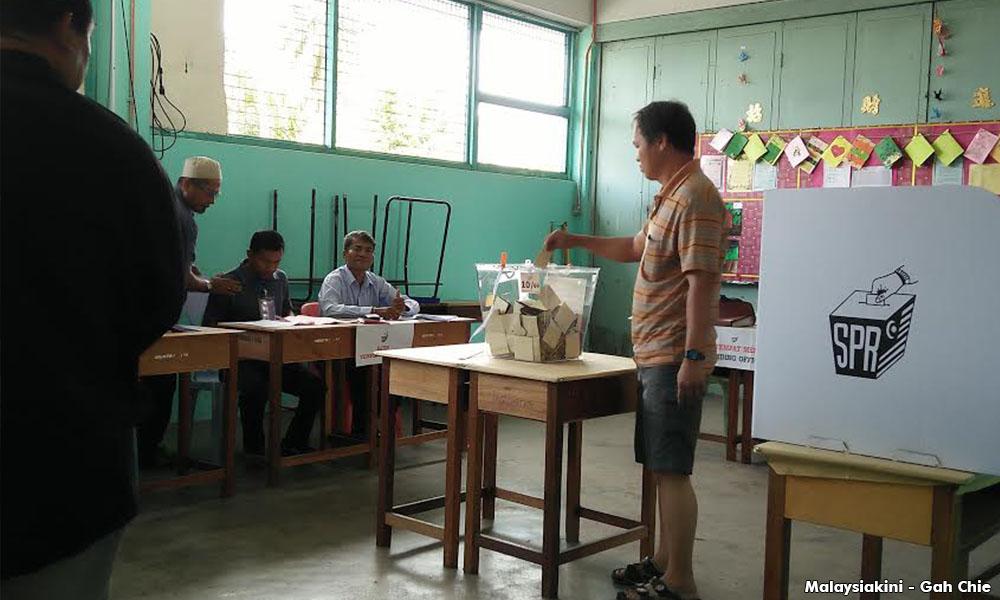
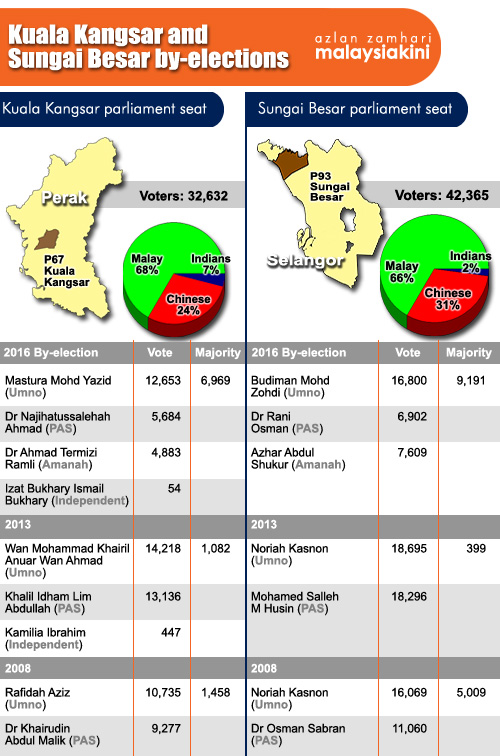
 The June 18 Kuala Kangsar by-election saw a 71 percent voter turnout, compared with the 84.1 percent turnout in the 2013 general election.
About 4,800 voters in Kuala Kangsar did not turn up to vote last Saturday.
In Sungai Besar, the turnout was 74 percent compared with 88 percent in 2013. More than 10,000 voters did not cast their ballots.
"Throughout the campaign, DAP had portrayed the by-elections as a starting point for Pakatan Harapan to change the government in the next general election,” said Liew.
"But the people, particularly the young and middle class, were not impressed. They had more hope in (the defunct) Pakatan Rakyat taking over Putrajaya, than in Harapan.
Back then, PKR de facto leader Anwar Ibrahim, former Kelantan menteri besar Nik Abdul Aziz Nik Mat, DAP veteran Lim Kit Siang and the late veteran Karpal Singh shared common goals and were able to hold the coalition together.
"Now, you can't even agree on straight fights for a state election or by-elections. Are you going to fight for the positions of prime minister and ministers once you take over the government?”
Liew said people from the middle class and the young might have taken the risk of changing the government back then, but now they preferred stability amid a volatile economy and international terrorist threats.
"(Moreover), the people no longer feel they have to pick BN or the opposition. So, they choose not to vote in protest," he added.
Split in the opposition ranks
Political commentator Tang Ah Chai said the lower turnout rate was due to the split in the opposition ranks.
"BN was not strong, nor did it fight the battle impressively. The opposition just missed the chance to win as it had to deal with internal problems," Tang said.
He also pointed out that the opposition movement went into a decline in the absence of Anwar, who could have coordinated the battle in the twin by-elections.
However, Tang said, lower voter turnout was also noticeable in previous by-elections where the people felt their votes were not significant enough to bring about change.
For example, the Teluk Intan by-election in 2014 saw 66.5 percent turnout, compared with the 80.4 percent turnout in the 2013 general election (GE13).
In the 2015 Rompin by-election, only 73 percent of the voters cast their ballots, a 14 percent drop from the GE13 turnout.
The Bukit Gelugor by-election in 2014 saw only a 56 percent voter turnout compared with 86 percent in 2013.
"The local voters did not see the by-elections as something significant," said Mohamed Mustafa Ishak, the head of political, security and international affairs cluster of National Professor Council.
"There was no strong appeal for them to vote (in these by-elections) as they felt it would not change anything, regardless of whether the opposition or BN won.
"Some had decided they will vote only in the next general election," Mohamed Mustafa said.


Are you sure you want to delete this comment?
This action cannot be undone.