


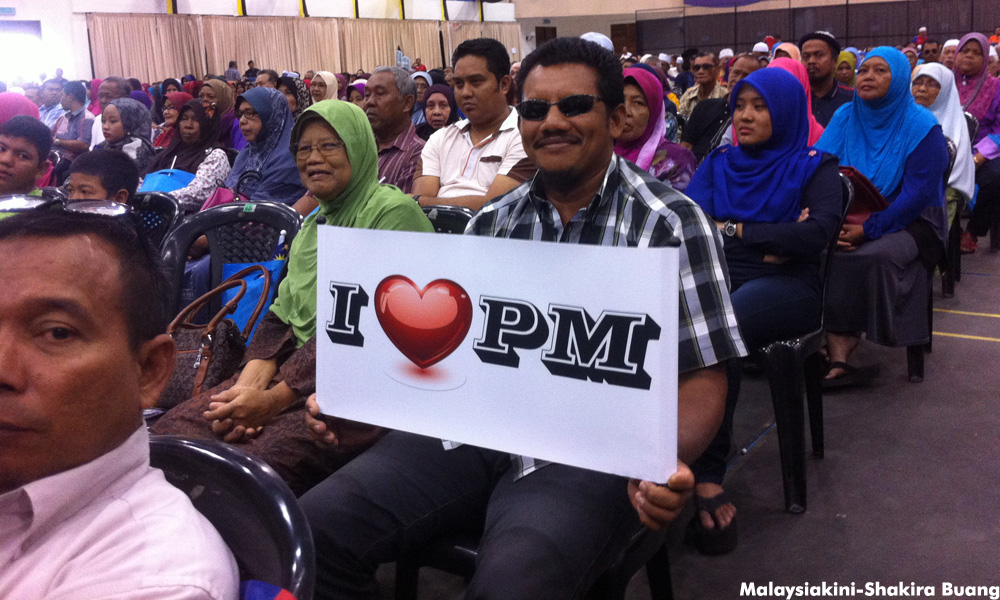

Twin polls show Umno’s grip still strong in rural seats
The twin by-elections last Saturday show Umno and BN may have no problem retaining its traditional stronghold seats in rural or semi-rural areas, and maintaining its grip on power in the next general election, said an academician.
This is because national issues like the 1MDB fiasco, RM4.2 billion that went into Prime Minister Najib Abdul Razak's private bank account and former premier Dr Mahathir Mohamad's Save Malaysia campaign did not significantly impact these constituencies.
The twin by-elections last Saturday show Umno and BN may have no problem retaining its traditional stronghold seats in rural or semi-rural areas, and maintaining its grip on power in the next general election, said an academician.
This is because national issues like the 1MDB fiasco, RM4.2 billion that went into Prime Minister Najib Abdul Razak's private bank account and former premier Dr Mahathir Mohamad's Save Malaysia campaign did not significantly impact these constituencies.
"Many expected BN supporters would swing to the opposition. I expected a 10 percent swing too, but it turned out BN secured a higher majority vote," said Mohamed Mustafa Ishak, head of the political, security and international affairs cluster of the National Professor Council (MPN).
Contrary to expectations, local issues such as fishermen's welfare, upgrading of university colleges and development issues took center stage, he said.
"The Sungai Besar and Kuala Kangsar polls showed that so-called national issues, which was harped on by the opposition, did not hold water with the voters," he said.
He said the same happened in the May 7 Sarawak election, which saw BN winning 72 seats out of 82.
Mustafa concluded that the premier may have no problem retaining most of BN's rural and semi-rural seats in the next polls.
Urban voters more aware
Umno won 88 of the 120 parliamentary seats it contested in the last general election in 2013, which comprised mostly rural and semi-urban seats.
BN won Sungai Besar with a 9,191-vote majority compared with only 391 votes in the 2013 general election.
The ruling coalition won Kuala Kangsar with 6,969 majority votes compared with 1,082 votes in 2013.
The twin by-elections were seen as a litmus test for Najib's approval rating, as it was the first poll in the Peninsular after the 1MDB and RM4.2 billion controversies erupted over the past year.
However, Mustafa noted it would be challenging for BN to win in MCA and Gerakan seats, as the two parties have their own internal problems.
Both MCA and Gerakan won only seven and two parliamentary seats respectively in the last general election.
He also admitted he couldn't draw the same conclusions for the urban voters, who are more sophisticated and educated, and follow the ruling party's controversies closely.
These national issues would appeal to the middle-class in urban, semi-urban or Chinese majority seats, which are traditionally held by the opposition.
Too early to draw conclusions
Political commentator Tang Ah Chai, however, said it was still too early to draw conclusions for the next general election by looking at the recent twin polls.
This is especially since the twin by-elections saw a lower turnout, and the group of voters who did not turn up had yet to speak their mind, he said.
The Kuala Kangsar by-election saw only a 71 percent voter turnout compared with 84.1 percent in the 2013 general election.
This means approximately 4,800 voters in Kuala Kangsar did not vote last Saturday.
While in Sungai Besar, the turnout rate was 74 percent compared with 88 percent in 2013. This shows over 10,000 voters did not cast their ballot this time.
"You must also realise politics changes rapidly," said Tang.
Things may turn out differently if the opposition is able to coordinate straight fights and bring about a higher voter turnout, he said.
"However, if the opposition is unable to coordinate among themselves for a straight fight, then I do not rule out that the same voting pattern in the twin polls will occur in the next poll," he said.
Urban strategy wrongly used
Mustafa said the twin polls saw the opposition making the mistake of applying their strategy to woo urban voters in semi-rural constituencies.
Meanwhile, BN had successfully split the opposition, and then played the development card well, he said.
Najib may call a snap poll next year, he said, but the decision also depends on economic factors.


Report this comment
Are you sure you want to delete this comment?
This action cannot be undone.