




AI: Msia needs statutory police complaints body
Malaysia needs a statutory body to conduct external investigations independently of the police force if the government is to regain public confidence and enhance the force's image, according to an Amnesty International (AI) report.
Malaysia needs a statutory body to conduct external investigations independently of the police force if the government is to regain public confidence and enhance the force's image, according to an Amnesty International (AI) report.
Entitled 'Malaysia: Towards Human Rights-based Policing', the 71-page report said such a body was essential in inculcating a culture of respect for human rights in the discharge of policing duties.
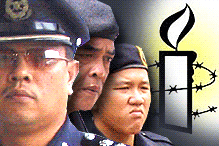 The AI report, its first comprehensive compilation of complaints, feedback and recommendations on human rights-based policing in Malaysia, was released at a press conference in Petaling Jaya today.
Premised on the framework of "representativeness, responsiveness and accountability", the report illustrates how public confidence in the police and the present complaints system has been severely undermined.
The report said the investigative body must have operational independence from government, politics and the force itself in order to deal effectively with specific complaints involving the police.
Though similar to investigation procedures of the Human Rights Commission of Malaysia (Suhakam), the body should be empowered to refer matters for criminal prosecution as well as for disciplinary action.
The body should be financially independent, accountable to Parliament or a designated oversight body, and required to publicise all its activities, added the report.
Human rights at the core
It said external investigation procedures were necessary to complement existing internal disciplinary procedures that are largely based on prevailing civil service methods and procedures.
"Central to this report is AI's conviction that human rights should be at the core of police philosophy and practice," the report said.
"(We) believe that there should be no conflict between human rights and policing, but rather that effective policing requires both the protection of human rights and the combating of crime with the consent and support of the wider community."
Calling on the "continued demonstration of political will and the sustained support" of the police force's leadership, the report described the recommendations as a critical opportunity to implement institutional reform.
It has reproduced examples, affidavits, case studies and recorded human rights violations by the police on the excessive use of force during arrest, policing and dispersal of public assemblies, torture and ill-treatment while in custody, and the denial of access to legal counsel, family and medical treatment.
Found therein are excerpts from memorandums to and recommendations by Suhakam, the Bar Council, human rights watchdogs and community groups which explain the nature and scope of ongoing reforms.
 The report also extensively cites, with lengthy footnotes, the numerous street skirmishes between demonstrators and the police, particularly the anti-riot squad, as well as cases of deaths in police custody.
Reforms to enhance the internal procedures have also been recommended in the report.
This includes a total overhaul of the Police Force Commission and the Public Officers (Conduct and Discipline) Regulations following a more detailed examination of the disciplinary mechanisms.
Three core legislation - Criminal Procedure Code, Police Act 1967 and Lock Up Rules 1953 - have been recommended for review and amendment to appropriately reflect proposed changes in the force's internal complaints procedures.
"Reports of police inaction are discussed, in addition to serious concerns about a lack of impartiality, transparency and effectiveness of internal disciplinary procedures and existing code of conduct."
Code of conduct
The thrust is to formulate and publicise a code of conduct specific to the requirements of a human rights-based policing in line with the United Nations Code of Conduct for law Enforcement Officials.
"All police internal disciplinary procedures and mechanisms should be clearly set out in publicly available documents to ensure transparency and improve accessibility," read the report.
"All officers should be made aware through the chain of command that failures to protect or violation of human rights will result in investigation and corresponding sanctions."
The report also placed an overwhelming emphasis on all internal investigation, policing and disciplinary procedures to be made public.
"The Standing Orders should be effectively disseminated and enforced within the force and made available to the public."
To boost the force's responsiveness to internal complaints, the report suggested that all allegations of human rights violations or misconduct be "received without impediment and immediately investigated".
T
 he complaints are to pass through formal internal channels or an independent oversight mechanism depending on the seriousness of the alleged violations.
"A human rights-based police code of conduct, a clearly defined duty to report abuses; and a transparent and effective chain of command, responsive to and supportive of human rights, are essential to ensure operational accountability."
The report stated that commanding officers should formulate and enforce clear internal guidelines for personnel to report abuses, and impose penalties for failure to report or cover up any misconduct.
Among other legal reform is a review of the emergency laws which deny judicial scrutiny of preventive detention procedures and conditions.
"...while permitting incommunicado detention, (such laws have) had a negative impact on police culture and the treatment of detainees."
The report also noted the May deadline for the Special Commission to Enhance the Operations and Management of the Royal Malaysian Police for the release of its final report which marks the completion of its one-year tenure.


Are you sure you want to delete this comment?
This action cannot be undone.