




Chinese station protests axing of Asian broadcast
Millions of viewers in Asia will no longer be able to watch New Tang Dynasty Television (NTDTV) programmes from today following the decision of European satellite provider Eutelsat W5 to terminate NTDTV's broadcast into the region.
Millions of viewers in Asia will no longer be able to watch New Tang Dynasty Television (NTDTV) programmes from today following the decision of European satellite provider Eutelsat W5 to terminate NTDTV's broadcast into the region.
The New York-based free-to-air Chinese language television station, which has broadcast its programmes in Asia since July 2003, said it was a victim of "intense pressure" on Eutelsat by the Beijing government on account of the New York-based station's uncensored and objective reporting.
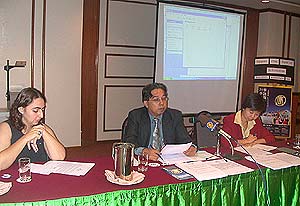 At a press conference held today in Kuala Lumpur, its Malaysian bureau chief Wong Mei Yee urged the Malaysian government to join leaders worldwide in condemning Eutelsat's decision and pressure the satellite provider into resuming the broadcast.
According to Wong, 65 members of the European Parliament, 93 members of the US Congress, various ministers of European countries, as well as numerous international non-governmental orgnanisations have called on Eutelsat to continue broadcasting NTDTV into Asia.
She also said NTDTV, which has arrangements with other companies to transmit its programmes to other parts of the world, seeks to highlight the threat posed to freedom of expression, flow of information and commerce by the termination of its programmes into Asia
"Eutelsat has opened the door for all repressive governments to censor the content of every channel on every satellite that broadcasts into its territory," she said in a statement, which was read by NTDTV correspondent Raymond Ng.
"We continue to believe that the rights of free expression, free commerce and free flow of information are universal rights and that these rights must be protected by free societies.
"Our viewers in Asia, including China, have a right to know the truth, which their government clearly does not want them to know, and which is only available at this time in their own country through NTDTV's broadcasts.
Olympics coverage threat
Wong also claimed that the Beijing government had pressured Eutelsat by threatening to cancel an agreement to allow its broadcast of the 2008 Olympics if the satellite services provider continued its contract with NTDTV.
"Despite Eutelsat's claims that they are purely making a commercial decision to terminate NTDTV's broadcast, all evidence indicates that this decision is a direct result of intense pressure from Beijing, coupled with lucrative reward."
That pressure had also occurred in Malaysia, said Wong, who recounted the allegations by an official in the Chinese embassy, which were published in a local Chinese daily, alleging NTDTV's connection to "cults and terrorists" and its guilt of "misleading the public."
NTDTV has since filed a RM100 million suit against the Chinese embassy and the daily for libel.
 Earlier, Centre for Independent Journalism director Sonia Randhawa asserted that the issue was not merely a matter of freedom of expression, but also freedom to information that affected everybody and not just media practitioners.
Of particular concern, said Sonia, was the economic advantage that some people groups may have over others as a result of unequal access to information.
"It's important not just for the Chinese (in China) but for Asians generally so that they can compete on a level playing field," she said.
Echoing her statements, Raymond said it was not merely such 'political rights' as freedom to information and expression that were threatened, but objective and current information that were crucial to Asians' financial and economic welfare.
"Our viewers, such as in China, are in need not just of objective but of timely reporting," he said, citing NTDTV's breaking news story on Feb 10, 2003 of the SARS crisis, three weeks before the Chinese government admitted to the outbreak.
He said further that businesses and investors' ability to make sound financial decisions hinged on accurate and timely information so as not to be "burned" by ignorance of current developments.
Despite refusals by some parties to engage with NTDTV, he said it will continue to seek other satellite service providers while highlighting the issue in the more than 50 countries that it operates.


