



What happens when the sex offender is a child?
SPECIAL REPORT | Charles, 12, and Mary, 11, were more than friends. One day, the puppy love between the primary school students turned sexual. It was a moment that forever changed their lives.
When Mary’s parents found out, Charles was arrested. He served 15 years in prison for statutory rape despite being a minor himself. He was released after receiving a royal pardon.
Under the Penal Code, a male above the age of 10 can be convicted of statutory rape if he had sexual intercourse with a female under the age of 16 regardless of consent.
Now 27, the label ‘child sex offender’ still haunts him.
 Charles was among those counselled by children rights NGO Suriana Welfare Society Malaysia through its Children at Risk Diversion Programme.
The programme focuses on preventing young offenders from potentially descending into a life of crime.
“He (Charles) insists that they were in love,” said James Nayagam, chairperson of Suriana Welfare Society Malaysia.
Charles' story is not that uncommon.
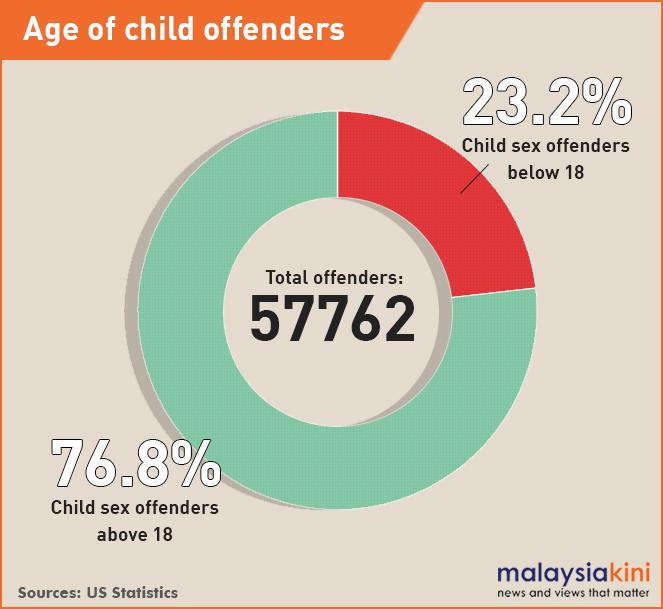
Data from Malaysia is scarce but research by the United States Department of Justice found that almost a quarter of reported cases of child sexual abuse are perpetrated by individuals under the age of 18.
The high rate of young offenders underscores the need for rehabilitation, but the rehabilitation of those who sexually abused children remains a thorny topic...
SPECIAL REPORT | Charles, 12, and Mary, 11, were more than friends. One day, the puppy love between the primary school students turned sexual. It was a moment that forever changed their lives.
When Mary’s parents found out, Charles was arrested. He served 15 years in prison for statutory rape despite being a minor himself. He was released after receiving a royal pardon.
Under the Penal Code, a male above the age of 10 can be convicted of statutory rape if he had sexual intercourse with a female under the age of 16 regardless of consent.
Now 27, the label ‘child sex offender’ still haunts him.
 Charles was among those counselled by children rights NGO Suriana Welfare Society Malaysia through its Children at Risk Diversion Programme.
The programme focuses on preventing young offenders from potentially descending into a life of crime.
“He (Charles) insists that they were in love,” said James Nayagam, chairperson of Suriana Welfare Society Malaysia.
Charles' story is not that uncommon.
Data from Malaysia is scarce but research by the United States Department of Justice found that almost a quarter of reported cases of child sexual abuse are perpetrated by individuals under the age of 18.
The high rate of young offenders underscores the need for rehabilitation, but the rehabilitation of those who sexually abused children remains a thorny topic.
The plight of the child victims and their families drive society to push for heavier penalties, with some countries such as Indonesia introducing chemical castration to much public support.
 Madeleine Yong (photo), founder of Protect and Save the Children, has seen how young victims of sexual abuse and their families struggle for years, even after the abuse has stopped.
But even Yong believes punishment of sexual offenders alone is not enough to ensure children’s safety.
“Rehabilitation is mandatory. Even if they don’t get convicted,” she said.
According to Yong, rehabilitation is crucial because of the likelihood of these offenders committing the crime again.
Taboo topic
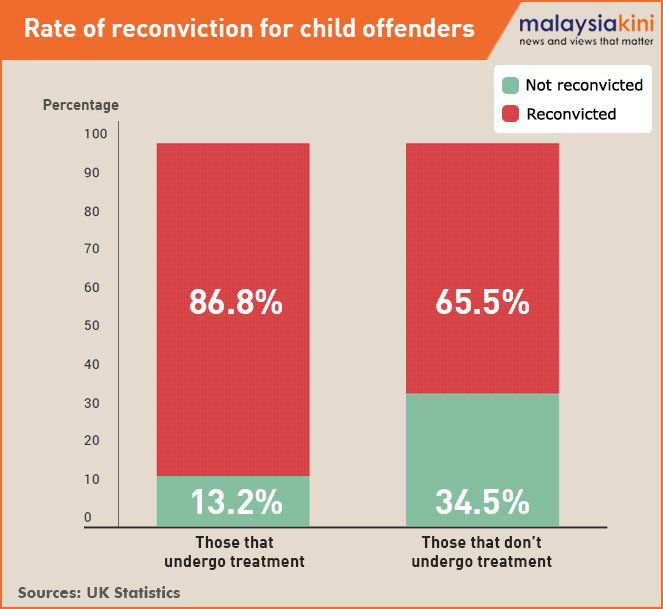
Nuraisyah Chua Abdullah, a law professor at Mara Technology University (UiTM), said research has shown that re-conviction rates of child sex offenders are lower in countries with rehabilitation programmes.
“Punishment is one of the methods but not the only one. It is important to have a kind of programme to suit (sexual offenders),” she said.
While general rehabilitation programmes exist for Malaysian prisoners, it is unclear if there is a specialised rehabilitation programme for sex offenders.
There are such programmes in the United States and the United Kingdom, but according to James, who has worked with the Prison Department for 11 years, including during his time as a human rights commissioner, there is no such programme in Malaysia.
 Nuraisyah (photo), however, believes that such a programme is in place but details are not publicly available because it is a “taboo”.
“Because of taboo, people don’t speak openly,” she said.
The Prisons Department declined Malaysiakini’s request for an interview while a Health Ministry counsellor who works with sex offenders said he was not authorised to speak to the media.
Information on rehabilitation of sex offenders in Malaysian prison is not the only thing that is scant.
There is also little public data on how many re-offend and are convicted again, Nuraisyah said.
 However, she said the tendency to re-offend is very high even after imprisonment.
“It is much higher than any grand offences,” she said, conceding that her observation is limited due to lack of data.
Research from countries which offer rehabilitation programmes for sex offenders supports the need for them.
In the UK, a 1988 study showed 34.5 percent of those who did not undergo rehabilitation were reconvicted, while only 13.2 percent of those who did were re-convicted for the same offence.
Even so, further studies show that reconviction rates are not truly reflective as many offenders re-offend undetected.
‘Does an eye for an eye ease the trauma?’
Punishment and rehabilitation of offenders is also not enough to keep children safe, Nuraisyah said.
“The whole system needs to be rebuilt. Young children need to be told about sexual abuse and the discussion of sex needs to be introduced at a very young age,” she said.
She added that a solely punitive system does not serve justice.
“The concept, if you treat the person the way you treat him, the whole process, it’s a form of hatred,” she said.
“An eye for an eye. Does it solve your trauma? Does it reduce the pain?
“At the end of the day, we ask if they are imprisoned for long, does it reduce the trauma which is faced by the victims?”
Part 1: For child victims, muddled line between love and sex abuse


Are you sure you want to delete this comment?
This action cannot be undone.