




No signs of a softer PAS
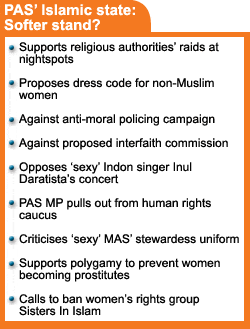
Barely three months ago, PAS announced that it will ' soften ' its stance on the controversial Islamic state policy. However, recent developments seem to suggest otherwise.
Barely three months ago, PAS announced that it will ' soften ' its stance on the controversial Islamic state policy. However, recent developments seem to suggest otherwise.
 Previously, its Youth chief Salahuddin Ayub said PAS will revert to the Barisan Alternatif's common manifesto adopted for the 1999 general election, meaning it will no longer stress on forming an Islamic state.
Instead, he said PAS will just mention Islam as an addeen or way of life. A special committee was also set up to re-brand the party's image.
However, the party has recently gone on the offensive, holding demonstrations and locking horns with human rights groups on several issues, one of them being the proposed inter-faith commission.
Last month, PAS came under fire for proposing a strict dress code for non-Muslim women in Kelantan, the only state it controls. Some of its MPs had also joined their Barisan Nasional counterparts in condemning the ' sexy ' uniforms of Malaysia Airlines stewardesses.
Different approaches
Yesterday, Salahuddin insisted that the party had not backtracked but requires more time to change its policy.
"It's quite difficult in a short time for us to convince the public we are going to soften the image. We are not in a conducive situation, it's quite difficult for me to explain," he said when met in Parliament.
He added that many different approaches have been taken in dealing with this issue such as organising a series of ' turun padang ' (going to the ground) programmes to change the public's perception of PAS.
 "The Malays can realise our change, but I understand that the non-Muslim community still has a very bad perception about us," he said, adding that a majority Muslims were on the same front with the party in issues concerning religion.
Although the public still equated PAS with "terrorists and chauvinists", Salahuddin stressed that the party is for democracy.
"It's two different issues on our decision to soften the party's stance on the Islamic state policy and our reactions towards those issues, the latter are our concerns. We are steadfast on religious issues, those are our core business, we cannot tolerate," he said.
Salahuddin himself had recently withdrew from the parliamentary human rights caucus - an unprecedented caucus in Malaysia's parliament history - to protest against its support for the campaign against moral policing.
Another PAS leader, Kamaruddin Jaffar agreed that the strong reactions from the party might not be able to convince the public that it is in the process of softening its stance.
"I agree in this sort of cases, we are viewed to be extremist or harsh, but I believe we are not, we have been misrepresented. We can't shy away from being very frank and honest on Islamic values," said the Tumpat MP.
However, he conceded that the party's six parliamentarians have raised more religious issues in recent sittings compared to those of national interest.
"(The view is) quite true... but unfortunately we are lacking in opportunity to speak. When we have a chance to speak, we are viewed as only touching on religious issues. I admit we should be talking about broader issues," he said.
 Kamaruddin lamented that PAS has always been caught in an unfortunate situation where it is singled out in issues related to religion.
Citing the objection to the proposed interfaith commission, he said it was not only PAS that opposed but also Umno, the Department of Islamic Development Malaysia (Jakim) and Institute of Islamic Understanding Malaysia (Ikim).
Balanced coverage
He called on the media to give a fair and balanced coverage but also reminded the party top leaders to take initiatives to counter negative perception towards the party.
"The leaders should come out more openly and express their views on a broad range of issues that the nation is encountering... We have been viewed as a religious party, so when religious issues crop up then only we are asked for comment.
"For example in international issue that have nothing to do with Israel and Palestine we are deemed irrelevant. I would actually like to see PAS being seen as relevant in all issues," he said.
He added that it was crucial for PAS to revert to the 1999 common manifesto's spirit in view of the need to form a strong opposition coalition.
 Meanwhile, PAS veteran leader Abdul Halim Abdul Rahman said the new leadership to be elected at the party's
muktamar
(annual general meet) in June will shed more light on the Islamic state policy.
Meanwhile, PAS veteran leader Abdul Halim Abdul Rahman said the new leadership to be elected at the party's
muktamar
(annual general meet) in June will shed more light on the Islamic state policy.
The former Kelantan deputy menteri besar refrained from further comment on the topic.
Two weeks ago, Abdul Halim, who is the Pengkalan Chepa MP, found himself in a spot over his comments in support of polygamy.
He claimed that single women who could not get satisfaction from sex may end up becoming prostitutes and contribute to social ills hence polygamy should be welcomed.
Defending his view, Abdul Halim said it should not be construed as being discriminative towards women.
"The phenomenon is a reality and it was my sincere and truthful view, I didn't meant to offend anyone," he explained.


Are you sure you want to delete this comment?
This action cannot be undone.