




Shahrir: Theres no absolute parliamentary freedom
Is the separation of powers between the legislative, executive and judiciary too idealistic a practice to be implemented in Malaysia? Veteran politician Shahrir Samad seems to think so.
Is the separation of powers between the legislative, executive and judiciary too idealistic a practice to be implemented in Malaysia? Veteran politician Shahrir Samad seems to think so.
"There is no absolute freedom of Parliament," said the Barisan Nasional Backbenchers Club (BBC) chairperson in an interview with malaysiakini recently.
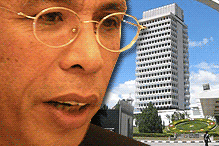 He acknowledged that government business is given priority in the House but was quick to add that the 'consultation' between the Parliament's speakers and the government as normal in anywhere else in the world.
Parliamentarians, especially those from the opposition, have long complained that the House often turns down their motions.
Last year, the late speaker Dr Mohamed Zahir Ismail came under fire for consulting the Attorney-General's Chambers before disallowing an opposition's motion seeking to impeach the Election Commission chief over numerous irregularities during the general election.
Recently, Shahrir strongly criticised the frontbenchers - ministers, deputy ministers and parliamentary secretaries - over their unsatisfactory performance in the House.
Among others, he took ministers to task for not honouring statements made in the House and their poor attendance as well as unsatisfactory ministerial replies on the debates.
However, the attendance of backbenchers also leaves much to be desired but Shahrir has a different view on quorum.
"I see the quorum is only necessary to start the session because focusing on the quorum (throughout the sitting) is detracting MPs from their real role of the MPs," he said.
Overhaul needed
Unhappy with the present situation which equated parliamentarians to civil servants, Shahrir said the parliamentary structure needs to be overhauled.
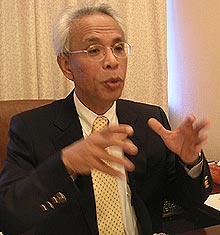 He disclosed that a committee has been formed to look into all the 'old' parliamentary procedures.
During the 40-minute interview, the media also repeatedly fell under Sharir's crosshair for allegedly encouraging the idea that backbenchers were 'unnecessary' by ignoring their comments in the House.
"That is not right, in that sense, the media has degraded democracy itself because Parliament is an essential part of the democratic and political system," he said.
As for money politics in Umno, the veteran politician said he has no sympathy for those found guilty .
"The rules are clear, you look at the rules, you like it you take it, to me politics is like that," he said.
Shahrir was also questioned on how he viewed Umno's rising star Khairy Jamaluddin, who is the party's deputy Youth chief and son-in-law of Prime Minister Abdullah Ahmad Badawi.
 Khairy, 29, has been criticised by certain quarters as being too young and politically immature for his post. It is also alleged that he secured the post due to his relationship with the premier.
"I have heard (similar criticisms) before, (but) my conscience is clear and I don't abuse my position. So (reporters) have to ask him (Khairy) whether his conscience is clear," said Shahrir, noting the similarity he shares with Khairy by being involved in politics at a young age.
Shahrir, who is 56-year-old now, was first elected as member of Parliament for Johor Baru in 1978 at the age of 28 and became a minister for the Federal Territory in 1983. He was made the political secretary to Tun Abdul Razak when he was 25.
During the 1987 Umno crisis, he was aligned to the faction led by Tengku Razaleigh Hamzah - who lost his bid for party presidency against former premier Dr Mahathir Mohamad by a mere 47 votes.
This led Shahrir to resign from his parliamentary sea, re-contest it as an independent candidate and winning with a vast majority.
 From 1990, Shahrir has been heading the Johor Baru Umno division. However, he was suspended for three years (1995-1998) following accusations that he supported an opposition candidate during the 1995 general election.
In 2000, he won an Umno supreme council seat despite not holding any ministerial position and this paved the way for his return to active politics. He is now an appointed Supreme Council member of the party since the party polls last year.
On a lighter note, the politician who has a sibling in the opposition, said their different political ideologies has never been an issue for them during family's reunion. His brother Khalid Samad is the PAS Shah Alam division chief.


