



Should gov't ratify international treaties as mere lip service?
Should the government be allowed to ratify international treaties like the convention on the elimination of all forms of discrimination against women (Cedaw), convention on rights of children (CRC) and convention on the rights of persons with disabilities (CRPD) as mere lip service?
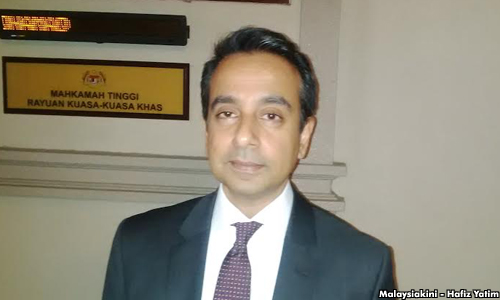
This question was posed by former National Human Rights Society (Hakam) president Malik Imtiaz Sarwar, who viewed human rights issues as a challenge not only for lawyers but judges as well.
Should the government be allowed to ratify international treaties like the convention on the elimination of all forms of discrimination against women (Cedaw), convention on rights of children (CRC) and convention on the rights of persons with disabilities (CRPD) as mere lip service?
This question was posed by former National Human Rights Society (Hakam) president Malik Imtiaz Sarwar, who viewed human rights issues as a challenge not only for lawyers but judges as well.
The senior lawyer cited the case of Bato Bagi in which a Federal Court judge ruled that international treaties do not fall under Malaysian law.
"The judge also said we should not use international norms to interpret the Federal Constitution," he said at the International Malaysian Law Conference in Kuala Lumpur.
Malik said judges should not legislate by limiting in ruling against human rights.
"They (judges) should be given the latitude to place values in interpreting international laws like in the M Indira Gandhi case at the High Court," he added.
Malik said legitimate expectation is not a normal issue.
"It is a question of whether we want to be shackled by a narrow approach (in terms of human rights) or create a bigger room to host these issues.
"For this, judges and lawyers have to work together," he added.
Meanwhile, Shanthi Dairiam, who is a human rights and women's rights advocate as well as founder of the International Women's Rights Action Watch Asia Pacific, reminded that judges cannot operate in a vacuum when dealing with human rights issues and should be brave to operate on new ground.
She also said human rights development and human rights should be protected by the law.
On the topic of Online/Offline: Addressing Child Sexual Abuse, United Nations Children's Rights and Emergency Relief Organization (Unicef) representative in Malaysia Marianne Clark-Hattingh said there is a need for more trained personnel from the welfare department and enforcement agencies like the police to handle sexual abuse victims.
She said insufficient numbers of trained personnel led to low rates of successful prosecution.
Meanwhile, lawyer Srividhya Ganapathy said at present there is no adequate provision for child grooming in the country and with the advent of internet there is a need for such laws.
She said studies have shown that a predator communicates to the victim in two separate occasions and with the internet, this can hasten such abuses involving children.


