


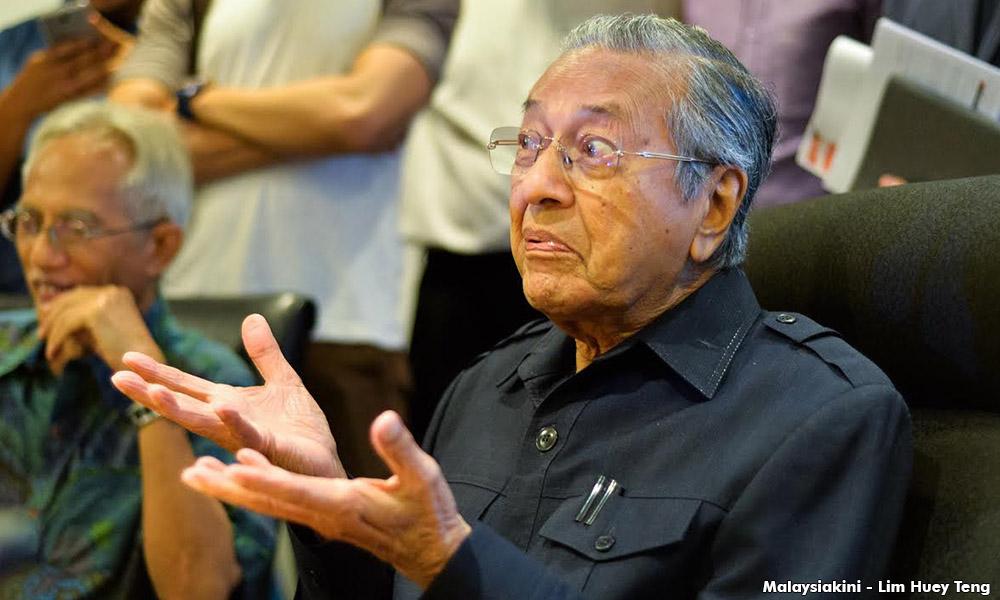

Dr M: Budget 2017 meaningless, Putrajaya has no money
Prime Minister Najib Abdul Razak is slated to table Budget 2017 in Parliament on Friday, with political pundits wondering if it would include the bells and whistles of an election budget given the rife speculation that snap polls are around the corner.
However, Dr Mahathir Mohamad described the upcoming budget, the eighth national fiscal plan under Najib, as meaningless since the government coffers are facing a financial drought.
Prime Minister Najib Abdul Razak is slated to table Budget 2017 in Parliament on Friday, with political pundits wondering if it would include the bells and whistles of an election budget given the rife speculation that a snap polls is around the corner.
However, Dr Mahathir Mohamad described the upcoming budget, the eighth national fiscal plan under Najib, as meaningless since the government coffers are faced with a financial drought.
"No doubt huge sums of money will be allocated to the ministries and agencies of the government. Parliament will surely pass the budget because it is the budget presented by the government party which has the majority in parliament.
"But the people know that the government has not got the money to meet the budget. They know ministries in the last two years have been told that the money is not available and therefore must spend less than what is budgeted for.
"The budget is actually meaningless because the government knows it will not have the money," he added in a blog post this morning.
Mahathir claimed the government is cash-strapped because its finances have not been used for good governance, development and the well-being of the people.
The money, he said, is being used for winning popularity for the prime minister instead.
"For this the prime minister has created sinecure jobs for a lot of loyalists. There are now nine ministers and three deputy ministers in the Prime Minister's Department.
"There are now 51 divisions in the Prime Minister's Department. The budget allocation for the Prime Minister's Department has risen from RM5.2 billion in 2000 to RM20 billion in 2016, a four folds rise.
"It is 13 percent of the 2016 budget of RM267 billion. It was less than four percent between 2000 and 2008," he added.
Mahathir also claimed that a large portion of the Prime Minister's Department fund is channelled to unspecified programmes which the PM controls.
"If we see the PM giving away money to organisations and individuals not named in the budget they must come from these allocations," he said.
BR1M meaningless too
The former premier also took another swipe at Bantuan Rakyat 1Malaysia (BR1M), which he also described as meaningless.
"Under BR1M, seven million people got initially RM500 each. Now they are promised RM1,000. There will be more increases next year. At RM500 it will cost the government RM3.5 billion. At RM1,000 it will cost RM7 billion.
"Perhaps the very poor would benefit but for most of the recipients RM500 for a year is meaningless," he said.
The better thing to do, he suggested, is to provide the hardcore poor with monthly allowances, while for the rest, the government should create employment opportunities and provide training.
Apart from this, Mahathir also noted that emoluments have increased, rising from RM26 billion in 2003 to RM89 billion in 2016.
"But federal revenue is decreasing relative to the GDP. Because the government believes in high income as the indicator of the level of development, salaries are increased without any regard for revenue or productivity.
"In the first place per capita income is not the real criteria of the level of development. Many oil-producing countries have very high per capita income but are not considered as developed.
"What is important is the purchasing power of the income. The rise in the cost of living has negated the benefit of high income," he added.
Cost of living to rise
According to Mahathir, the new budget is likely to cause the cost of living to rise and affect the standard of living adversely, especially if the GST rate is increased.
Mahathir said the depreciation in the value of the ringgit would also affect the purchasing power of the income.
"Since the government does not believe in local industries which can benefit from a cheaper ringgit but encourages imports, the cost of these will go up as the ringgit depreciates. There will be a greater outflow of funds, resulting in trade deficits," he added.
Noting that the government has also been increasing the minimum wage, Mahathir said this would increase the cost of production much more than anticipated.
"Not only will those earning less than the minimum pay get a rise in their pay but those earning above the minimum wage would expect and demand their pay to be increased to maintain parity against those working under them.
"Overtime pay and holiday work will have to be increased. All these would increase the cost of doing business in Malaysia. Already many foreign-owned manufacturing companies have left Malaysia, contributing towards unemployment.
"The real economy will continue to suffer, and along with it the well being of the people. Many professionals are leaving the country to look for jobs in other countries. We are going to be one of those countries dependent on remittances by our people abroad.
"The level of borrowings by the government has reached record levels. Future generations will have to pay these loans.
"All these will not show up in the budget. But the people will know as they struggle to make ends meet. This is the real 2017 budget." he added.


Are you sure you want to delete this comment?
This action cannot be undone.