



After travel ban, Maria receives Korean human rights prize in M'sia
Attendees of the Gwangju Prize for Human Rights award ceremony held in Korea in May faced an 'empty' stage because two of its intended recipients faced travel bans from their respective governments.
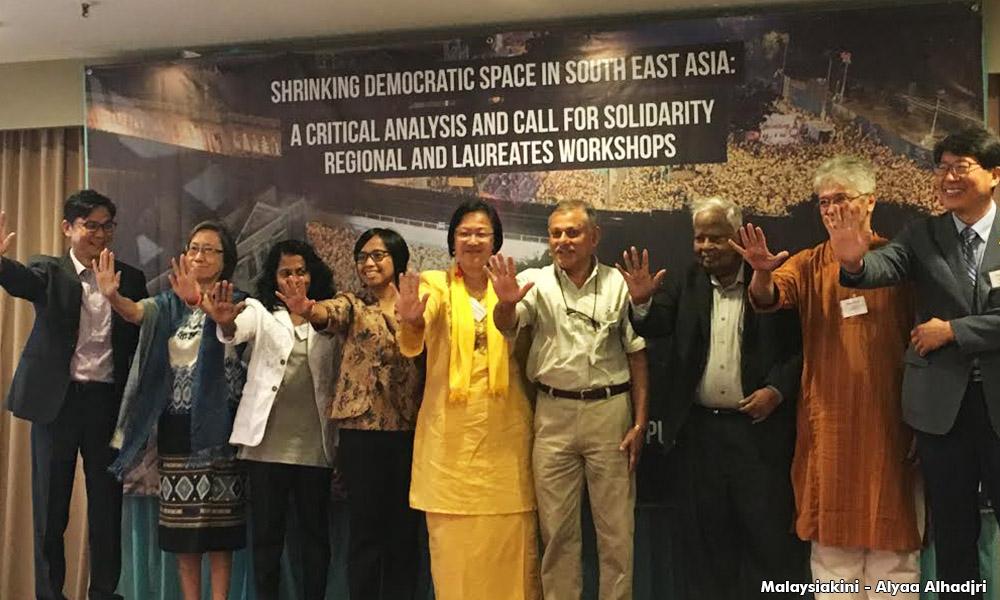
Today, five months later, Bersih chairperson Maria Chin Abdullah finally received her award, from May 18 Memorial Foundation executive director Kim Yang Rae at a ceremony held at Vistana Hotel in Kuala Lumpur.
In her speech, Maria noted that one of Bersih's two nominators for the annual award has also been banned from entering Malaysia.
Attendees of the Gwangju Prize for Human Rights award ceremony held in Korea in May faced an 'empty' stage because two of its intended recipients faced travel bans from their respective governments.
Today, five months later, Bersih chairperson Maria Chin Abdullah finally received her award, from May 18 Memorial Foundation executive director Kim Yang Rae at a ceremony held at Vistana Hotel in Kuala Lumpur.
In her speech, Maria noted that one of Bersih's two nominators for the annual award has also been banned from entering Malaysia.
"Mugiyanto nominated Bersih for this award but he is not here because he has been banned from entering Malaysia," Maria said, referring to Indonesian 'reformasi' activist Mugiyanto, who was deported upon arrival in Kuala Lumpur in January.
"Thank you for recognising the struggle of the people of Malaysia," said Maria, who described the award as a form of solidarity for democracy development in the region.
Among others, the award was presented in recognition of Bersih's efforts to push for electoral reforms.
The annual award is organised by Korean NGO May 18 Memorial Foundation, set up in commemoration of the 1980 people's uprising in Gwangju, South Korea.
In his speech, Kim said the empty stage during the first ceremony was clear evidence of the reality of human rights in many Asean countries.
"I still remember the moment when I heard Maria Chin was banned from travelling to Korea receive the award.
"It was the night before the 2016 Gwangju Prize for Human Rights ceremony. At the time, to be honest, I didn't know what to do," he said.
"(Vietnam's pro-democracy activist) Nguyen Dan Que (the second recipient) was also not able to be present at the ceremony because of house arrest," Kim said.
Their absence that day, he added, had strengthened solidarity among human rights defenders across the region.
The ceremony today was also held together with a regional conference on 'Shrinking Democratic Space in South East Asia', featuring participants from Indonesia, Bangladesh, Sri Lanka, the Philippines and East Timor, among others.
Also present were Bersih secretariat members and officials from conference co-organiser, Suaram.


