




May 27: High Court decision on Bar quorum
The Kuala Lumpur High Court today set May 27 to deliver its decision as to whether the one-fifth quorum requirement is needed to validate an annual general meeting (AGM) of the Malaysian Bar.
The Kuala Lumpur High Court today set May 27 to deliver its decision as to whether the one-fifth quorum requirement is needed to validate an annual general meeting (AGM) of the Malaysian Bar.
Justice Raus Sharif will also have to decide on the legality of the Bar's AGM - that was held on March 19, 2005 without quorum - and the resolutions that were passed by members present in the meeting.
He had earlier heard lengthy submissions from counsel representing plaintiff senior Louise Edward Van Buerle and the Bar Council, which was named as defendant in the application.
Van Buerle, 55 was among a group of senior lawyers who had walked out of the AGM to protest the council's decision to proceed with the meeting although the one-fifth quorum - a requirement which was set in past AGMs - had not been met.
Attendance of at least 2,340 lawyers - from a total of 11,700 from Peninsular Malaysia - is said to be required for a quorum.
The council's lawyer Sulaiman Abdullah submitted that section 64 of the Legal Profession Act 1976 (LPA) does not expressly provide for a quorum of one-fifth of the members of the Bar to present at an AGM.
"It is not the defendant's submission that one or two person are sufficient or that no persons need be present to constitute the quorum for an AGM by the Malaysian Bar to proceed," he said.
"Rather, it is the defendant's submission that as long as there are members of the Bar present that should suffice. There need not be present one-fifth of members of the Malaysian Bar. We submit that whoever is present at the AGM of the Bar constitutes the quorum."
Primary statute
He also argued that the intention of Parliament is clear and unequivocal - there is no requirement for a quorum of one-fifth of the members to present at an AGM.
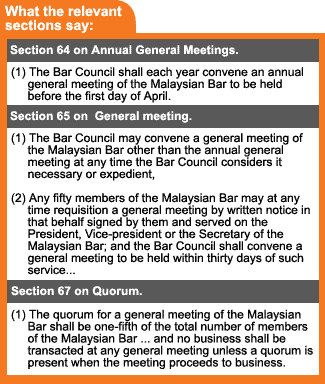
"The law provides that a meeting to be held in March of every year, whether is not there are people who come for the meetings. That is what was intended by Parliament," he said.
He said the provisions with respect to the procedure governing an AGM and a general meeting are separate and distinct and only the latter meeting requires the one-fifth quota requirement to be fulfilled.
He pointed out that the common law principle and the past practice of the Bar Council is requiring a quorum of one-fifth of the members of the Bar to be present at an AGM is not material as the Act is the primary statute governing the legal profession of this country
"The Act must be looked at for the purposes of determining the quorum requirement for an AGM of the Bar and not the rules of the common law or any other law."
He also claimed that Van Buerle's application to nullify the recent AGM is an attempt to prevent the council from performing its statutory obligations - one of which to hold the AGM.
"We submit that the plaintiff's application should be dismissed on this ground alone as the council being a body established under the LPA cannot be stopped from performing its duties," he said.
'Numbers count'
Van Buerle's counsel Zainur Zakaria argued that there is nothing in the Act that supports the council's contention that the one-fifth quota requirement is not needed for the AGM.
"There is nothing in the LPA or any other law that states whoever is present in the AGM is the quorum."
He said quorum quota is needed to ensure that an AGM is validly constituted which means that the majority must be present to represent the whole Malaysian Bar.
He also argued that the quorum quota is needed to avoid any misrepresentation.
"The recent meeting had 1,152 members. If there is no quorum requirement to be fulfilled, we will find next year's AGM to be attended by 500 members, then 230, then 50, and perhaps one day only two members. Surely that cannot be the law, My Lord.
"The quorum quota is to prevent a small group of lawyers from representing the members as a whole. If the court agrees with the defendant's contention that soon important resolutions will be passed by the only two people who are present at the AGM."
He also denied that the plaintiff has no intention to stop the council from carrying its statutory duties under the LPA.
"What we are saying is that you must carry out your statutory duties according to the law," he added.


