



Harapan's budget not without weaknesses, say economists
Opposition parliamentarians have criticised Budget 2017 as being unrealistic and providing little solutions for the economy.
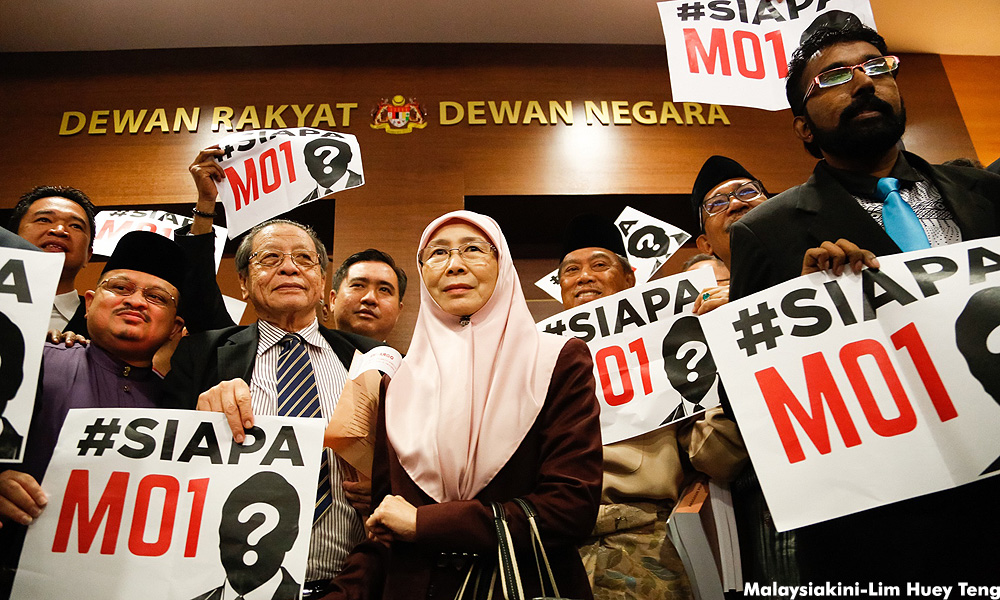
But what of Pakatan Harapan's own alternative budget for 2017, unveiled just one day before the federal government's?
Opposition parliamentarians have criticised Budget 2017 as being unrealistic and providing little solutions for the economy.
But what of Pakatan Harapan's own alternative budget for 2017, unveiled just one day before the federal government's?
While it is overall commendable, the opposition's proposed budget still has weaknesses, economists told Malaysiakini.
Ramon Navaratnam, chairperson of Asli Centre of Public Policy Studies, disagreed with Harapan's stance on the goods and services tax (GST).
"Keep GST as it is, don't disturb it. GST gives us more revenue. Don't go back to the old system," he said.
Harpan had maintained its proposal to make GST "zero-rate" but added it would consider "returning to pre-GST numbers on consumption tax".
Ramon agreed that basic products and services should be exempted or zero-rated to assist the poor or B40 (bottom 40 percent).
But the former secretary-general of the transport and finance ministries insisted that middle and high income groups should not be exempted from GST.
"They (Harapan) should look at it objectively. Don't be populist or political. Look at it from professional, economic and practical points of view," he said.
Ramon also proposed an innovative GST tax system, where some goods and services were kept at two percent or three percent, while others were maintained at the current six percent rate.
More cuts needed
Centre for Policy Initiatives director Lim Teck Ghee said the opposition needed to put more effort into slashing the government's operating expenditure budget.
"What may be faulted is the failure to bring down more drastically government operating expenditure which has spiralled out of control and is marked by rampant inefficiency, wastage and corruption.
"The cut in the budget allocation for the Prime Minister's Department (PMD) is long overdue and similar cuts should have been pursued across the board in all ministries, even the social development ones," he said.
The global economic growth is still anaemic and a sharp recovery in oil and commodity prices is not likely to take place in the foreseeable future, he noted.
"Thus, I would have liked to see a more rigorous review of current and planned development projects and greater prudence in the development expenditure budget," he said.
Ramon, meanwhile, said the PMD's allocation should be slashed as huge funds were spent on expensive foreign consultants.
The opposition had proposed a RM10 billion budget cut for PMD, which has received increasingly larger allocations since 2012.
The trend finally reversed with Budget 2017, which allocates RM15.9 billion for the PMD next year as compared with the RM20.3 billion it was allocated under the 2016 budget.
Shadow budget overall good
Weaknesses aside, both the economist praised the opposition's alternative budget.
"Overall, this is a reasonable budget and a good alternative view. The government should consider," said Ramon.
"Harapan must be congratulated for presenting a comprehensive, well-formulated and realistic reform-oriented budget," said Lim.
"The budget can benefit poorer states and the lower income population strata and is nevertheless growth-oriented.”
Harapan proposed to allocate 60 percent of the federal development budget to the five poorest states - Sabah, Kelantan, Sarawak, Kedah, and Terengganu.
Lim said the opposition's budget contains a number of innovative proposals for stimulating the economy without needing to expand the budget deficit.
He praised the proposed increase in monthly minimum wage to RM1,500, and the idea of having the private sector share the cost of the increase, saying it will reduce the nation's dependence on foreign labour.
Malaysians, he said, would be encouraged to enter the labour market and push labour to be more efficiently and effectively deployed.
Anti-graft measures
Ramon wanted to see the government instil anti-corruption measures to curb leakage and wastage in the system.
Harapan had claimed it would save 20 percent of the federal government's operating budget with the proposed implementation of anti-graft measures.
"Corruption is undermining national and international economy. It also caused inflation," said Ramon.


Are you sure you want to delete this comment?
This action cannot be undone.