


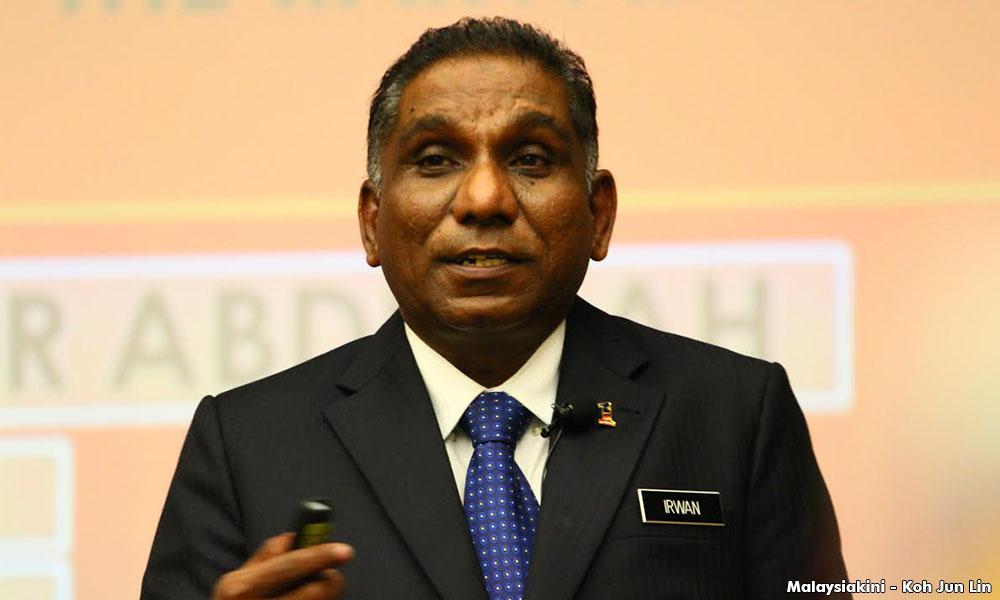

Treasury sec-gen defuses Pua's 'deficit time bomb' claim
Treasury secretary-general Mohd Irwan Serigar Abdullah has dismissed claims that the increasing deficit recorded by non-financial public corporations (NFPC) amounted to a "ticking time bomb".
He said there is nothing to worry about, as the economy is stable and the NFPCs are large companies that would be able to repay their loans once they recoup their investments.
Treasury secretary-general Mohd Irwan Serigar Abdullah has dismissed claims that the increasing deficit recorded by non-financial public corporations (NFPC) amounted to a "ticking time bomb".
He said there is nothing to worry about, as the economy is stable and the NFPCs are large companies that would be able to repay their loans once they recoup their investments.
"So linking the NFPC and the government debt level and so on... it is a contingent liability. It is a pressure, we know, but it is not a time bomb kind of thing because they can repay their loans.
"They are big entities with resources. They are profit-making entities. All those entities like TNB, Telekom... They are making profits [...]
"So don’t worry. The country is good. Financially it is stable. There are countries with over 100 percent debt level (compared to their GDP); we are below 55 percent," he told a post-budget forum in Kuala Lumpur today.
He was asked at the event organised by the Malaysian Economic Association (MEA) to respond to a Facebook posting from an unnamed parliamentarian that had gone viral yesterday.
In a statement yesterday, Petaling Jaya Utara MP Tony Pua had raised the issue of ballooning deficit amongst the government's 29 NFPCs.
'Technically, GST only around 3pct'
He pointed out that their spending deficit was RM10.6 billion in 2013, but is estimated to reach RM50.5 billion this year.
He claimed that this is where the bulk of government's allegedly excessive spending is "hidden" to give the impression of a relatively small budget deficit, when in fact such spending had been shifted to NFPCs.
"There is no question that the NFPC deficit is the biggest time bomb to the Malaysian public finances. We can already feel its ticking with the rapidly rising 'debt service charges' which the government is forced to bear annually.
"This is caused, in no small part, by the government being obligated to pay for interest and loans that the NFPCs are unable to fulfil," he wrote.
Meanwhile during his presentation, Irwan told the audience that the government's effective Goods and Services Tax (GST) rate is just over half the six percent rate of standard-rated itmes.
This is because of the hundreds of items that are exempted from GST, he said.
"There itself, we are losing more than RM5 billion, so effectively GST is not even six percent. It is less than six percent because we have a lot of exemptions.
"We have calculated and it is three-point-something percent," he said, while outlining Malaysian's current financial standing.
'Essentials not affected by budget cuts'
According to the 2017 government revenue estimate released last Friday, the government expects to collect RM38.5 billion from GST this year and RM40.0 billion next year.
Irwan also told the audience that although many government agencies have had their budgets slashed this year in anticipation of a tough financial year, no essentials had been affected.
Instead, these budget cuts reflect savings made from boosting efficiency.
"Cut means we didn't cut those essential things. Don't go saying that we have cut essential things. We have cut those things that can be saved. We reduced wastage so we can be more efficient in our administration.
"I called all the secretaries-general and told them not to spend lavishly on certain things," he said.
He said some of the expenditure cuts include the catering of food at meetings, and the replacement of vehicles that are still in serviceable condition.
He said such expenditures are usually not the first to go when a spending cut is ordered, but he had insisted that the civil servants much change their mentality.
"The usual thing (that happens) when you cut spending is that they (the civil servants) will go and cut the essential ones.
"They won't cut the ones that they are spending lavishly and show the government that: Hey, give us more money. We cannot provide service and so on.
"You must have read certain things going viral, that the government has no money to provide medicines and so on. This is pure... I don’t want to use bad word, but okay.
"We provided enough money for the hospitals - RM4 billion for medicines. If they say it is not enough, I don’t understand," he said.


Are you sure you want to delete this comment?
This action cannot be undone.