


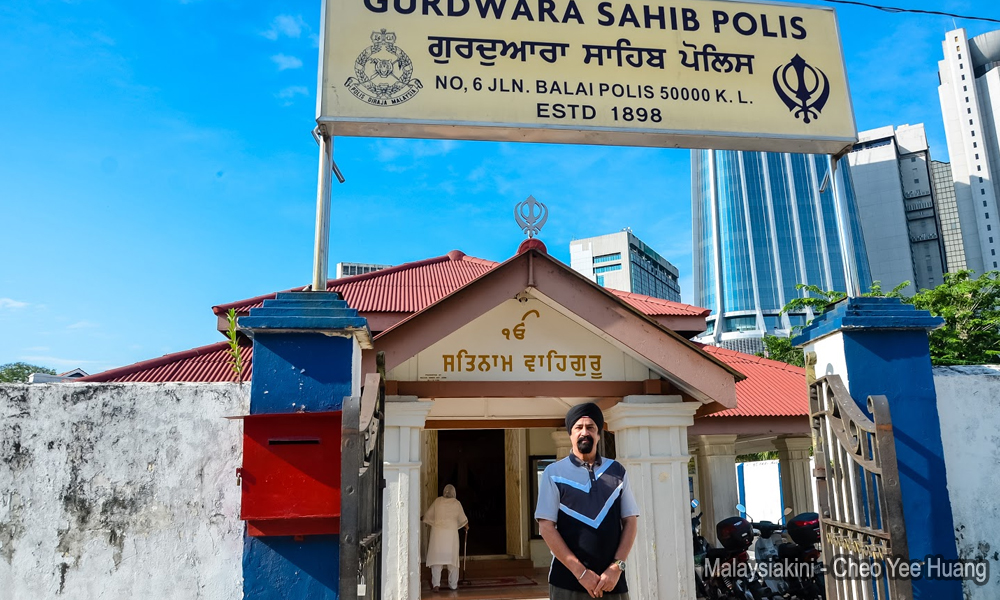

Gurdwara Sahib Polis - the story of Sikh Malaysians
FEATURE The building is a testament to how integral the Sikh community is to the country's police force since the British colonial era.
Every Sunday morning, the sound of Sikh prayer recitals rings out along Jalan Balai Polis in Kuala Lumpur early in the day.
The prayers come from beyond the walls painted in the colours of the Royal Malaysian Police.
Behind the wall sits a historical Sikh temple, the 118-year-old Gurdwara Sahib Polis.
The building is a testament to how integral the Sikh community is to the country's police force since the British colonial era.
Gurdwara Sahib Polis president Hardev Singh shared that in the early days of the Royal Malaysian Police - then the Federated Malay States Police - Sikhs made up more than half of the police force.
He said the British had recruited Sikhs heavily into its force as they recognised the community's loyalty.
"We Sikhs are like that, we are as simple as - given a duty, our loyalty is there.
"And the best way to win our loyalty is to satisfy our religious and spiritual hunger," he said.
It is for this reason, he said, the British were willing to construct temples for the Sikh police community.
FEATURE The building is a testament to how integral the Sikh community is to the country's police force since the British colonial era.
Every Sunday morning, the sound of Sikh prayer recitals rings out along Jalan Balai Polis in Kuala Lumpur early in the day.
The prayers come from beyond the walls painted in the colours of the Royal Malaysian Police.
Behind the wall sits a historical Sikh temple, the 118-year-old Gurdwara Sahib Polis.
The building is a testament to how integral the Sikh community is to the country's police force since the British colonial era.
Gurdwara Sahib Polis president Hardev Singh shared that in the early days of the Royal Malaysian Police - then the Federated Malay States Police - Sikhs made up more than half of the police force.
He said the British had recruited Sikhs heavily into its force as they recognised the community's loyalty.
"We Sikhs are like that, we are as simple as - given a duty, our loyalty is there.
"And the best way to win our loyalty is to satisfy our religious and spiritual hunger," he said.
It is for this reason, he said, the British were willing to construct temples for the Sikh police community.
The British, recognising the Sikh community's martial skills in the Anglo-Sikh wars in 1848 and 1849, had recruited them into its force after occupying Punjab.
The recruitment was intensified when the Sikhs supported the British when India rebelled against colonial rule in 1857. The Sikhs went on to serve in armies and police forces across the British Empire, including in then Malaya.
The British trust was not only in the Sikhs' loyalty, but also their combat prowess, the most famous example was the Battle of Saragarhi where the 36th Sikhs infantry regiment of the British Indian Army defended an army outpost to their deaths.
The battle took place in modern day Pakistan, in 1897, where 21 Sikhs stood against an army of 10,000 Afghans, just a year before the Gurdwara Sahib Polis was built in then Malaya.
The old Kuala Lumpur police contingent headquarters which once stood adjacent to the Gurdwara Sahib Polis is now a car park overseeing a row of shops, some of which have been converted into cafes.
Today, the road and temple name as well as the blue and white paint on some parts of the building, is all that is left of the policy legacy in the area.
Place for all faiths
Walking past the temple's gates hinged on two blue stone pillars, visitors are greeted by a humble beige-coloured building.
A basket of headscarves at the entrance indicates to visitors that they, and not only Sikhs, are welcomed.
Initiated Sikhs are required to cover their hair but visitors can take from the basket to cover up before entering the Gurdwara, or "God's Place".
The building also house the priest's quarters, as well as a hostel and a Langar, a Sikh canteen that provides free food to people of all faiths.
The back of the temple used to host a police hostel, as still could be seen from its trademark blue and white paint, but had since been converted into a hostel for the needy, which is rented out at minimal cost.
Hardev said Sikhism emphasises brotherhood regardless of backgrounds and the Langar was also a reflection of this.
"The religion of universal love, universal unity, and oneness of mankind, that is Sikhism.
"No such thing as Chinese you cannot come in, Muslim you cannot come in, no such thing," he said.
He said the Langar only serves vegetarian food to ensure it is suitable for people of all faiths.
Hardev, a former police officer, took over leadership from his father in maintaining the temple.
Gurdwara Sahib Polis is traditionally run by family members of Sikh police officers.
The 50-year-old Hardev recalled how he had grown up playing in the temple compound.
"When I was eight years old, or ten years old, it's always been the same.
"The staircase that I used to run up is still the same staircase here," he said.
The earliest migration of Sikhs to this region began around 1850 as some of the community's leaders were exiled by the British to modern day Singapore after the Anglo-Sikh wars.
The second wave of migration began in 1873, when Sikhs were brought in, under the Malay State Guides, to restore order in Malaya amid clashes between two Chinese Mining kongsi, Hai Shan and Ghee Hin.
As of today, there are an estimated 150,000 Sikhs in Malaysia, the largest Sikh community in Asia after India.


