




Remove racial bias in the force, says commission
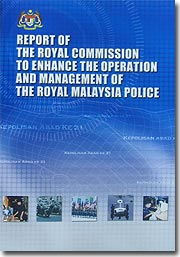
The police force must be racially representative to ensure proper observance and handling of ethnic sensitivities, the Royal Commission to Enhance the Operation and Management of the Royal Malaysia Police (PDRM) has recommended.
The police force must be racially representative to ensure proper observance and handling of ethnic sensitivities, the Royal Commission to Enhance the Operation and Management of the Royal Malaysia Police (PDRM) has recommended.
 This would ensure better and more effective communication with different ethnic groups over culturally-sensitive issues and for crime prevention and law enforcement matters.
In the recommendation, from a total of 125, the commission said a racially-balanced team would avert allegations of ethnic bias and victimisation.
The 16-member body that had been led by a former chief justice lamented the present intake's bias against the minority communities particularly the largest two of Chinese and Indians.
"The present situation with regard to racial composition in PDRM and intake of recruits of different ethnic groups is unsatisfactory," the commission said in the 607-page report released Monday.
"Minority participation in PDRM is very low and completely inadequate for modern policing in a racially-diverse community."
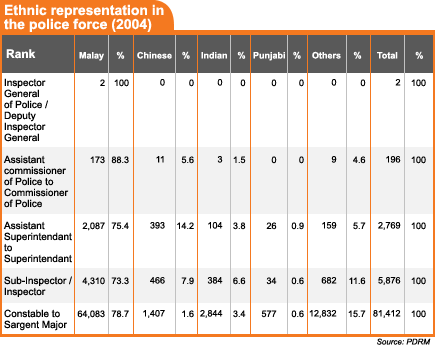
Grossly under-represented in the 90,000-strong force were ethnic Chinese (2.5 percent), Indians (3.7) Punjabis (0.3) and other minority groups (15.2) including Kadazan, Iban, Bidayuh, Murut, Thai and Ceylonese.
The highest-ranking Chinese in PDRM was only an Acting Deputy Commissioner of Police and the highest-ranking Indian was one Senior Assistant Commissioner II.
Urgently rectified
The commission said the present situation was a sharp contrast with May 1969 where 68 percent of non-Malays were Division One officers, a situation it noted as being "equally unsatisfactory".
Police claim the Chinese mainly prefer higher ranks than entering as constables, which is where the bulk of new recruitment takes place.
"The non-Malay community, especially the Chinese and Indians, are dissatisfied with the lack of explanation given for the rejection of application in a number of cases," said the commission, adding that it leads to harbouring feelings of being deliberately discriminated against.
"This ethnic representation situation in the PDRM needs to be urgently rectified by increasing the proportion of non-Bumiputra intake as provided for by government policy in the Third Outline Perspective Plan and the 8th Malaysia Plan."
The commission believes that a more ethnically-diverse police force is essential to see the co-relation between crime and social ills peculiar to certain ethnic groups due to circumstances and problems that are unique to them.
"(For example), different types of crimes and problems such as gangsterism, drugs, corruption, incest, triads, illegal gambling, credit card frauds, family violence and rape are identified with different cultures and races."
Until more ethnic Chinese and Indians make a career in policing, the commission feels it would be an uphill task to raise the proportion of both representative groups in the force.
Few female cops
The commission also found that the force suffers from a similar "serious imbalance" in terms of women's participation which currently stands at only 9.4 percent.
The presence of women at senior levels above the rank of Assistant Superintendent of Police was "noticeably low" at only 0.2 percent.
It said that more female police officers would enable the force to effectively cope with rape cases, victims of domestic violence, child abuse and community policing.
A number of deficiencies were also observed in the recruitment procedures starting with a lack of competency profiling upon entry which made it difficult to identify and recruit the right candidate for the relevant job.
The inadequate emphasis on ethics and integrity as a recruitment criteria and in tests was another weakness which, if rectified, would help weed out "potentially corrupt and unethical personnel at the point of entry".
The commission said the force's inferior performance, high number of unresolved crimes and a lack of knowledge and specialisation in areas such as commercial crime were due to the absence of a performance-based human resource development model.
"It is difficult to target, attract and hire the right people for the right job. It is more difficult to customise training, skills development and career development to fit different competency profiles and personnel."
Lack of planning was also found to contribute to the force's inability to fill vacancies and in personnel distribution and deployment, among others.


Are you sure you want to delete this comment?
This action cannot be undone.