



Of Littoral Mission Ships deal and Najib’s visit to China
COMMENT China, which was once an ideological rival yet now a strategic partner, is destined to be a complicated neighbour to Malaysia. When China was deemed a backward and poor country many decades ago, it was nothing more than a source of ideological and revolutionary threats. There was no need for Malaysia to pay attention to a China which could barely offer us anything, rather, it anticipated our economic assistance instead.
However, things have changed rapidly. After China embarked on a profound socio-economic reform agenda under the rule of second-generation Chinese ‘core leader’ Deng Xiaoping, it is now Malaysia which looks to China for offers.
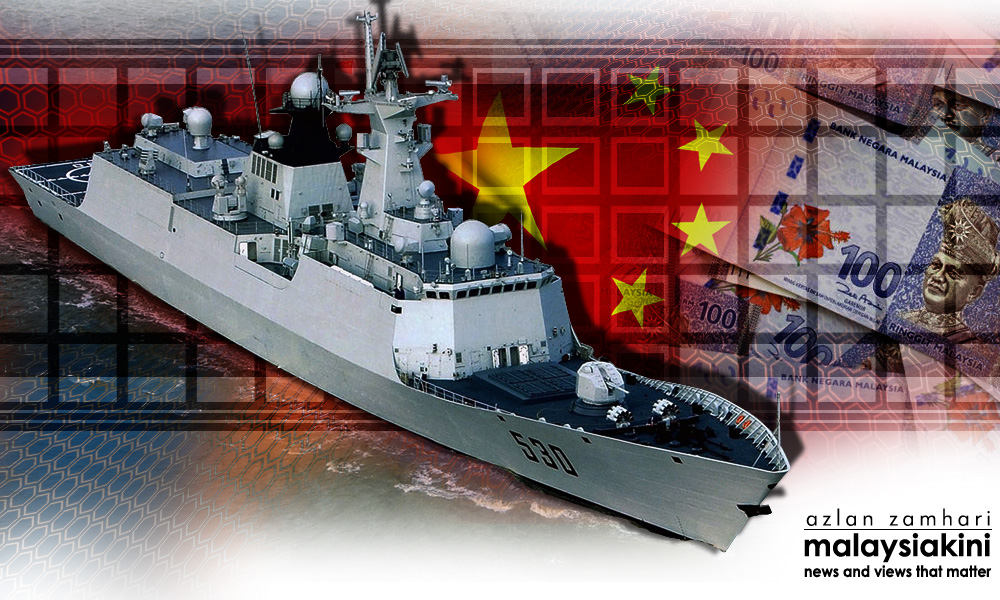
Prime Minister Najib Abdul Razak’s recent visit to China indicated a new level to Malaysia’s request for offers. During the visit, Najib witnessed 14 commercial Memorandums of Understanding (MOUs) and 9 bilateral governmental cooperation documents signed between Malaysian and Chinese officials. Among others, the Littoral Mission Ships (LMS) deal is the centrepiece.
The first arms importation from Beijing was made in 2009 when Malaysia symbolically bought 16 units of the FN-6 shoulder-fired anti-air missile. Then, in 2014, a Malaysian private company signed an MOU with a Chinese defence firm to acquire Chinese LY-80 medium range air defence missile, but the government of Malaysia did not endorse it.
Although it was not the first defence procurement from China, the LMS deal indicated Malaysia is finally willing to acquire more sophisticated weaponry from communist China.
The origin of LMS
Indeed, the requirement for LMS can be traced back to the New Generation Patrol Vessel (NGPV) project which was started two decades ago. The Royal Malaysian Navy (RMN) had requested 27 vessels which would be able to perform an ‘estate manager’ role in waters crucial to national interest; the safeguarding of oil and gas fields in the South China Sea, for example.
Originally, the NGPV was one variant of the German Meko class corvette, but modifications were made to suit Malaysia’s requirements which were low-cost, mass-produced, with high endurance in high seas and were able to engage in low intensity maritime conflicts, or equipped with less sophisticated weaponry.
To further lower the construction cost, the RMN decided not to install anti-ship missiles, but connecting ports were pre-fitted on board which enabled the Navy to install missiles in a short period in the event of there was a pressing need. The Navy named it as Fitted But Not With concept.
Nevertheless, the NGPV project ended with only six vessels being built, something which was reprimanded by the Auditor-General’s Report, in that the project was ill-planned, with weak implementation and a lack of monitoring, which resulted in a bloated construction cost of RM5.35 billion to RM6.75 billion in 2006.
Eventually, the Navy abandoned the whole project but kicked off another new project, ie the Second Generation Patrol Vessel which also consisted of six vessels, but with full-fledged multi-dimension combat capabilities. Later, the project was renamed to Littoral Combat Ship with the ceiling construction cost of RM9 billion or RM1.5 billion per vessel.
In fact, the Littoral Combat Ship is a frigate-type combat ship which is bigger even than Malaysia’s biggest frigate in service currently, ie the Lekiu class frigate. With such high unit cost, the Littoral Combat Ship project does not solve the RMN’s requirement of mass production of patrol vessel to meet its original target of 27 vessels.
Then the Littoral Mission Ship concept was introduced and the Navy indicated an acquisition of 18 ships were to be made. The LMS is an extension of the NGPV project was supposedly to have the same characteristics of low cost and ability for mass production.
The defence minister (at the time) Hishammuddin Hussein, finally revealed the unit cost was around RM250 million, which was not far from what I told Reuters recently. The unit cost is far cheaper than NGPV unit cost at RM1.13 billion and the cost of one LCS, and this means the LMS will not feature many state-of-the-art systems and will be smaller in size.
There are plenty international suppliers who are able to fulfil Malaysia’s need for the LMS, so why were the Chinese chosen?
Political interference in arms deal
People may think that being the end user of arms, the Armed Forces should have the final authoritative say in any arms acquisition effort. In practice, however, it is the prime minister and defence minister, who are politicians, who have the final say. And, normally, their decisions were purely politically-driven rather than technical based.
A very good example of this political interference was the acquisition of the MIG-29N/NUBs programme, which witnessed the shift of arms acquiring policy from western-based, to the Russians. Then-prime minister Dr Mahathir Mohamad did say that reducing reliance on western technology was the main consideration of the deal.
The shift of policy, however, created a logistical nightmare to the Air Force, which could not maintain the combat readiness of the MIG fleet to be at least on par with the western-made combat aircraft fleet.
The low quality of spares which were at least 50 percent more expensive than market price had crippled the maintenance effort of the MIGs. To prevent being continuously haunted by this politically-driven arms acquisition programme, the Air Force finally ordered the decommissioning of MIGs in 2015, even though the MIGs had not ended their life span.
The acquisition of the Scorpene submarine is another classic case which demonstrated how commissions, C4 and political preference dictated an arms sale. Therefore, it will be too naïve to ignore political considerations in an arms deal, particularly this time involving Malaysia’s past ideological enemy and contemporary rivalry in South China Sea territorial dispute.
COMMENT China, which was once an ideological rival yet now a strategic partner, is destined to be a complicated neighbour to Malaysia. When China was deemed a backward and poor country many decades ago, it was nothing more than a source of ideological and revolutionary threats. There was no need for Malaysia to pay attention to a China which could barely offer us anything, rather, it anticipated our economic assistance instead.
However, things have changed rapidly. After China embarked on a profound socio-economic reform agenda under the rule of second-generation Chinese ‘core leader’ Deng Xiaoping, it is now Malaysia which looks to China for offers.
Prime Minister Najib Abdul Razak’s recent visit to China indicated a new level to Malaysia’s request for offers. During the visit, Najib witnessed 14 commercial Memorandums of Understanding (MOUs) and 9 bilateral governmental cooperation documents signed between Malaysian and Chinese officials. Among others, the Littoral Mission Ships (LMS) deal is the centrepiece.
The first arms importation from Beijing was made in 2009 when Malaysia symbolically bought 16 units of the FN-6 shoulder-fired anti-air missile. Then, in 2014, a Malaysian private company signed an MOU with a Chinese defence firm to acquire Chinese LY-80 medium range air defence missile, but the government of Malaysia did not endorse it.
Although it was not the first defence procurement from China, the LMS deal indicated Malaysia is finally willing to acquire more sophisticated weaponry from communist China.
The origin of LMS
Indeed, the requirement for LMS can be traced back to the New Generation Patrol Vessel (NGPV) project which was started two decades ago. The Royal Malaysian Navy (RMN) had requested 27 vessels which would be able to perform an ‘estate manager’ role in waters crucial to national interest; the safeguarding of oil and gas fields in the South China Sea, for example.
Originally, the NGPV was one variant of the German Meko class corvette, but modifications were made to suit Malaysia’s requirements which were low-cost, mass-produced, with high endurance in high seas and were able to engage in low intensity maritime conflicts, or equipped with less sophisticated weaponry.
To further lower the construction cost, the RMN decided not to install anti-ship missiles, but connecting ports were pre-fitted on board which enabled the Navy to install missiles in a short period in the event of there was a pressing need. The Navy named it as Fitted But Not With concept.
Nevertheless, the NGPV project ended with only six vessels being built, something which was reprimanded by the Auditor-General’s Report, in that the project was ill-planned, with weak implementation and a lack of monitoring, which resulted in a bloated construction cost of RM5.35 billion to RM6.75 billion in 2006.
Eventually, the Navy abandoned the whole project but kicked off another new project, ie the Second Generation Patrol Vessel which also consisted of six vessels, but with full-fledged multi-dimension combat capabilities. Later, the project was renamed to Littoral Combat Ship with the ceiling construction cost of RM9 billion or RM1.5 billion per vessel.
In fact, the Littoral Combat Ship is a frigate-type combat ship which is bigger even than Malaysia’s biggest frigate in service currently, ie the Lekiu class frigate. With such high unit cost, the Littoral Combat Ship project does not solve the RMN’s requirement of mass production of patrol vessel to meet its original target of 27 vessels.
Then the Littoral Mission Ship concept was introduced and the Navy indicated an acquisition of 18 ships were to be made. The LMS is an extension of the NGPV project was supposedly to have the same characteristics of low cost and ability for mass production.
The defence minister (at the time) Hishammuddin Hussein, finally revealed the unit cost was around RM250 million, which was not far from what I told Reuters recently. The unit cost is far cheaper than NGPV unit cost at RM1.13 billion and the cost of one LCS, and this means the LMS will not feature many state-of-the-art systems and will be smaller in size.
There are plenty international suppliers who are able to fulfil Malaysia’s need for the LMS, so why were the Chinese chosen?
Political interference in arms deal
People may think that being the end user of arms, the Armed Forces should have the final authoritative say in any arms acquisition effort. In practice, however, it is the prime minister and defence minister, who are politicians, who have the final say. And, normally, their decisions were purely politically-driven rather than technical based.
A very good example of this political interference was the acquisition of the MIG-29N/NUBs programme, which witnessed the shift of arms acquiring policy from western-based, to the Russians. Then-prime minister Dr Mahathir Mohamad did say that reducing reliance on western technology was the main consideration of the deal.
The shift of policy, however, created a logistical nightmare to the Air Force, which could not maintain the combat readiness of the MIG fleet to be at least on par with the western-made combat aircraft fleet.
The low quality of spares which were at least 50 percent more expensive than market price had crippled the maintenance effort of the MIGs. To prevent being continuously haunted by this politically-driven arms acquisition programme, the Air Force finally ordered the decommissioning of MIGs in 2015, even though the MIGs had not ended their life span.
The acquisition of the Scorpene submarine is another classic case which demonstrated how commissions, C4 and political preference dictated an arms sale. Therefore, it will be too naïve to ignore political considerations in an arms deal, particularly this time involving Malaysia’s past ideological enemy and contemporary rivalry in South China Sea territorial dispute.
Malaysia and China bilateral relations
No matter what standard you use, Najib’s visit to China signifies the great leap forward of bilateral relations between both countries. After the Malaysian government reached a peace truce with the Malayan Communist Party in 1989, bilateral relations between Malaysia and China have grown from strength to strength.
In terms of socio-economic relations, both countries entered into a strategic partnership in 2013, and China became the largest trading partner for Malaysia few years ago. Moreover, Malaysia joined the China-dominated Asia Infrastructure Investment Bank without any hesitation and actively takes part in China’s One Belt One Road initiative.
However, the Malaysian government is still cautious about the revival of communist ideologies in domestic politics. Prohibiting the then-secretary-general of the Malayan Communist Party Chin Peng from going back to Malaysia was one of the cautious reactions. Furthermore, the Royal Malaysian Police is still listing overcoming the communist threat as one of the main security intelligence core tasks in 2017’s federal budget.
Apart from that, the outstanding territorial dispute in South China Sea will remain at status quo in the foreseeable future. Malaysia acknowledges China is one of the claimants, but does not recognise the validity of Chinese claims. Malaysia did express displeasure over the presence of Chinese enforcement ships in the water near to Bintulu, Sarawak, but Malaysia has no intention of escalating the dispute by any means.
To protect territorial integrity and national security, Malaysia has long relied on the Five Power Defence Arrangements whose membership consists of the United Kingdom, Australia, New Zealand and Singapore. Despite the defence group’s dubious position over the contestation of the Spratly island’s ownership, the group still conducts military drills close to the disputed waters regularly.
To be sure, the defence group is the only official foreign military assistance Malaysia can rely on in the event of an arms conflict.
Never in the modern history has Malaysia relied on potential rivalry to guarantee its national maritime security. The LMS deal, however, is going to break this norm.
Certainly, Malaysia relies on Chinese defence technology providers to preserve its national maritime security and territorial integrity sounds very odd to security observers. In addition, uncertain risk may be posed to national security when there is still a distrust exists between both countries over sensitive and strategic issues.
The embattled Najib
Even though arms acquisition is dictated by political considerations, have Malaysia and China reached such high political mutual trust to conclude the LMS deal? Apparently, they haven’t.
It seems that the conclusion of LMS deal was driven by personal political consideration rather than national one. It is a public fact that Najib has been caught in the 1MDB scandal, which recently came to a head with the filling of a civil suit by the US Department of Justice in July 2016.
Undeniably, the legitimacy of the Najib administration is seriously eroded by the 1MDB scandal which is also under investigation in various countries including Singapore, Switzerland, United States and Hong Kong.
Although Najib said he had a pleasant chat with Obama at the Asean Summit last September, Najib chose to skip the 2016’s United Nations General Assembly Debate held in New York, a prestigious avenue for a small state to speak to the world leaders. This implied that Najib was trying to avoid to be intimidated by American media over the July’s Justice Department (DOJ) complaint.
The fact is,Najib has yet to meet with any prominent Western leaders properly since July, except for visiting Germany in September.
The 1MDB scandal is the sword of Damocles for Najib who is looking for ways to allegedly cover up the huge debt created by 1MDB’s improper finance management. No western democratic countries will be willing to lend a hand to Najib at this critical juncture, except for China which is well known for its lack of concern for integrity and good governance.
China cares only for achieving their strategic goals with their overwhelming financing, infrastructure building and cheap goods providing capabilities. Having said that, China is more than willing to fill the vacuum the western countries hesitate to fill.
China is already involved heavily in the Bandar Malaysia project, and China again was announced officially will be the main contractor for the RM55 billion-worth East Coast Rail Line project. In large extent, China is supporting Najib’s pet projects with enormous investment.
The embattled Najib should have felt relieved by getting support from China. In return, China managed to defuse the legal pressure and obligation imposed by the Hague arbitration ruling on maritime rights over South China Sea made in July.
Particularly, Malaysia agreed to not mentioning the ruling and also conceded that involvement of parties “not directly concerned” with the maritime dispute “could be counterproductive” as stated in the joint statement issued during Najib’s visit to China. This implied Malaysia doesn’t welcome the involvement of United States, Japan, Australia and India in the disputes, a position that Malaysia used to hesitate to say publicly.
On top of that, Najib in his article published in a Chinese newspaper ticked off former colonial powers for being arrogant on always wanted to “lecture countries they once exploited” on how to govern their countries. Najib added that “Malaysia and China are united in agreeing on the need to defend the sovereignty of the nation state and in the belief that the individual histories, values and governance systems of different countries must be respected.”
Beijing gave what Najib wanted, and Malaysia needs to pay back for Chinese support on top of the diplomatic lip service, i.e. giving out contracts to China to build Bandar Malaysia, East Coast Rail Line, Littoral Mission Ships, and perhaps the Kuala Lumpur-Singapore High Speed Rail project, too.
Checks on the deals
By right, those mega projects should have undergone international tender process to select the most accountable and capable international partners. But the Najib administration chose the method of direct negotiation to select partners at his discretion. In plain language, Najib wanted to choose freely who will get the benefit from his mega projects.
Suffice to say, Najib is mixing his personal political interest with national ones in representing the government by inking deals with China. It goes without saying that those deals must be scrutinisedcarefully to separate Najib’s personal interest and the interest of the nation.
Parliament and the auditor-general are the best authorities to safeguard these deals. Malaysia should continue carrying out deals which conform with national interest and review those which don’t.
Malaysia values the strategic partnership with China and that’swhy we have to make sure the deals really benefit both countries but not for personal interest.
LAM CHOONG WAH is a senior fellow at Research for Social Advancement (Refsa). He holds a Master’s degree in Strategic and Defence Studies from Universiti Malaya.


Report this comment
Are you sure you want to delete this comment?
This action cannot be undone.