




Perak Mufti agrees to fight drug with drug
The controversial proposal to use synthetic drugs to battle drug addiction found an unlikely ally today in the form of Perak mufti Harussani Zakaria.
The controversial proposal to use synthetic drugs to battle drug addiction found an unlikely ally today in the form of Perak mufti Harussani Zakaria.
 He recommended the use of methadone as part of drug substitution therapy if studies proved that its judicious administration could cure heroin addicts of their addiction.
"If methadone is a medicine and has indeed been found to remedy drug addiction by bringing drug addicts out of their habit, then we should use it," he said when contacted.
"It is not a question of whether there is a fatwa (religious edict) on it or not. The objective of medicine is to cure us of sicknesses, and we are told to take medicines to cure ourselves of them," he added.
However, Harussani said that allowing the use of methadone hinged on whether or not it would itself lead to abuse and another form of addiction to heroin addicts.
"But if it is a medicinal drug, and studies have shown that it does bring heroin addicts out of their habit and its administration can be controlled, then it should be used," argued the mufti.
Controversial statement
Harussani's statements come as a surprise in light of the criticisms he triggered after suggesting on April 21 that Aids and bird flu sufferers be quarantined in a far away place in order to isolate the dangerous diseases.
A number of human rights organisations criticised his statement, with one stating that it reflected a lack of awareness on the part of the mufti and would not contribute to finding viable solutions to the problem.
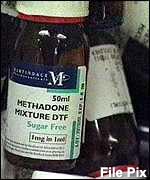 Opponents of methadone in drug substitution therapy argue that the drug, an opiate derived from the opium poppy (
papavar somniferum
), is merely the synthetic form of heroin produced under laboratory conditions.
Opponents of methadone in drug substitution therapy argue that the drug, an opiate derived from the opium poppy (
papavar somniferum
), is merely the synthetic form of heroin produced under laboratory conditions.
On these grounds, former head of the national anti-drug agency Zainuddin A Bahari called for the national fatwa council to address the use of methadone in light of the fact that heroin as an abused drug had long been declared haram for Muslims.
"The fatwa council should review its decree on the issue of drugs as intoxicants and decide whether the consumption of methadone, which is the artificial and synthetic form of heroin, is in conflict and contradiction to Syariah," said Zainuddin.
"Methadone is actually heroine that is produced in the laboratory and has all the chemical components of heroin. If heroin is forbidden by the laws and religion, then shouldn't methodone be similarly prohibited by Islam?" he asked.
Explore alternative methods
Parliamentary secretary of the health ministry Lee Kah Choon, however, opines that alternative methods of drug treatment have to be explored as the authorities seemed to be waging an ever-losing war on drugs.
"We know that there are reservations about the use of methadone coming from the police authorities, the religious authorities, social groups and others. We know that there are ethical and moral issues surrounding the drug," he said when met recently in Kuala Lumpur.
"But we have to consider the use of methadone. We have to look at the realities of the day," he added.
Methadone is already readily available in hospitals and some psychiatric clinics. Officials from the Internal Security Ministry, however, have said that it would start using the drug as part of a pioneer programme in drug treatment.
 The Star
today reported its deputy minister Noh Omar as saying that addicts will be expected to pay RM13 for each dose of methadone when the programme begins.
The Star
today reported its deputy minister Noh Omar as saying that addicts will be expected to pay RM13 for each dose of methadone when the programme begins.
Presently, the authorities were still in the process of formulating guidelines and an effective monitoring system to prevent abuse of the synthetic drug.
"Now that we have decided to start a trial programme on the use of methadone, we want to make sure that if it is accepted as a treatment regime, it can be monitored properly," said Noh in the report.


