



'Outdated' OSA used to hide misconduct, claims Abim
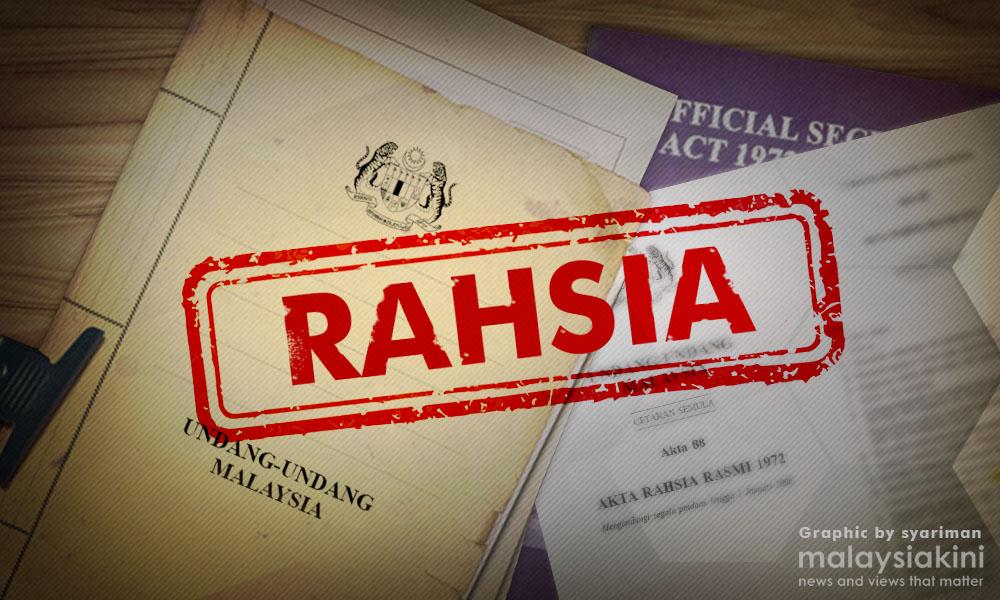
The Official Secrets Act 1972 (OSA) is an outdated legislation that hides misconduct in government, said the Muslim Youth Movement (Abim).
This comes after PKR's Pandan MP Rafizi Ramli was found guilty of breaching the OSA and sentenced to 18 months in jail for exposing a sealed document.
The charge was slapped against Rafizi for his exposure on the delayed payments of pensions and gratuities to armed forces personnel.
Abim said the 1972 legislation is also imprecise as it does not define the term 'official secret', allowing any information to be sealed at the whim of a minister, menteri besar or chief minister of a state.
The Official Secrets Act 1972 (OSA) is an outdated legislation that hides misconduct in government, said the Muslim Youth Movement (Abim).
This comes after PKR's Pandan MP Rafizi Ramli was found guilty of breaching the OSA and sentenced to 18 months in jail for exposing a sealed document.
The charge was slapped against Rafizi for his exposure on the delayed payments of pensions and gratuities to armed forces personnel.
Abim said the 1972 legislation is also imprecise as it does not define the term 'official secret', allowing any information to be sealed at the whim of a minister, menteri besar or chief minister of a state.
"Instead of putting the limit only on the documents that would pose a serious and demonstrable risk to national security, the Act stipulates a general term, reflecting that any document can be classified as secret.
 "Furthermore, the classification of any document as secret can be made by the appointed public officer without any safeguard against unnecessary and improper classification as enshrined under section 16A of the OSA," Abim secretary-general Muhammad Faisal Abdul Aziz (photo) said in a statement late yesterday.
This is inconsistent with democracy and the world's move to openness through Freedom of Information (FOI) and whistleblower protection laws, he added.
1MDB cover-up
In its statement, the Center to Combat Cronyism and Corruption (C4) pointed out that even neighbouring Thailand has the Official Information Act 1997, which allows the public access to government information.
However, Malaysia continues to lag, with only Selangor and Penang having FOI enactments.
C4 director Cynthia Gabriel said replacing the OSA with FOI legislation would also encourage public participation and constructive criticism of the government.
"What happened to Rafizi could also happen to the three former ministers, Mohd Shafie Apdal, Muhyiddin Yassin and Ahmad Husni Hanadzlah, who are now being investigated under the OSA.
"This shows active use of the OSA to cover up elements of corruption and 1MDB misdeeds," Cynthia said.
The three ex-ministers are being investigated for allegedly breaching their secrecy oaths in their speeches on 1MDB in the Dewan Rakyat.
Cabinet minutes are OSA, but ministers frequently make announcements following decisions made at the meetings.
The action against Muhyiddin, Shafie and Husni prompted outcries from lawmakers, who argued that this was a breach of parliamentary immunity.
Intimidating whistleblowers
Similarly, Human Rights Watch said Rafiz's conviction is an abuse of the OSA to "intimidate whistleblowers into silence over the 1MDB corruption scandal".
HRW deputy director for Asia Phil Robertson said in a statement: "No one should forget that this is all about the auditor-general's annual report, which previously has been treated as a public document after its submission to Parliament."
 Robertson (photo) also called for the conviction to be overturned and the OSA to be revised so that disclosure of information is only criminalised if it harms national security.
In a statement yesterday, Rafizi said he was fulfilling his duty as an elected representative to speak up for the retired armed forces personnel whose voices were not heard.
However, cabinet ministers Abdul Rahman Dahlan and Azalina Othman said Rafizi reaped what he sowed as the law was clear.
Also in a statement issued yesterday, Amnesty International called on the Malaysian authorities to quash the jail sentence handed down to Rafizi.
"Rafizi Ramli acted in the public interest by bringing to light information about one of the biggest corruption scandals in Malaysia’s recent history.
"The authorities should have published the auditor-general’s report from the beginning, rather than trying to suppress it,” Amnesty International’s deputy director for Southeast Asia and the Pacific, Josef Benedict, said.
“Rafizi Ramli’s sentence should be quashed immediately and he should be protected against any retaliation stemming from the disclosure of information that show wrongdoing.
“By invoking the Official Secrets Act, the Malaysian authorities are yet again taking the cover of national security to stop people from raising legitimate questions about the 1MDB funds and obstructing the society from receiving such information,” Benedict said.
He added that Amnesty International is alarmed by the widespread use of national security legislation and other restrictive laws to choke peaceful dissent in Malaysia.


