


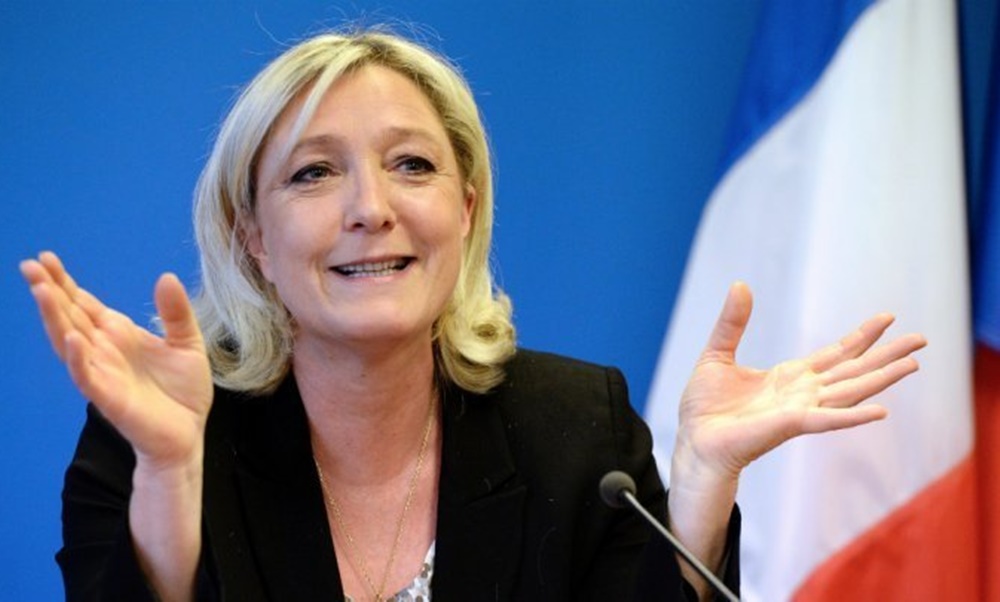

French far-right leader hoping to ride Trump wave
Marine Le Pen seems confident of riding a wave of populism to create a major upset in France's presidential election in 2017, five months after Donald Trump won the White House.
Hours after Trump's victory speech last week, Le Pen did not hesitate to claim his win as part of a growing global movement that her far-right National Front party reflected.
"What happened was not the end of the world. It was the end of one world," Le Pen said to supporters in Nanterre, outside Paris.
The decision of the American people should be interpreted as a victory of liberty, she said, adding that the US election and Britain's vote to exit the European Union were laying the foundation for the future.
"I dare to repeat here, that the election of Donald Trump is a good thing for our country," Le Pen said.
The National Front has created upsets before.
In 2002, National Front founder Jean-Marie Le Pen garnered enough votes in the first round of the presidential election to face incumbent conservative Jacques Chirac in a second round.
The outcome shocked France and drove tens of thousands of people to the streets to protest.
Lionel Jospin, a Socialist who lost to the older Le Pen by a narrow margin, immediately announced his retirement from political life and called for the French to unite and defend "the values of our Republic" by casting a vote for the candidate of the Socialists' traditional rival party.
Le Pen was defeated. But many analysts expect a similar shake-up next year, when the French cast their ballots in two rounds of elections in April and May.
Only this time it won't be Jean-Marie Le Pen on the National Front ticket, but his daughter, Marine - a politician who has made it a priority to give the party a more mainstream appeal.
She has worked to rid the party of its tarnished past, engaging in a highly public - and ultimately successful - tussle to oust her father over his racist remarks. The elder Le Pen has been to court multiple times over comments he has made publicly, including that the Holocaust was a "detail" of history.
Many believe that Le Pen will triumph in the first round, to be defeated in the run-off by voters banding together from the other - primarily two dominant - parties.
"Opinion polls show that it'll take an exceptionally weak alternative candidate for her to win the final prize," said Erik Nielsen, a chief economist at UniCredit Bank.
"Even if Le Pen were to win the presidency (terrible as that would be), she would still have to rely on parliament to an entirely different decree than Trump has to deal with Congress, where 'his' party has a majority," Nielsen added.
The leading candidate for France's conservative Les Republicains, Alain Juppe, reacted to the US election outcome with concern, warning the French not to fall prey to "demagogy and extremism".
Another top candidate for the party, former president Nicolas Sarkozy, said Trump's ascendance reflected the need for political change.
"The refusal of TAFTA and, more generally, wild globalisation, pacification of international relations, notably with Russia, disengagement from bellicose expeditions that have originated a large migratory wave of which we are a direct victims - (Trump's) positions, if carried through, will benefit France," Le Pen said.
Many of the positions held by the National Front echo Trump's style of conservatism, including bolstering economic protectionism and fostering close ties with the Kremlin.
"Nominated by a party that has done everything to make him fail, (Trump) has become - him, the billionaire - the paradoxical messenger of the small and the populist anti-globalization and anti-illegal-immigration revolt that has spread across the West, with accents reminiscent of Marine Le Pen or Brexit," wrote the conservative Le Figaro newspaper.
A leading liberal newspaper, Le Monde, published a cartoon following the US election depicting Le Pen with a yellow swirl attached to her shoulders mirroring Donald Trump's notorious hair. It read: "Marine Le Pen feels wings grow."
- dpa


