


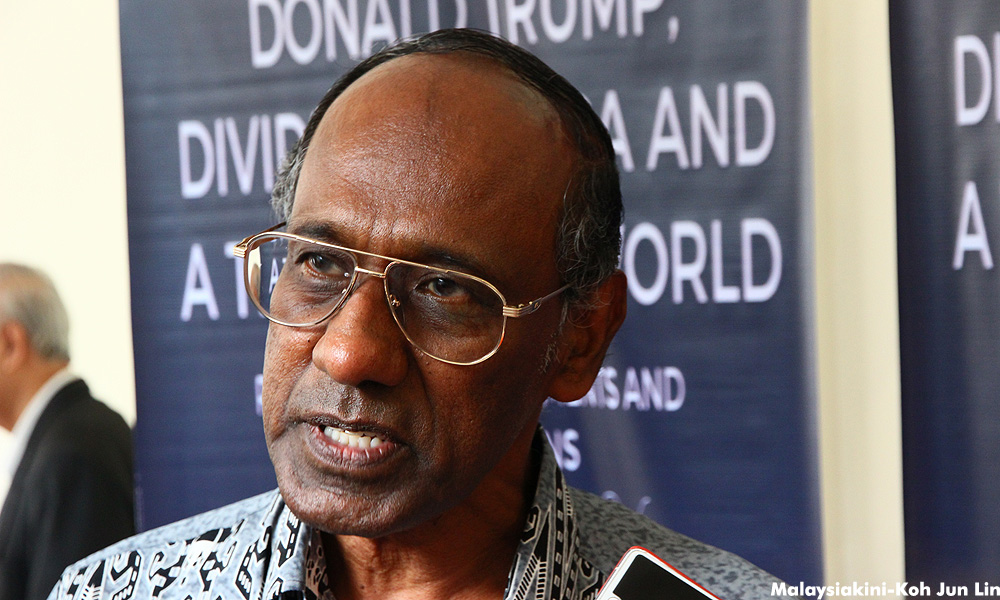

Too early to declare TPPA dead, says don
Despite the bleak outlook for the Trans-Pacific Partnership Agreement (TPPA), Malaysian Association for American Studies president KS Nathan said it is still early to declare the agreement dead.
He said it is not yet a foregone conclusion that US president-elect Donald Trump would carry out his campaign pledge to pull the US out of the agreement.
“About TPPA, we cannot draw a conclusion yet that President Trump would cancel it. There may be room to renegotiate several aspects that Trump believes are against American interests.
Despite the bleak outlook for the Trans-Pacific Partnership Agreement (TPPA), Malaysian Association for American Studies president KS Nathan said it is still early to declare the agreement dead.
He said it is not yet a foregone conclusion that US president-elect Donald Trump would carry out his campaign pledge to pull the US out of the agreement.
“About TPPA, we cannot draw a conclusion yet that President Trump would cancel it. There may be room to renegotiate several aspects that Trump believes are against American interests.
“This is because the TPPA is an international trade framework with many interests involved, not just Malaysia’s and America’s, but also the America, Malaysia, and Asean’s partners,” he told reporters when met at the Universiti Islam Antarabangsa (UIA) Malaysia campus in Gombak yesterday.
He said the TPPA is a good counterbalance to China’s rising influence, which brings its own plans and framework for advancing Chinese interests.
Without an economic counterbalance to this, the international relations professor said, the situation would not be beneficial to any country and can affect the stability of the region.
During the US presidential election campaign, both Trump and his main opponent Hillary Clinton had vowed to scrap the TPPA - both viewing them as harmful to the US economy, particularly in terms of reducing job opportunities in the US.
Following Trump’s victory, the incumbent President Barack Obama had suspended efforts to push the TPPA for congressional approval.
The TPPA involves 12 countries, of which the US is the largest economy. The other signatories for the deal signed in February are Malaysia, Singapore, Brunei, Vietnam, Australia, New Zealand, Chile, Peru, Japan, Mexico, and Canada.
There is a two-year ratification period after the deal is signed. However, nations may unilaterally withdraw from the deal without penalty after giving a six-month notice.
Bilateral free trade agreement
Malaysia had said that if the TPPA fails to materialise, it may opt to negotiate bilateral free trade agreements with the TPPA countries instead. It is also now focusing on the China-backed Regional Comprehensive Economic Partnership (RCEP).
Meanwhile, The Star quoted Prime Minister Najib Abdul Razak yesterday urging the incoming US administration to approve the TPPA.
As for Nathan, he said is unclear if Trump has any interest in Malaysia or the Asean region, and this should change.
“We can only hope that we could draw his attention so that he can leverage on his strengths in business and a trading to invest more in Asean, including Malaysia, and continue to develop good relations between the US and Malaysia,” he said.
Meanwhile, UIA history professor Abdullahil Ahsan said China’s rising influence should not be perceived as a threat.
“The rise of China, I think, should be looked at rationally. I think from what we have seen so far, it is not aggressive.
“Therefore if this non-aggressive policy from China continues, I don’t see any threat from China,” he said.


Are you sure you want to delete this comment?
This action cannot be undone.