




Tobacco profits, healthcare costs do not add up
The amount of money the government receives from the manufacturing and sale of tobacco in Malaysia is negligible when compared to the huge amount of resources spent on treating the consequences of smoking among smokers and second-hand smoke victims.
The amount of money the government receives from the manufacturing and sale of tobacco in Malaysia is negligible when compared to the huge amount of resources spent on treating the consequences of smoking among smokers and second-hand smoke victims.
 "The argument that tobacco farming and industries contribute to the economy is obviously flawed and certainly not supported by empirical evidence," Malaysian Council for Tobacco Controls (MCTC) president Prof Dr Syed Mohamed Aljunid told the Anti-Tobacco Conference in Kuala Lumpur yesterday.
In his paper The economics of tobacco: Will tobacco control save your economy? , he said that a recent study on local health care cost showed that diseases associated with smoking eats into a significant portion of the country's gross domestic product (GDP) annually.
"The study found that (on average) 0.8 percent of the GDP, or RM3.1 billion, is spent yearly on the health care costs of three common diseases associated with smoking - ischemic health diseases, lung cancer and chronic obstructive airways," he said, adding that this is equivalent to 41 percent of the government's annual health expenditure.
Industry unimportant for economy
Syed Mohd also presented a chart categorising the government's collected income from the manufacturing and sale of tobacco. The income is primarily generated by import and excise duties as well as sales, company and additional taxes.
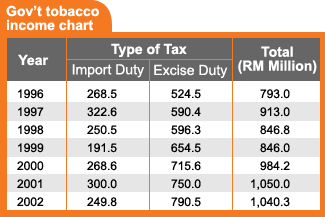 The chart revealed that in 1996 the government's total income was RM793 million. This steadily increased over the decade to RM1.04 billion in 2002.
Syed Mohd expressed frustrations with the struggles faced by anti-tobacco advocates as its influence on policy-makers is "diminished to a certain degree by the tobacco industries' tactics that link tobacco use to economic development".
It was further argued, however, that these claims by tobacco companies were inaccurate.
Dr Hana Ross from the Research Triangle Institute also argued that not only was the tobacco business unimportant to the economy, it also hurt the country's economy by the substance's consumption and its impact on life expectancy.
Her paper also refuted the argument that jobs created by the tobacco industry were a large contributory factor to the economy.
"(The) jobs created represent only a small proportion of the overall employment and there is a global trend decline in tobacco related employment. Money not spent on tobacco will be spent on other goods and services, creating new jobs in the economy and adding to a tax base," she added.
Hana also highlighted that tobacco consumption increases the gap between the rich and poor.
Steps to reduce impact
The three-day conference also emphasised that developing countries which are now the common target and fastest increasing victim of the tobacco industry must take steps to reduce the impact of smoking as the number of lives claimed by the habit is on the rise.
 Syed Mohd added that "despite the fact that one person dies every 6.5 seconds in the world today from diseases related to smoking, with significant loss to productivity, many policy makers in developing countries are still not convinced that tobacco farming and industries have negative impact on the overall economy".
Malaysia is a tobacco-farming country with close to 30,000 growers nationwide.
He stressed that the need to nip the problem in the bud was crucial and must be done through both price and non-price controls.
"Price control such as effective tax increase has been proven to be a very successful method in reducing smoking prevalence especially among adolescents. School-based health promotion and restrictions of smoking in public places should be carried out systematically," he added.
Excies duty on cigarettes in Malaysia has increased more than five-fold over the last 15 years and laws exist to prevent the sale of cigarettes to minors (below 18). A campaign to encourage Malaysians to shun the indulgence is also underway albeit rife with controversy.
Despite the campaign, criticism has been levied against the government over their conflicting approach in the past and most recently during this conference.


Are you sure you want to delete this comment?
This action cannot be undone.