


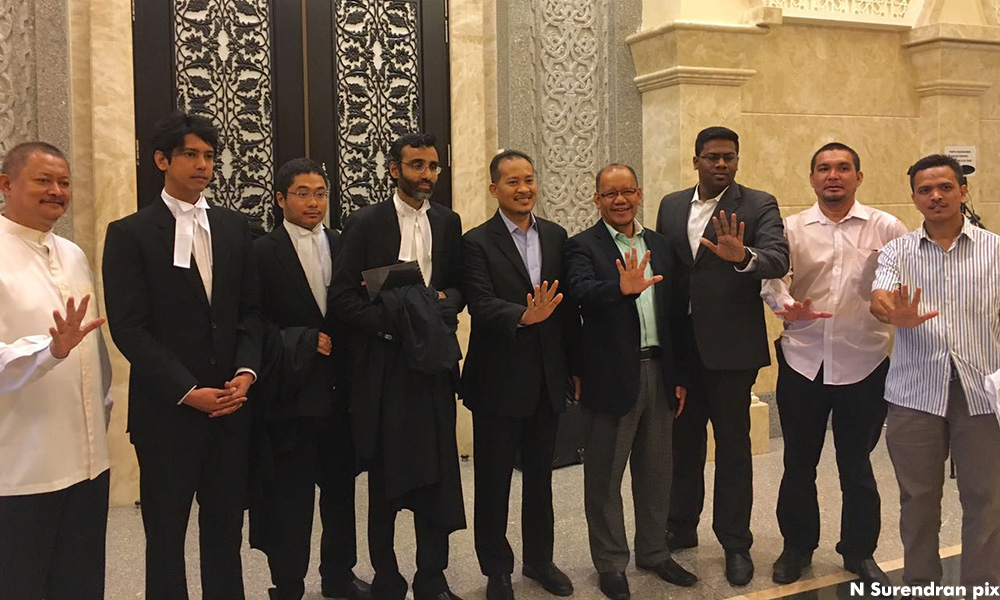

Prosecution must prove intention in sedition cases, court rules
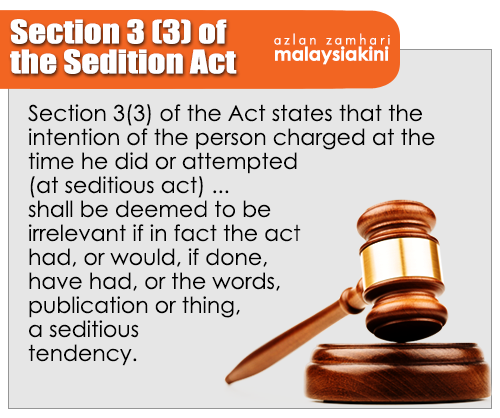
In a landmark decision today, the Court of Appeal struck down Section 3(3) of the Sedition Act 1948, ruling that the prosecution must prove intention when charging a person with sedition.
This ruling of the court will have an impact on all ongoing sedition cases, lawyer N Surendran said.
The ruling was made in the case of Mat Shuhaimi Shafiei vs the Public Prosecutor, in which Surendran appeared for the Sri Muda assemblyperson.
In a landmark decision today, the Court of Appeal struck down Section 3(3) of the Sedition Act 1948, ruling that the prosecution must prove intention when charging a person with sedition.
This ruling of the court will have an impact on all ongoing sedition cases, lawyer N Surendran said.
The ruling was made in the case of Mat Shuhaimi Shafiei vs the Public Prosecutor, in which Surendran appeared for the Sri Muda assemblyperson.
A three-member bench of the Court of Appeal, chaired by Justice Lim Yee Lan, unanimously allowed the appeal.
Justice Varghese George Varghese, who delivered the judgment, ruled that Section 3(3) contravenes Article 10 of the Federal Constitution on freedom of expression, and therefore it is invalid and unenforceable.
 "This is a novel constitutional challenge, the specifics of which were never litigated before," Justice Varghese said.
The other judge presiding on the panel was Justice Harmindar Singh Dhaliwal.
Justice Varghese said Section 3(3) failed the test of proportionality, which is contained in Article 8 of the constitution.
The judge said there were merits in Mat Shuhaimi's application as Section 3(3) was a total displacement or removal of any consideration or necessary finding of intention of the accused, or termed 'mens rea', which was an essential ingredient to be proved in criminal proceedings.
Criminal intent always essential
In criminal law, 'mens rea' or proof of intention behind a purported act, has always been an essential element to show culpability of a crime.
Justice Varghese said although Section 3(3) stated the intention of the person charged was deemed irrelevant, in this court's assessment, it was not to create a presumption that the accused could disprove.
“More significantly, apart from seeking to totally relieve the prosecution of the burden to prove intention, ...that provision also had the effect of putting the issue of the accused's intention beyond judicial consideration; such would not have been the drastic effect if such restriction was couched as a rebuttable presumption,” he said.
The judge also said that Section 3(3) also was in conflict with Section 505 of the Penal Code, where intent had clearly to be proved for any offence in the Penal Code.
“It is indisputable that an accused under the Sedition Act would be clearly disadvantaged and in effect be discriminated,” he said, adding that this would open the door to selective prosecution.
As a result, Justice Varghese said, the panel was unanimously of the view that Section 3(3) was in violation of the constitutional right of a citizen to be treated equally under Article 8.
“Hence, we order that Section 3(3) of the Sedition Act 1948, contravenes Article 10 of the Federal Constitution and therefore is invalid and of no effect in law,” he said.
Mat Shuhaimi was charged in February 2011 in the Sessions Court in Shah Alam with posting an allegedly seditious article in his blog, srimuda.blogspot.com, on the appointment of Mohd Khusrin Munawi as the new Selangor state secretary.
He was alleged to have committed the offence at Pusat Khidmat Rakyat, Jalan Anggerik Vanilla, Kota Kemuning in Shah Alam, on Dec 30, 2010.
Mat Shuhaimi is the political secretary to Selangor Menteri Besar Azmin Ali.


Are you sure you want to delete this comment?
This action cannot be undone.