


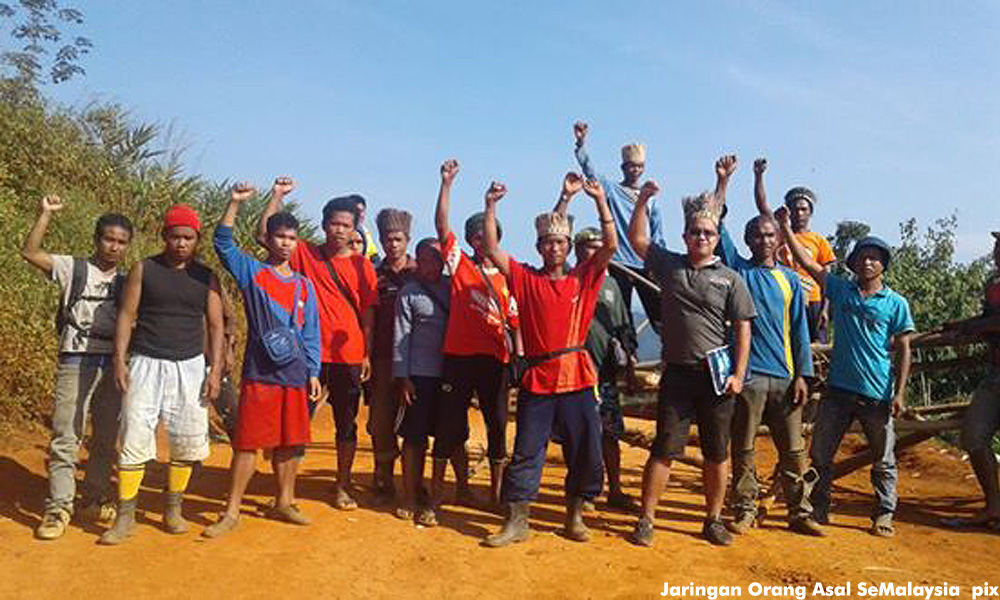

Orang Asli in Gua Musang fear not just logging but also dams
The crackdown on the Orang Asli's blockades in several locations in Gua Musang, Kelantan, on Tuesday has drawn new attention to logging activities in the area.
However, it appears that logging might not be the only issue there as there are plans to build two dams in Gua Musang to mitigate floods in the area.
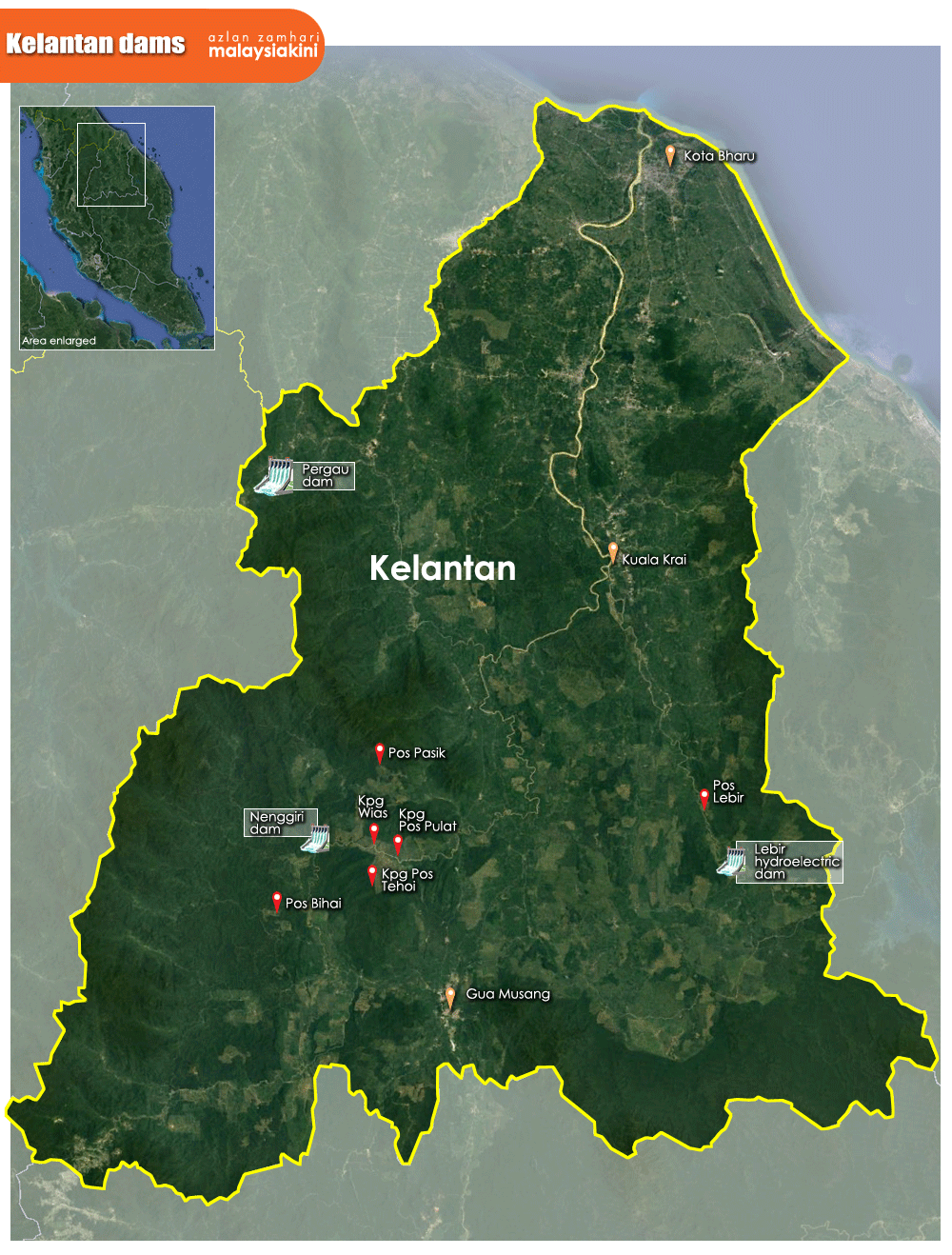
The two dams are to be built on Sungai Nenggiri and Sungai Lebir, where water from these two rivers converge into Sungai Kelantan at Kuala Krai...
The crackdown on the Orang Asli's blockades in several locations in Gua Musang, Kelantan, on Tuesday has drawn new attention to logging activities in the area.
However, it appears that logging might not be the only issue there as there are plans to build two dams in Gua Musang to mitigate floods in the area.
The two dams are to be built on Sungai Nenggiri and Sungai Lebir, where water from these two rivers converge into Sungai Kelantan at Kuala Krai.
It was initially reported that the two dams were proposed by the Drainage and Irrigation Department (JPS) to contain the heavy flow of rainwater upstream, especially from the Gunung Gagau range.
Energy, Green Technology and Water Minister Maximus Ongkili revealed more about the two dams in a written reply to PAS Senator Khairiah Mohamed during a Dewan Negara session last year.
"The government intends to build both these dams, especially after the massive floods that occurred in these two areas - at Gua Musang and Kuala Krai in Kelantan - towards the end of 2014 till early 2015," Maximus said in the reply, dated April 28, 2015.
He said the government had given approval to Tenaga Nasional Bhd (TNB) to start the Nenggiri hydroelectric project with a capacity to generate as much as 300 megawatts of electricity.
The dam to be built for this project will also be used as a source of water supply and to mitigate floods that occur during the monsoon season every year.
Plan to increase size of dam
Maximus added that TNB and the Kelantan state government were in discussion to reconsider restrictions on the project, which states that the reservoir cannot exceed 5,000 hectares, as that is only suitable for the "low dam" option.
This is so that the proposed Nenggiri dam can hold a bigger water volume for the "high dam" option, which allows an area of up to 10,400 hectares to be inundated, he explained.
Maximus had also said then that the Lebir hydroelectric project, which is meant to generate 274 megawatts of electricity, would require the cooperation from various parties, including the federal government, state government and TNB.
In Prime Minister Najib Abdul Razak's presentation on the 11th Malaysian Plan (11MP), he also mentioned the two dams.
"Under the flood mitigation projects, or RTB, the government will implement RTB Sungai Kelantan in an integrated manner with the construction of the Nenggiri and Lebir dams," Najib said in his 11MP speech in May 2015.
However, when the Nenggiri and Lebir dams were announced last year, there were stringent protests from the Orang Asli community affected by the twin projects.
It was reported that the day after the prime minister's 11MP speech, Kelantan Orang Asli village committee youth chief Dendi Johari warned that the dams would destroy their villages.
The dams are expected to affect several villages of the Temiar and Batek tribes, such as Kampung Pos Pulat, Kampung Wias, Kampung Pos Tehoi and Kampung Kuala Wook, Dendi had said.
"We are saddened to hear as this will destroy our houses, our history, our grave sites and the jungle which is our source of livelihood and income.
"We totally object to the building of the dams," he had said, adding that the Orang Asli were not consulted on these projects.
Dams will affect customary lands
In an immediate reaction to the 11MP speech, the Centre for Orang Asli Concerns (COAC) noted that the indigenous people had protested against the two dams as it would affect their customary lands.
They would also be forced to resettle if the dams were constructed, even if their lands were not submerged in water.
The Orang Asli also believed that the floods in the Kelantan were the result of the massive deforestation and destruction of the environment, COAC said.
Currently, there is only one dam in Kelantan - the Pergau dam across Sungai Pergau in Jeli.
In September this year, the Orang Asli set up anti-logging blockades on the road leading into the Balah Permanent Forest Reserve, with the blockades later expanded to Pos Pasik, Pos Petei and Pos Bihai, among other locations.
The blockades were aimed at stopping loggers from transporting logs out of the forests in the area.
The community said they were doing this to protect and preserve the native forests and land, which were the legacy of their forefathers, from being destroyed by loggers.
Over the past week, the crackdown on the blockades by the Kelantan Forestry Department (JPNK) had seen 54 Orang Asli activists arrested.
JPNK had defended its actions, saying that those who set up the blockades had broken the law by preventing authorities from entering and carrying out their duties in those areas, among other infractions.


Report this comment
Are you sure you want to delete this comment?
This action cannot be undone.