



PM, Umno are confident, but are Malaysians happy?
COMMENT Prime Minister Najib Abdul Razak and Umno leaders are generally confident of the future, but are Malaysians happy too?
There is no doubt that the Umno general assembly 2016 ended exuberantly on a strong basis of greater party loyalty and tighter Umno unity.
The Umno delegates apparently felt confident of winning the 14th general election, which is now expected to be held sooner, in 2017, rather than later.
But is this confidence and happiness among Umno leaders shared by all Malays and bumiputeras, and especially by most Malaysians, including non-Malays and non-Muslims?
I seriously doubt it, judging from my conversations with many Malaysians of all races and religions.
Why most Malaysians are less confident
The Umno leaders are invariably confident and happy because they are the top political leaders, with high prestige and holding important influential positions. They are also unlikely to be from the poor and struggling masses of Malays, bumiputeras, Chinese and Indians and other groups all over our beloved country. They are mostly the elite.
Hence, there is less empathy at the high rarified political levels, for the poor, hardworking and lower income Malaysians who belong to the Bottom 40 and lower middle income groups.
In fact, there appears to be a serious disconnect between the ruling political leaders and the poorer masses of Malaysians. This disconnect has to be studied, recognised and rectified as soon as possible.
Indeed, the so called Confidence Gap or Happiness Gap has to be closed if public hope and happiness in the present and in the future are to be raised. So, what do we do? We should be brave to ask the right questions, so as to strive to get to the right solutions...
COMMENT Prime Minister Najib Abdul Razak and Umno leaders are generally confident of the future, but are Malaysians happy too?
There is no doubt that the Umno general assembly 2016 ended exuberantly on a strong basis of greater party loyalty and tighter Umno unity.
The Umno delegates apparently felt confident of winning the 14th general election, which is now expected to be held sooner, in 2017, rather than later.
But is this confidence and happiness among Umno leaders shared by all Malays and bumiputeras, and especially by most Malaysians, including non-Malays and non-Muslims?
I seriously doubt it , judging from my conversations with many Malaysians of all races and religions.
Why most Malaysians are less confident
The Umno leaders are invariably confident and happy because they are the top political leaders, with high prestige and holding important influential positions. They are also unlikely to be from the poor and struggling masses of Malays, bumiputeras, Chinese and Indians and other groups all over our beloved country. They are mostly the elite.
Hence, there is less empathy at the high rarified political levels, for the poor, hardworking and lower income Malaysians who belong to the Bottom 40 and lower middle income groups.
In fact, there appears to be a serious disconnect between the ruling political leaders and the poorer masses of Malaysians. This disconnect has to be studied, recognised and rectified as soon as possible.
Indeed, the so called Confidence Gap or Happiness Gap has to be closed if public hope and happiness in the present and in the future are to be raised. So, what do we do? We should be brave to ask the right questions, so as to strive to get to the right solutions.
Inflation
The prices are rising across the economy. From essential foods to housing and shelter, transport, heath and education, every item of basic needs has gone up. How then can our Malaysians be confident and happy, please?
The solution is to examine all ways of freeing the economy of unnecessary economic and financial constraints and over-protection and business preferences that create monopolistic conduct.
Corruption
Corruption is causing a huge distortion of the country's economic resources and causing costs to rise.
Most Malaysians feel that much more should be done to fight corruption. They ask, with a sense of hopelessness, how come the really big political fish are getting away, while the focus has shifted to senior government officials. In the meantime corruption is getting to be rife, at all levels of the public service - and not only at the lower levels, as in the past.
So, the government and the Malaysian Anti-Corruption Commission (MACC) should try to re-strategise, if possible.
Unemployment
This is a growing problem. It is the source of much unhappiness, especially to about 200,000 university graduates and their families, whose members can amount to about 1,000,000, and mainly Malays. Can they be confident about their and our country's future?
Of course, the political leaders may not feel the pain of this problem. Their children would generally get more preference for scholarships to attend better universities abroad and thus have brighter employment prospects.
But what about the large numbers without proper skills, training and proficiency in the international languages like English, Arabic and even Chinese? The Education Blueprint has some solutions.
However these have to be implemented faster and more effectively, to have a real impact on rising unemployment. We should also not feel shy, nor apologetic, to raise the standards of science, mathematics and English.
Human rights
Our human rights are being more marginalised. This is causing major unhappiness, loss of confidence and a depression among many NGO leaders and the masses who believe in basic human rights and freedoms.
Most Malaysians and the international community ask why should Maria Chin Abdullah, who is regarded as a heroine and champion of the human rights of the rakyat, be held in solitary confinement, under the anti-terrorist law Security Offences (Special Measures) Act 2012 (Sosma)?
The government and the police have to give good accountability to justify this draconian treatment to Maria, which is regarded as unfair and even cruel. Where is Wasatiya and Moderation and free speech, if even mild Maria can be treated so harshly?
Fear and intimidation are being spread and this causes a loss in public confidence and unhappiness. Then, there is the case of others who are treated lightly for using seditious language and threats to life and limb, who get away easily.
So the rakyat ask whether there is selective justice? Is there state capture, where some governments use the institutions of state, like the police, to keep the political leaders in power, sometimes, in perpetuity?
Surely, all this authoritarian and harsh treatment causes the lowering of public confidence and the rise in unhappiness, which bodes ill for the future.
Security and safety
Finally, our security and safety have deteriorated! We all felt much more secure before. Today, there is more fear to walk in the streets, especially at night. In fact, people try to avoid going out at night.
We do not have the confidence that we will be safe, or that our children are secure. The police complain of lack of staff, but perhaps, if they reallocate their understandably limited resources to pursue criminals, rather than trail some political leaders, we the people might have more confidence in public safety.
Everyday we read, with dread, about murders, shootings, snatch thiefts, about powerful crime syndicates and corruption, even in the formerly prestigious Royal Malaysian Police Force (PDRM).
One solution would be to encourage the employment of more auxiliary police personnel to supplement the weakened and depleted PDRM. This will raise public confidence, even if they have to pay for better security services. At least we can hire and fire errant police personal more easily - and raise the quality of security.
Conclusion
Malaysia's public confidence, by any measure, is now low and declining. This can be checked out.
Worse still, the public perception is that confidence in the country is declining rapidly. That is one reason why the ringgit is falling badly and why capital outflows and the brain drain continue to worsen!
But Malaysians are generally patriotic, loyal and diligent and want to make Malaysia great, without all this racial polarisation and religious bigotry that is largely aggravated by irresponsible politicians for their own selfish, greedy and parochial interests.
Malaysians across the board are widely unhappy with this sad situation. The confidence at the level of elite political leaders may therefore be unjustified. The declining public confidence in good governance is increasing. This is causing much loss of public confidence and unhappiness, which all political leaders must address expeditiously, before it's too late for the 14th general election.
The rakyat want reforms, improvements, changes and a more united, prosperous, fairer and better Malaysia.
To be fair, please give us Malaysians, what we rightly deserve.
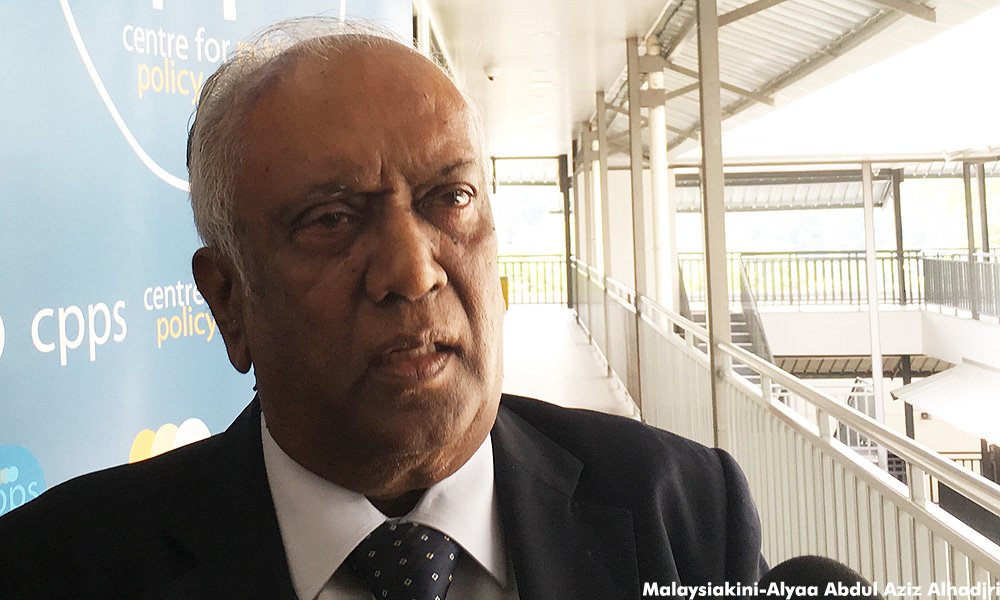
RAMON NAVARATNAM is chairperson of Asli/Centre for Public Policy Studies.


