



Harapan wants High Speed Rail project inking to be put off
Putrajaya should postpone the signing of the bilateral agreement between Malaysia and Singapore on the Kuala Lumpur-Singapore High Speed Rail (HSR) project, slated to be done on Dec 21, until after a thorough project reliability is done, says Pakatan Harapan.
PKR Bayan Baru MP Sim Tze Tzin, Amanah Kuala Krai MP Hatta Ramli and DAP Serdang MP Ong Kian Ming made the call on the grounds that both countries would share the future revenue generated from HSR.
Putrajaya should postpone the signing of the bilateral agreement between Malaysia and Singapore on the Kuala Lumpur-Singapore High Speed Rail (HSR) project, slated to be done on Dec 21, until after a thorough project reliability is done, says Pakatan Harapan.
PKR Bayan Baru MP Sim Tze Tzin, Amanah Kuala Krai MP Hatta Ramli and DAP Serdang MP Ong Kian Ming made the call on the grounds that both countries would share the future revenue generated from HSR.
"(Thus) the government needs to table a financial plan openly to the public on the proportion of the revenue for Malaysia and how the construction cost will be shared by both parties," they said in a joint statement today.
This should also include the total loans take-up for the project, Sim, Hatta and Ong said.
The government should not keep such information secret, like that practised in Third World countries, because the project would involve a huge amount of public funds, with plenty of land expected to be acquired by the government, they said.
Construction of the 350-km railway line, with only a 15km stretch located in Singapore, is expected to begin in 2018 and the HSR is slated to start operating in 2026.
The railway line will cut travel time between Kuala Lumpur and Singapore to just 90 minutes.
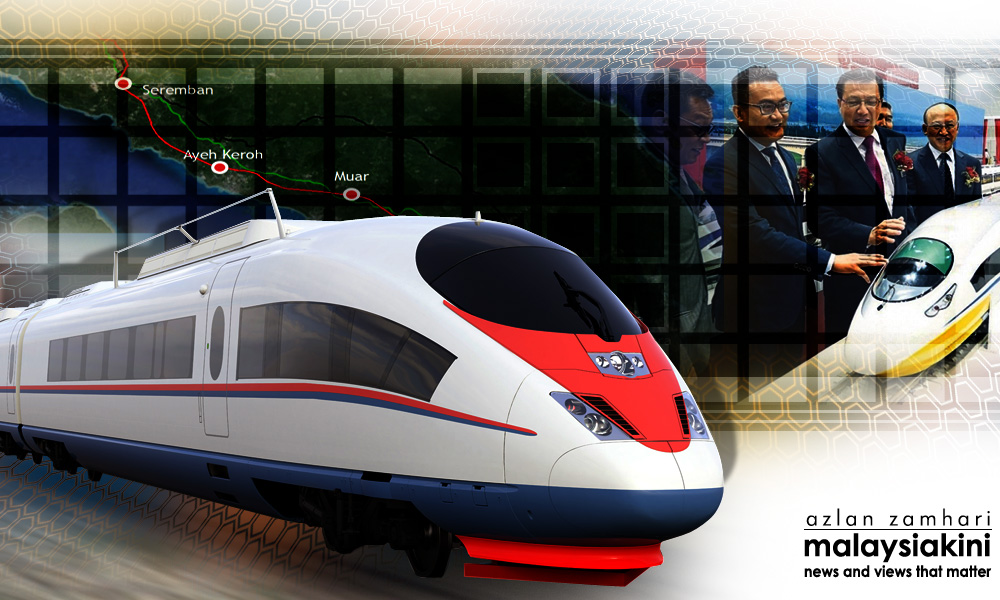
The HSR terminal in Singapore is to be located at Jurong East while Malaysia will have seven stations, at Bandar Malaysia, Putrajaya, Seremban, Ayer Keroh, Muar, Batu Pahat and Iskandar Puteri.
MOU on HSR signed on July 19
Prime Minister Najib Abdul Razak and his Singapore counterpart Lee Hsien Loong witnessed the signing of a memorandum of understanding for the HSR project in Putrajaya on July 19.
The Harapan lawmakers estimated that the cost of the project would not be less than RM40 billion.
They also made a simple calculation and surmised that ticket sales from the HSR may only be enough to service the interest on the loan for the project.
"(We have) approximately 45 flights between Kuala Lumpur and Singapore in a day. This shows that the daily air traffic between two places only records 9,000 travellers, if we have 200 passengers on every flight," the statement by Sim, Hatta and Ong said.
"Should Malaysia face the risk with HSR's new (daily) capacity of 18,265 passengers? This is twice the capacity of the current air traffic, but the returns will only be enough to settle the loan interest, even if the train tickets are sold out everyday."
They urged the government not to sacrifice public interest by getting involved in an unwise investment.
"The government should learn from the 1MDB episode, with the debts building up and the people having to bear (it) via the Goods and Services Tax (GST), the hike in transport fees and highway tolls, as well as the reduction of petrol subsidy," they said.
Instead of implementing HSR, Sim, Hatta and Ong said the government should focus on the RM8 billion Gemas-Johor Baru Electric Train Service (ETS) project.
"(The government) should focus on the ETS system, not implement the HSR, which will ultimately compete with ETS and reduce its profit," they added.
Transport Minister Liow Tiong Lai announced in December 2015 the awarding of the Gemas-JB ETS project to China Railway.
Currently, only 46 percent of the 1,641.4km of railway network in Malaysia consists of electrified double tracks.
The Gemas-JB line will complete the whole electrified double-tracking rail network up to Padang Besar.


Are you sure you want to delete this comment?
This action cannot be undone.