




Q&A: Dont be social parasites, Amien Rais tells students
University students, who are morally obligated to speak up for the people, are the best assets for reformation, said former Indonesia parliamentary speaker Dr Amien Rais .
 In an exclusive interview with
malaysiakini
, the politician
speaks
on the importance of students heading a reformasi movement and how they would become 'social parasites' if they only think of flashy cars and good salaries.
In an exclusive interview with
malaysiakini
, the politician
speaks
on the importance of students heading a reformasi movement and how they would become 'social parasites' if they only think of flashy cars and good salaries.
Malaysiakini: How would you describe reformasi in the region in the current stage?
Amien Rais: Not all of the South East Asian countries are undergoing reform. There is no reform in Singapore and I don't see any reform in the true sense in Thailand. Malaysia, it is only in its inception...the beginning level. Probably because (ex-prime minister, Dr) Mahathir (Mohamad) had been in power for too long and, I don't see that Pak Lah (Abdullah Ahmad Badawi) is seriously changing the political substance in the country. I think it's business as usual, I mean under Abdullah, I see politics in Malaysia as business as usual. Maybe Anwar Ibrahim will take up his unfinished job if he has the chance.
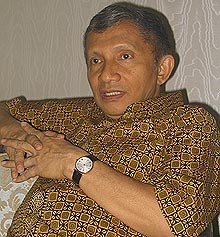
University students, who are morally obligated to speak up for the people, are the best assets for reformation, said former Indonesia parliamentary speaker Dr Amien Rais .
 In an exclusive interview with
malaysiakini
, the politician
speaks
on the importance of students heading a reformasi movement and how they would become 'social parasites' if they only think of flashy cars and good salaries.
In an exclusive interview with
malaysiakini
, the politician
speaks
on the importance of students heading a reformasi movement and how they would become 'social parasites' if they only think of flashy cars and good salaries.
Malaysiakini: How would you describe reformasi in the region in the current stage?
Amien Rais: Not all of the South East Asian countries are undergoing reform. There is no reform in Singapore and I don't see any reform in the true sense in Thailand. Malaysia, it is only in its inception...the beginning level. Probably because (ex-prime minister, Dr) Mahathir (Mohamad) had been in power for too long and, I don't see that Pak Lah (Abdullah Ahmad Badawi) is seriously changing the political substance in the country. I think it's business as usual, I mean under Abdullah, I see politics in Malaysia as business as usual. Maybe Anwar Ibrahim will take up his unfinished job if he has the chance.
So you're saying that apart from Indonesia, other countries have yet to undergo serious reforms?
I think so yes.
What can the reformasi movement in Malaysia learn from Indonesian reformasi activists?
First of all there must be rallying issues. You don't necessarily need rallying figures but rallying issues. Issues that could move Malaysians to have a kind of a common goal so that they can work together to change the political situation for the better.
I believe students could function as the spearhead of the reform. So the country's chances for a true reform - whether or not it is to a certain extent or to a great extent - depends on the attitude of the students.
 But in Malaysia, students are governed and restricted by a law (Universities and University Colleges Act) which bars them from active involvement in politics and demonstrations. How can they do what the students in Indonesia do?
A similar law was also enforced in Indonesia from early 1980s until the late 1990s. The students were forced to concentrate only on activities within the campus they have to study and banned from active participation in politics. But this kind of regulations could be broken by the strong will on the part of the students. They (the Indonesian students, then) said enough is enough. They violated the campus regulations and that was it.
So I believe that it is only the students who could initiate reforms. But if the students are complacent and are not sensitive enough to the political ecology and environment, there will be no hope that reforms will take place. Students are the key factor.
Rallying issues... does it mean that the people must take their dissatisfaction to the streets?
As I saw the process in my country, the student leaders held a lot of seminars in campus. They invited some intellectuals from outside the campus, informal leaders to talk or to address the relevant problems felt by the society at large like unemployment, low quality of education, the deteriorating situation in the ecology. Because the future was considered somewhat bleak, the students suddenly realised that something had to be done.
The fires of reforms were contagious from one campus to another and finally the students leaders held demonstrations in the streets and followed by the youths in general. And then it was like an inevitable political wave. In my country there is an interesting rule of thumb regarding the security perception. Some of the police told me if the demonstration consisted of only 50 students, they will dismiss the demonstration. But if it is followed by thousands of students and people, the police will just watch closely. But if it is joined by tens of thousands, the police will join them!
So in this sense the students represent the interest of the nation. Why?
Because the students have their parents, uncles, aunties and friends in the villages. So you cannot dismiss the demonstration of students as demonstrations representing the few. I believe the students are the nerve of the society. That is why any regime is afraid of students demonstration.
What is your advise to the students here?
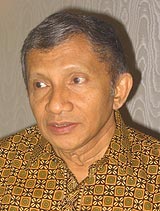 There is a saying that students and lecturers cannot live in ivory towers. And we hope that the graduates from universities become real human beings. Not just robotic humans. They have to train themselves to be sensitive to the lives of their own people.
So if students see the miserable lives of the common people without it impacting their own lives, then that kind of students are hopeless, if I can say so, to be the agent of change. That is why to me extra campus organisations are indeed very significant as they can educate the students on their social and political task.
But look, if the students concentrate only on their studies, go to the libraries and spend most of the times reading, when they graduate they will be very insensitive..I mean...they would only think of flashy cars, good houses and big income and that's it! It think these kind of students could become social parasites.
Have all the reformations you sought when you first started the reformasi movement in 1998 been fulfilled?
More than half of the agendas have been fulfilled. Four out of six agendas have been fulfilled. For example, now we have amended our constitution.
And then we have restructured the functions of military forces who used to have a dual-function which is very dangerous as it can kill democracy by living on the two jobs. The civil posts were heavily dominated by the military people and they became governors, mayors and even ministers. So we have been successful in putting the armed forces into their barracks.
And thirdly we have the local autonomy by giving a wide ranging autonomy to the provinces and cities. And last but not least, the Indonesian people are really enjoying the democratic life. We enjoy freedom of press and we have full political liberty and not a single political prisoner has been detained by the government. Suddenly Indonesia is the largest democratic country after United States and India.
But there are two agendas that are difficult to solve which are corruption and the upholding of the rule of law.
In a scale of one to 10, how would you rate the success of the reformasi in Indonesia?
Hmm. Maybe 6.5. Because I still think there is a lot of homework that we have to finish.
What about Malaysia?
I don't want to make any comment on that. I am a guest here you know (laughs).
 You said that you hope Anwar would take-up his unfinished business in creating reformations in Malaysia. What steps must he take to be successful in that course?
I don't know the real political context in Malaysia. I am however aware that it is difficult for him to re-enter the political stage. Not only does he face some political restrictions - I was told that he has to wait for a couple of years to be able again to enter politics, but on top of that it depends on the perception of the Malaysian people.
In this regard there is a unique position enjoyed by brother Anwar. I think he has the charisma, when he speaks people listen and the international community from the Middle East to Washington are sympathetic to him. This is his unique position. He is accepted widely by Arab countries but at the same time Washington, London and Paris are also very much sympathetic to him too. So this is unique.
When I said that he has an unfinished job because in the Indonesian people perception's is that he was the automatic replacement for Mahathir but suddenly there was a political incident where he was jailed by Mahathir for many years and now it depends on Anwar and his supporters to come back. I cannot judge his chance. I don't know. You must know better than I do.
Following the reformasi days, Indonesia has undergone two general elections where two different coalitions ruled the country. Some believe the development showed the maturity of the Indonesians as voters of a democratic system. What can the opposition political parties here in Malaysia learn from Indonesia?
I think not much because we are also still learning. We have multi-party system but the bottom line is that there is a problem we are facing that is somewhat similar to the past.
There is one very strong political party which has the final say in many national policies. Although I have to add immediately that to a great extent other parties are growing and also have a say in the final decision of the national policy.
So we are changing now but not as fast as I had imagined. Even I see the return of Golkar to the political stage. When Suharto was president, Golkar was the greatest political machine and it functioned more than a political party because it was very powerful.
Even rejected to be called a political party, it is called just Golkar - Golongan Karya- it behaves more than political party because it dominates the military, the police, the bureaucracy and even entrepreneurs, businessman are also subordinated to the Golkar.
But now Golkar's power has been broken and some of them will try their best to come back. But now there is a hope in my country. I can say that Golkar still in control of more than half of the power but the other half is shared by other political parties.
So at least there is a positive change in the Indonesian political landscape.
What about Islamic parties in the region? Like in Malaysia, PAS faces difficulty in garnering vote? Does it have anything to do with its quest for the establishment of an Islamic state. Does it have anything to do with the sentiments of the Muslims themselves on the issue?
I think the problems faced in Malaysia is the same as what we are facing in Indonesia. I think Muslim activists can be categorised in two groups. One group believes that starting a Syariah state while the other believes Islam as a universal religion but in political matters, it has a wide room for Ijtihad - or having intellectual exercise- that you take from Islam its moral foundation, its moral paradigm but you have very big room to some intellectual exercise because we live in a different era.
As I see it the Quran gives us ample and wide probabilities to find out what is the best system for us. So I also believe in Syariah - as a true believer of Islam- but, at the same time I believe that our Prophet taught us to be flexible in solving our worldly problems. I mean there are many problems which are given by God to some exercise by our own. So I think this is the bone of contention among Muslim leaders both in Indonesia and Malaysia.
And the wonderful position of Anwar Ibrahim is that he is accepted by many party members both from PAS and Umno. Anwar will be a Malaysian leader who can make the two streams to converge.
Let us move on to Malaysia-Indonesia ties. A total of 380,000 illegal Indonesian immigrants were sent back to be legalised recently. A lot of problems arose from that exercise. Do you think that the Malaysian government could have handled the matter in a better manner?
 I think yes it could have been handled in a different manner. It is a fact of life that we have cheap labour. We have a kind of surplus of labour because as you know the unemployment rate in Indonesia is staggering. These people come to Malaysia to make money. They become general labours in the construction and agriculture sectors.
Every time I see the Indonesian workers return from Malaysia and treated sometimes like sub-human...I protested. I criticised Mahathir severely and harshly for imposing the whipping sentence - an archaic law used in the Roman empire. I think as two brotherly countries any issues or problems must be solved through deliberations or musyawarah ... not only through formal diplomatic channels. I think the leaders of the two countries can always meet each other in either Kuala Lumpur or Bogor in Jakarta because we are only about one-and a half hour flight away from each other.
I fail to understand that the tension between the two countries seemed serious. Like the issue of Ambalat - although I know the Malaysian media did not cover the issue as widely as we did in Indonesia - I think it is a very simple issue. I know it is very controversial but why don't we share together, for example, we just make the best of it. I think that is plausible, I don't see any reason for us not to forge that kind of cooperation.
As you said earlier Indonesia reacted strongly to the Ambalat dispute while Malaysia did not. Why is there such a contrast between two nations so similar to each other?
I don't know why. I assume that the Ambalat issue was exploited by a certain elite individual in my country to distract people from the real problems faced there. Because we are still unable to solve the problems of unemployment which is often described like a social time-bomb. And we have failed to improve our standard of living and therefore the easiest way is to create issues. And then people came out to the street shouting 'Crush Malaysia, Ganyang Malaysia'...I think this is ridiculous! But there are people who think that this kind of political engineering was meant to distract the people's attention from the failure of the government to improve the situation.
But many viewed that the Indonesian media was responsible for instigating the Indonesians So are you saying that the media was used by an Indonesian elitist?
I must admit that my knowledge of Ambalat is rather limited. But yes I was told that there are some economic interest in that issue. At least from the demonstration which I saw in Jakarta, Surabaya and other cities, when those people repeated what we did almost two generations ago in 1965-66 when the Ganyang Malaysia was popularised by Soekarno, it reminded me of Soekarno's strategy to distract the people.
Touching on the Indonesia media, do you think with all the press freedom that it is enjoying, there is any balance between free press and social responsibility?
Most of them (media organisation) yes...they do try their best to strike a balance but some of them do misuse the freedom of the press by misinforming the people. Sometimes if you read the press you cannot believe it. It is too free, too liberal, too independent, too ...I don't how to describe now .. Too irresponsible. But there are some people who have defended this by saying that imagine if you have been contained for a long time and suddenly you are suddenly given full freedom. It is like a horse that has been tied for a long time and when it is released it will run wild. So it is like a pendulum.
Will the situation improve?
Yes I believe so. that it will improve.


Are you sure you want to delete this comment?
This action cannot be undone.