



Malaysian economy 'slowed but robust', says World Bank
The Malaysian economy has slowed but remains robust despite being affected by economic uncertainty abroad, according to the World Bank.
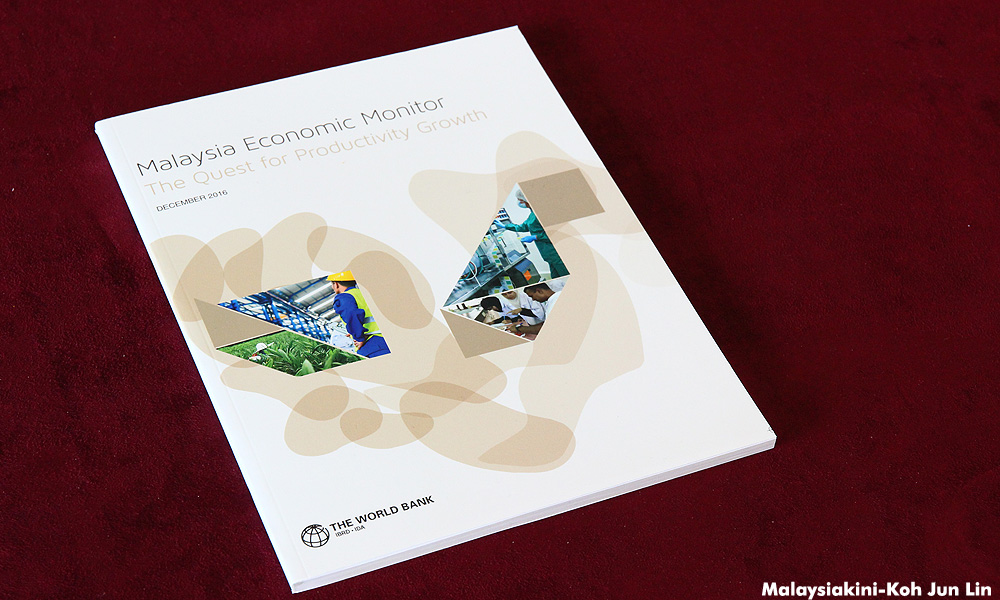
The bank’s December 2016 edition of the Malaysia Economic Monitor report released today forecasts a GDP growth of 4.2 percent this year, compared with five percent last year.
“In a global context where growth has been declining and there are always uncertainties, this means that the Malaysian economy would continue to be very robust,” says the report.
The Malaysian economy has slowed but remains robust despite being affected by economic uncertainty abroad, according to the World Bank.
The bank’s December 2016 edition of the Malaysia Economic Monitor report released today forecasts a GDP growth of 4.2 percent this year, compared with five percent last year.
“In a global context where growth has been declining and there are always uncertainties, this means that the Malaysian economy would continue to be very robust.
“This is something important when you look around the world. To you 4.2 percent might not sound that high, but in a global context in this environment, it is actually robust. It is quite strong.
“It has to do with fundamentally good macroeconomic policies. The fiscal reconsolidation is continuing, and deficit target this year (3.1 percent) is going to be reached - almost certainly - and the government target is 3.0 percent for next year and this again we project will be achieved,” said World Bank Southeast Asia director Ulrich Zachau in his opening remarks at the report’s launch.
In his presentation later, the bank’s senior country economist for Malaysia, Rafael Munoz Moreno, said Malaysia’s GDP would see a continued but weak growth over the next year.
Global trade and commodity prices are both also expected to be higher next year compared with this year.
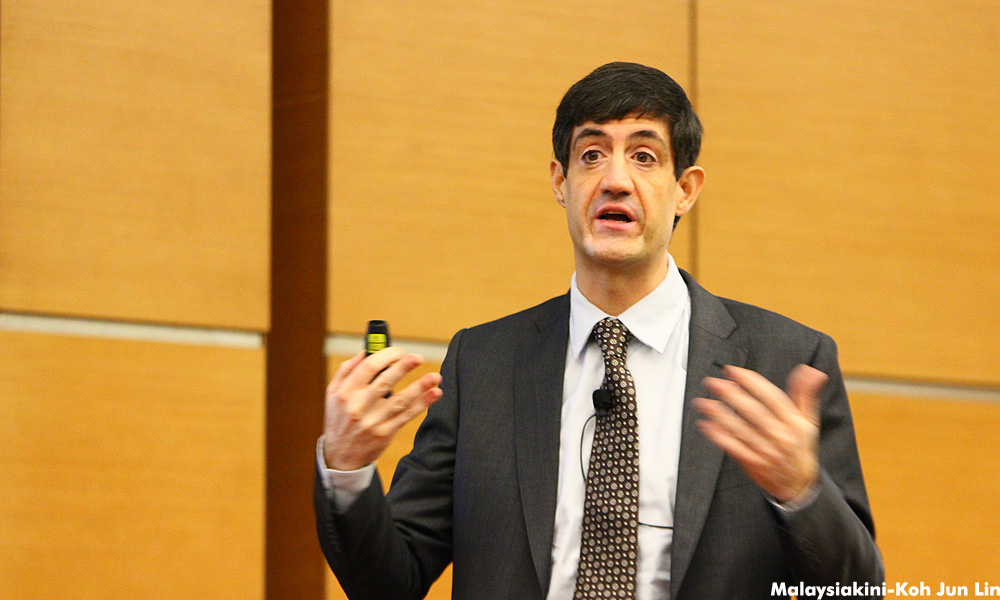 “Having said that, we also expect higher uncertainty. This means that all these expectations are subject to higher volatility than before. It could go up, but it could go significantly down too,” Moreno (photo) said.
Ringgit depends on externalities
After the launch, Moreno was asked about the ringgit’s weak performance, compared with the US dollar, with the ringgit now at its weakest point since the 1998 Asian Financial Crisis.
He said the ringgit’s eventual recovery would depend a lot on external developments, which drove most of its decline.
Among the issues that would remain to be seen is how the new US administration would roll out its trade and fiscal policies in the next six months, and the beginning of the Brexit negotiations that would provide some insights on how the UK’s exit from the European Union would materialise.
Also on the horizon next year are the elections in France and Germany, and whether these would affect the countries’ policies.
These factors would in turn drive financial inflows and outflows, and affect the exchange rates of currencies, including the ringgit.
Diversifying the economy
Also at the launch event was the Minister in the Prime Minister’s Department Abdul Rahman Dahlan, who said Malaysia is tackling these economic challenges from a position of strength.
Rahman said when Prime Minister Najib Abdul Razak took power seven years ago, Malaysia’s dependence on oil and gas revenue was about 41 percent. The figure stands at 14 percent as of last year, due to the government’s efforts to diversify the economy.
“Can you imagine if we are still 41 percent dependent on oil and gas revenue? When the oil prices fall sharply, we are strongly affected,” added the minister in charge of the Economic Planning Unit said.
Rahman said he attended a meeting between the Organisation of the Petroleum Exporting Countries (Opec) member states and non-Opec countries in Vienna last week.
Malaysia would follow suit with Opec’s decision to cut oil production in a bid prop up oil prices, he added, but Petronas would only announce the magnitude of its production cut after the Opec states have announced their individual contributions to the production cut.


