



Alleged Berlin truck driver's Tunisian family in disbelief
Gathered in a small and unadorned room in the hills of central Tunisia, the relatives of Anis Amri, the young man linked to Monday's terrorist attack in Berlin, are in a state of shock and disbelief.
"I simply can't believe that Anis could have done something like this," his 28-year-old sister Najwa said.
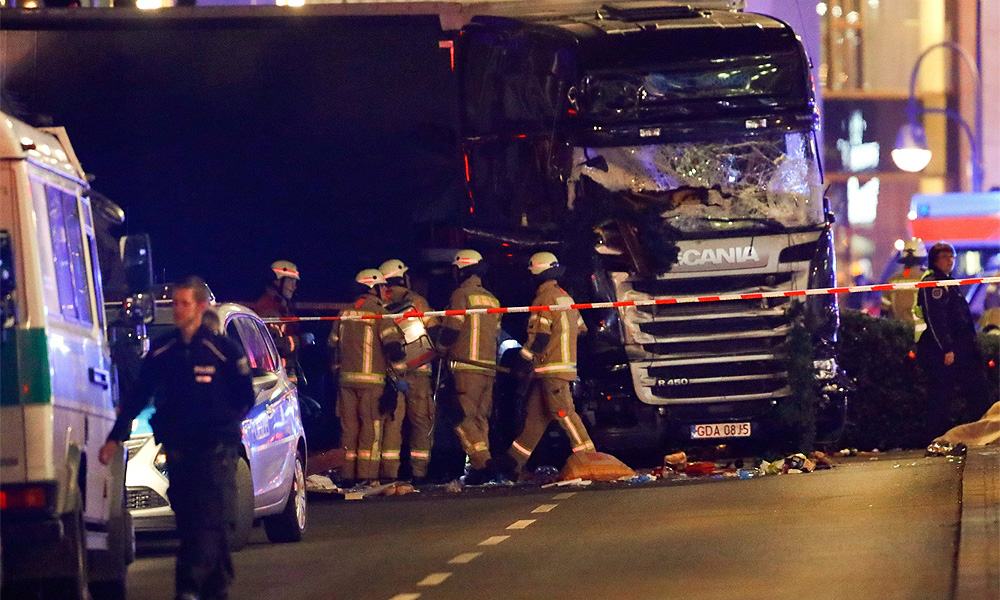
Her brother had phoned home on Sunday, she added, just a day before the heavy articulated truck thought to have been driven by him, crashed through a row of stalls at a Christmas market in central Berlin, killing 12 and injuring many more.
All five of his sisters and two of his three brothers are gathered here, seated around a low table, as neighbours come and go through the door open to the cold wind outside.
Amri's mother's face reveals traditional Berber tattoos. His father greets guests with his left hand, as his right arm is missing.
"None of us can believe it," says another sister dressed in a tracksuit. "Anis was never religious. He used to drink and party and listen to pop music," she says from under her headscarf.
The impression that emerges is of a normal 24-year-old.
According to the family, Anis and four others from the area set out to cross the Mediterranean in March 2011, just three months after the start of the Arab Spring.
"We didn't believe that anything would change here," Najwa says. The family scraped together its savings to pay the people traffickers working out of the coastal city of Sfax ferrying illegal migrants to Italy.
At the time Amri was just 17 and facing a lengthy jail term for theft, charged with stealing a truck.
At the time thousands were heading for the Tunisian coast, many of them with similar backgrounds, from small places like Oueslatia, the dusty town of some 8,000 with its low houses and dusty streets that was once his home.
Amri initially found himself in an Italian refugee camp, and later served time in prison there, the family says.
It must have been during this phase of his life that he was radicalized, in the view of Alaya Allani, a history professor and expert on jihadi radicalism at Manouba University in Tunis.
"He was young and came from a poor family. His parents had separated, and he had left school after eight years," the professor says.
"His radicalisation should be seen in connection with his socio-economic situation."
Despite its small population of some 11 million, Tunisia is seen as one of the world's major recruiting grounds for jihadis. US think tanks put the number of Tunisians fighting for Islamic State in Syria, Iraq and Libya at 7,000.
The main wave of radicalisation took place between 2011 and 2014, however, when Amri was in jail in Italy.
Released from prison and not eligible for deportation by the Italian authorities, he travelled to Germany, phoning home or communicating by Facebook regularly.
He once sent a parcel containing a mobile phone and chocolate. "But it was hard for him. He couldn't find his feet and wanted to return to Tunisia, as he said in each phone call," Najwa says.
He had even contacted a lawyer with a view to having his Tunisian jail sentence imposed when still a juvenile set aside.
Amri's mother takes out a document dated Sept 9 this year in which a witness retracts previous evidence incriminating her son.
The family took seriously his expressed intentions to return home and tried to do all possible to help him.
"What I don't understand is why he wasn't arrested if he was really so dangerous and under observation," Najwa says. The question is left hanging in the air unanswered.
A few weeks after arriving in Germany, Amri sent his sisters a photograph showing him arm-in-arm with a young blonde woman whom he described as "his girlfriend."
The family was happy with the arrangement, just as they have left the decision whether or not to wear a headscarf to their daughters to decide for themselves.
"I just want the truth to come out," his mother, Nur el-Houda, says. She and her daughters are constantly in tears. "We are praying for the victims," she says.
- dpa


Are you sure you want to delete this comment?
This action cannot be undone.