




Challenge the UUCA in court, students told
Why not file a lawsuit against the government to challenge the laws that restrict the rights and freedom of students?
This was a possibility raised by lawyer Amer Hamzah Arshad when calling on students to be more proactive during a forum in Kuala Lumpur last night.
Why not file a lawsuit against the government to challenge the laws that restrict the rights and freedom of students?
This was a possibility raised by lawyer Amer Hamzah Arshad when calling on students to be more proactive during a forum in Kuala Lumpur last night.
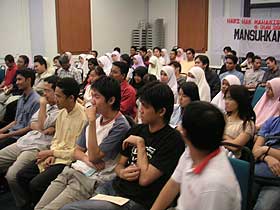
"Students should think proactive, not reactive. Why can't students file a suit to challenge the unconstitutional provisions in court?," he asked the 80-odd participants.
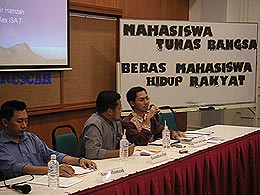 Amer also raised the possibility of students submitting a memorandum to Parliament on the restrictive clauses contained in the Universities and University Colleges Act (UUCA).
Citing the 'ISA 7' case as an example, the lawyer called on students to battle on no matter what the odds.
"We must realise there are many obstacles in every struggle, but it doesn't matter, we should stand up and fight.
"Others may think you are banging your head against a brick wall, but after a while there will be sound and people will hear it, it will be a success for you then," he said.
'ISA 7' was the name given to the seven students who were suspended after being charged with illegal assembly. Amer was one of their lawyers.
They were acquitted this April after a four-year trial and are seeking reinstatement in their respective universities.
One of them, Universiti Teknologi Mara (UiTM) student Helman Sanuddin had his application turned down on the grounds of technicality.
Damaging amendments
 Former student leader Iqbal Nordin, who is also a lawyer, was another speaker at the forum held in conjunction with
Undergraduates' Rights Day
.
Former student leader Iqbal Nordin, who is also a lawyer, was another speaker at the forum held in conjunction with
Undergraduates' Rights Day
.
He called on student activist groups such as the Malaysia Undergraduates Solidarity coalition to take the lead in the campaign to repeal the UUCA.
"Whereas students should canvass support from professors, academicians, the Bar Council, the Human Rights Commission of Malaysia (Suhakam)," added the former Universiti Kebangsaan Malaysia students council president.
Recalling the advent of the law three decades ago, Iqbal said then education minister Hussein Onn, when tabling the UUCA bill in Parliament in 1971, claimed that the act will not restrict academic freedom or prevent students from expressing their political beliefs and opinions.
However, the amendments to the UUCA four years later led to the erosion of student power in this country.
The amendments were made following a series of mass demonstrations by students in 1974 against the prevalent poverty among peasants in Kedah and the plight of squatters in Johor Baru.
 One of the main amendments included the prohibition of students from joining or aligning themselves with political parties as well as the dissolving of all autonomous student organisations.
Apart from this, Iqbal said student councils were also barred from possessing assets and representing or defending a student in a disciplinary inquiry.
At present, students facing disciplinary proceeding must defend themselves and are not entitled to the rights of counsel.
Iqbal said the right for students to be affiliated with national and international registered student groups was also retracted in the 1975 amendments without explanation.
 "The government realised that if there is a national or international student networking, it will be a very strong force," he said, adding that the government's fear was reflected in the dissolving of the Malaysian National Students Association (Persatuan Kebangsaan Pelajar Malaysia or PKPM).
According to him, PKPM was initially a influential students group that organised programmes in villages and even received funding from the authorities. However, it was dissolved when it became critical of government policies.
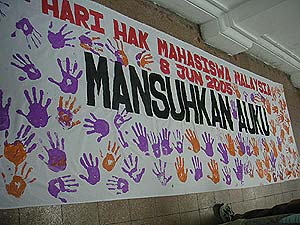
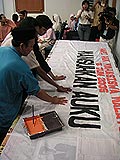
Participants at the forum also put their palm print on a banner calling for the abolishment of the UUCA.


