


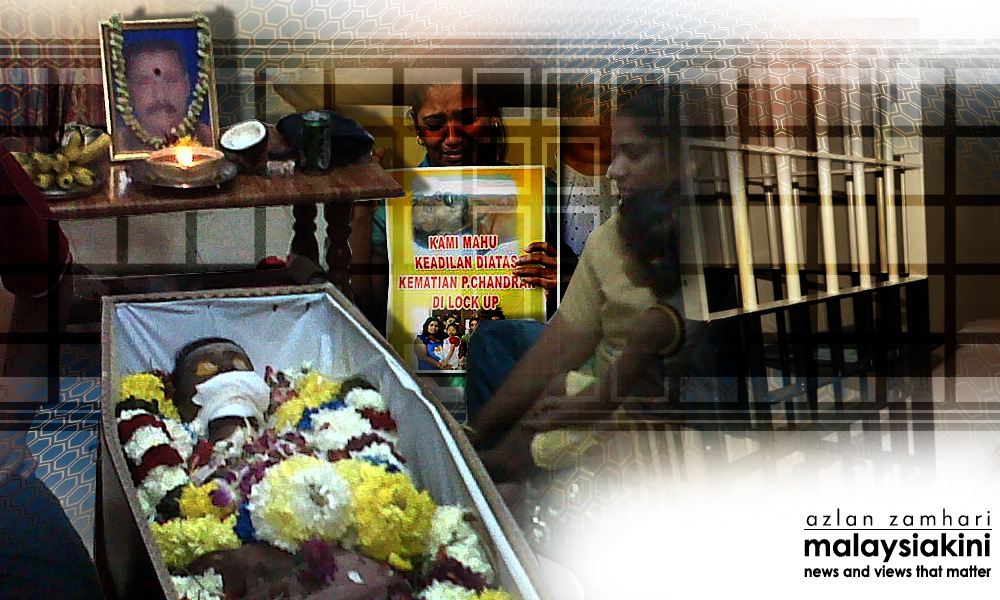

Gov't, cops told to pay RM357k to detainee's family over custodial death
The Kuala Lumpur High Court today ordered the police and government to pay RM357,500 to the family of lorry driver P Chandran who died at the Dang Wangi district police headquarters lock-up more than four years ago.
Justice S Nantha Balan, in his 86-page written grounds, agreed with the finding of coroner Ahmad Bache that Chandran had died needlessly and his death could have been averted had the police performed their duties and responsibilities.
The judge ruled that the police and government acted in negligence in not sending Chandran to the hospital and breached their duty to take care of the lorry driver.
The Kuala Lumpur High Court today ordered the police and government to pay RM357,500 to the family of lorry driver P Chandran who died at the Dang Wangi district police headquarters lock-up more than four years ago.
Justice S Nantha Balan, in his 86-page written grounds, agreed with the finding of coroner Ahmad Bache that Chandran had died needlessly and his death could have been averted had the police performed their duties and responsibilities.
The judge ruled that the police and government acted in negligence in not sending Chandran to the hospital and breached their duty to take care of the lorry driver.
"In my view, if the police and the officers on patrol duty and those monitoring the CCTV at IPD Dang Wangi had done their job, they would have observed that there was something not right with the deceased, especially on the early morning of Sept 10, 2012.
"They should have taken steps to intervene and send the deceased to the hospital but it appears that everyone who had a duty to look after the detainees as per the Lock-Up Rules 1953, had abdicated their responsibilities and washed their hands off the matter," he said.
Chandran, who was 47 then, had died due to hypertensive heart disease as a result of the police not giving or allowing medicine related to his health.
It was reported during the inquest that police only noticed his death 12 hours after he died in the lock-up.
He was arrested by police due to suspected abduction of an Indonesian baby which was originally given up for adoption.
Chandran's wife, N Selvi, and their child C Rita are the plaintiffs in the suit filed in 2015, where they named five police officers, the inspector-general of police and the government as defendants.
Police have a duty to care
Justice Nantha Balan also ruled that police have a duty of care towards the inmates.
“In my view, both under common law and under statute, there is a duty of care to ensure the detainee is nor harmed by the police or by other detainees, or that they do not harm themselves.
“It is trite in common law that the detaining authorities owe a duty of care to ensure that the detainees are healthy, given proper medical care during the period of incarceration.” he said.
He further referred to the Lock-Up Rules as a complete code which governs the handling and management of detainees.
“Thus, detainees would be safe from harm or self-harm if the detaining authorities abide by the Lock-Up Rules 1953 and ensure they are fully complied with,” he stressed.
The court also noticed that the witnesses for the defendants claimed ignorance when they were called to explain why no action was taken when images showed the deceased was in pain in the early hours of September, 2012.
“Talking the above conduct of the police into consideration, it is my view there was a lackadaisical attitude by the four police officers whose investigation into the death of the deceased was perfunctory to say the least.
“This is quite clearly a case which is replete with instances indicative of a violation of the deceased's constitutional right not to be deprived of his life, liberty and be given proper medical attention,” said the judge.
Lawyer: No amount of money can compensate loss
Justice Nantha Balan said Chandran's death is both regrettable and lamentable.
“By all accounts, it was an avoidable death. It is just that neither the IO (investigating officer) nor the police personnel bothered to take the necessary steps to send the deceased to hospital. If this is not behaviour which is reprehensible and unconstitutional, then I do not know what it,” he added.
Following this, the judge ordered special damages of RM3,500, another RM10,000 for bereavement, RM144,000 for loss of dependency and exemplary damages of RM200,000.
Justice Nantha Balan also ordered the defendants to pay RM50,000 costs. He also noted despite Chandran's death, no action was taken against any of the police officers.
The family was represented by lawyer M Visvanathan, who said no amount of money is going to undo the damage or loss.
“Money can never compensate. An innocent man died for nothing.
“If the Attorney-General's Chambers files an appeal against today's decision, it is akin to aggravating the loss felt by the family. Let them have closure in the matter,” he added.


Are you sure you want to delete this comment?
This action cannot be undone.