




Absurd laws, guidelines hamper tobacco-control
Ridiculous legal definitions and tedious administrative guidelines have turned Malaysia into an international laughing stock in relation to enforcing anti-smoking laws, said an anti-smoking advocate.
Ridiculous legal definitions and tedious administrative guidelines have turned Malaysia into an international laughing stock in relation to enforcing anti-smoking laws, said an anti-smoking advocate.
Malaysian Council for Tobacco Control (MCTC) honorary secretary Shaari Ahmad Junid said the flaws in current laws and guidelines reflect the government's half-hearted approach to enforcement.
 For instance, he said, there is a direct contradiction between the objectives of the Food Act 1983 (FA) and the scope of its subsidiary legislation.
The FA mentions tobacco as a food product and defines the act of consumption as something "eaten or drunk", whereas the Control of Tobacco Product Regulations 2004 (CTPR) includes an offence of "smoking".
"The principal Act defines tobacco as 'food' without defining smoking as an act of consumption but the subsidiary regulation criminalises tobacco consumption through smoking," Shaari explained.
"Even the basis of consumption is different. Food and drink enter through the esophagus and end up in the stomach, whereas inhaled smoke travels through the bronchi to the lung. So, how can laws that conflict on objectives and jurisdiction be enforced at all?"
Impossible procedures
The tedious procedures in the tobacco control regulations are equally ridiculous, said Shaari, who has done extensive research on tobacco control laws and procedures.
Citing the health ministry's enforcement guidelines for the CTPR, he said it was "almost impossible to even initiate a prosecution".
"Enforcement officers must comply with 38 very detailed but mostly ridiculous procedures before they can even file a case, which often doesn't happen because it is just impossible to do so."
Before bagging the evidence - the smoking stub - officers must identify themselves, ask the smoker to surrender the stub, put it out, bottle it, seal it tightly, make visual observations of it and label it.
 "That is not all. They are also required to forcibly remove the stub from a resisting smoker, among a host of other impractical and time-consuming measures.
"Are these practical enforcement guidelines to cover half our population or almost 10 million smokers in the country? How many officers do you think would risk facing violent retaliation, harassment, ridicule, offensive remarks and other forms of resistance from smokers?"
In sharp contrast is the Kuala Lumpur City Hall's (Banning of Smoking) Rules 1972 which criminalises the act of lighting "a cigarette, pipe or similar substance" in any theatre.
He said the ruling which carries a maximum RM500 fine simplified enforcement work.
"City Hall should now extend this ban to all public places, not just a theatre. It should add a clause which revokes/cancels the business licence of premises that violate the smoking ban.
"Since business licenses are issued by local authorities which come under the housing and local government ministry, it should be allowed to formulate and enforce tobacco control laws with guidance from the health ministry - and not the other way around as is the case now."
Written consent
A major hurdle faced by enforcers, said Shaari, is the administrative requirement for written consent from the public prosecutor under Section 32A of the FA (Amendment 2001) in order to mount a prosecution.
He said this seriously hampers prosecution work, making it extremely difficult if not almost impossible. ( See table )
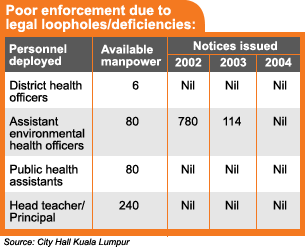 "Although the FA empowers many quarters to carry out enforcement, it is severely limited by both time and space, not to mention cost," he noted.
As an illustration, he said Section 33(1) of the amended FA compounds the problem through a three-level delegation of power in order to file a case for prosecution.
"This also requires the public prosecutor's written consent. Worse still, the onus is on the enforcers to prove a violation of tobacco control laws or smoking ban. Existing laws are not user-friendly but inconvenient, disabling and complicated."
Shaari urged the government to immediately rectify these shortcomings if it is serious about the national Tak Nak no-smoking campaign.
Other tobacco control laws are the Local Government Act 1976 and local authority by-laws, the Occupational Safety and Health Act 1993 and the Customs Act 1967.


