


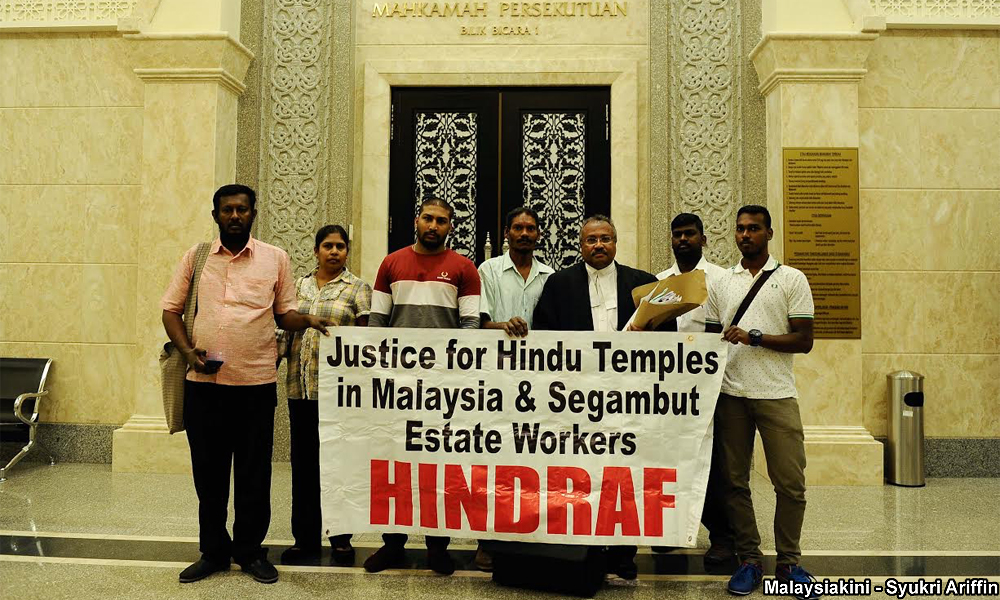

Federal Court dismisses Hindu temple demolition case
The apex court has dismissed the application by a group of former estate workers who claimed that the demolition of a 130-year old temple in Segambut was a criminal act and who wanted a court declaration to that effect.
Their lawyer P Uthayakumar told reporters that the three-member panel led by Court of Appeal president Raus Sharif today ruled that the case did not meet the threshold to warrant an appeal to be heard.
The judge ordered for the application to be dismissed, with cost of RM10,000 to be paid to the first respondents - the developers New York Empire Sdn Bhd and Triple-H Auto Parts Sdn Bhd - and RM1,000 to be paid to the attorney-general’s chambers as the second respondent.
The apex court has dismissed the application by a group of former estate workers who claimed that the demolition of a 130-year old temple in Segambut was a criminal act and who wanted a court declaration to that effect.
Their lawyer P Uthayakumar told reporters that the three-member panel led by Court of Appeal president Raus Sharif today ruled that the case did not meet the threshold to warrant an appeal to be heard.
The judge ordered for the application to be dismissed, with cost of RM10,000 to be paid to the first respondents - the developers New York Empire Sdn Bhd and Triple-H Auto Parts Sdn Bhd - and RM1,000 to be paid to the attorney-general’s chambers as the second respondent.
Other members of the panel were Ahmad Maarop and Aziah Ali. The first respondent was represented by lawyer Soo San San, while the second respondent was represented by senior federal counsel Mazlifah Ayob.
The appellants were named as Maswin Ripit and five others who were occupying two plots of land in Batu, Kuala Lumpur.
Speaking to reporters after the decision, Uthayakumar claimed his clients were never given a hearing in court since the case started at the Kuala Lumpur High Court in 2005.
“You see these people have been staying there for four generations, after being brought there by the British. They lived there, they died there, but the developers played dirty.
“You see from the names (of the appellants) you’d know they are Indonesians - Maswin Ripit and five others - all Indonesian names. They named them, and they got a court order (for the eviction of squatters).
“They never named these people (my clients) as parties,” he said, referring to the ethnic Indian estate workers at the Segambut Estate.
He said after his clients found out, they went to court and were given a one-day extension to file an appearance as parties to the case. When the day came, the Kuala Lumpur High Court dismissed the application saying that the applicants had failed to produce utility bills to prove that they resided on the estate.
Appeals before a different Kuala Lumpur High Court judge, to the Court of Appeal, and now the Federal Court had also been unsuccessful.
On July 25, 2015, parts of the estate including the Sri Nagakanni Amman temple that was supposedly more than 130 years old, were demolished.
The workers through Uthayakumar had sought the Federal Court’s answer to four legal questions, including whether the demolition of Hindu temples amounted to a violation of Article 11 of the Federal Constitution’s guarantee of religious freedom, and several laws under the Penal Code against the disruption of places of worship and burial places.
They also asked if the then Federal Territories Minister Zulhasnan Rafique’s statement in the Dewan Rakyat in 2008 that no more Hindu temples would be demolished in the future had the force of law.
“In the British parliamentary democracy, it (a ministerial statement in Parliament) has the force of law.
“A minister comes into Parliament and he says something, but the implementation is something else. So we are asking the court to declare whether a minister’s statement (in Parliament) has the force of law,” Uthayakumar said.
They also asked the court whether the demolition of estate workers’ homes was a violation of the Estate Workers Housing Scheme of 1973, which was a government policy in place since 1973.
Uthayakumar said that under the scheme, estate workers were to be provided housing within the estate.
He also expressed disappointment that the court had ordered the workers to pay costs to the respondents, despite his appeal that the workers could not even afford his legal fees and he was representing the workers on a pro bono basis.


Are you sure you want to delete this comment?
This action cannot be undone.