




Q&A: Why I want to stay on with UM
 Dr Edmund Terence Gomez, the top Universiti Malaya academic who was 'forced' to quit and later reinstated, tells
malaysiakini
on what should be done to reform our universities in this second of a three-part series.
Dr Edmund Terence Gomez, the top Universiti Malaya academic who was 'forced' to quit and later reinstated, tells
malaysiakini
on what should be done to reform our universities in this second of a three-part series.
Malaysiakini: Do you think the controversy over your secondment is a reflection of a crisis in education?
Gomez: I don't think my problem is unique. I know many other lecturers who left the university because they had tried unsuccessfully to bring about changes. They had spoken up, they left deeply disillusioned. Their attempts to bring about reforms had gone unheeded. I think this problem also exists in other universities, such as Universiti Kebangsaan Malaysia as well as Universiti Putra Malaysia. I will let the lecturers from these universities tell their own stories. I'm hoping more lecturers from other universities will come forward and speak about these issues.
 Dr Edmund Terence Gomez, the top Universiti Malaya academic who was 'forced' to quit and later reinstated, tells
malaysiakini
on what should be done to reform our universities in this second of a three-part series.
Dr Edmund Terence Gomez, the top Universiti Malaya academic who was 'forced' to quit and later reinstated, tells
malaysiakini
on what should be done to reform our universities in this second of a three-part series.
Malaysiakini: Do you think the controversy over your secondment is a reflection of a crisis in education?
Gomez: I don't think my problem is unique. I know many other lecturers who left the university because they had tried unsuccessfully to bring about changes. They had spoken up, they left deeply disillusioned. Their attempts to bring about reforms had gone unheeded. I think this problem also exists in other universities, such as Universiti Kebangsaan Malaysia as well as Universiti Putra Malaysia. I will let the lecturers from these universities tell their own stories. I'm hoping more lecturers from other universities will come forward and speak about these issues.
From my own dealings with union leaders of other universities, the problems I have spoken about, such as marks tampering as well as irregularities in the promotion exercise, are not unique to UM.
What do you think should be done?
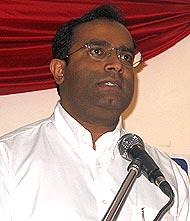 We have been calling for two things. First, there should be a separate scheme of service for academics. It must be de-linked from the civil service in the sense that it is a separate scheme of service unique to lecturers - the terms and benefits will be different, the incentives to join academia will be lucrative enough for them. At the moment, there is very little incentive for highly educated people to join the university. The salary scheme for those with PhDs is not attractive.
The other issue is clearly the glass-ceiling in the university. People are aware that their prospects for promotion are hindered if they speak up. So this brings us to other issues. There are several cases that we can cite where lecturers have complained that they have been marginalised when they have been vocal about certain issues.
The other matter is the leadership of the university. Now, while on one hand we must have a scheme of service which helps attract university lecturers, we must also have capable, competent leaders as vice-chancellors. The vice-chancellor should not be appointed by the executive. There should be an independent selection process.
We can cite the case of the United States where when there is a vacancy for the post of vice-chancellor, an independent body is set up, applicants are asked to apply and the best candidate is given the job. That immediately means that the vice-chancellor has the autonomy when it comes to decision making. When decisions are made, they are usually made in the interests of the university.
If we have just these two for a start - a good scheme of service and autonomy in terms of the selection of its leaders - we can move towards solving the general problem.
The other issue we have to put in place is the removal of legislations that impede academic freedom - the University and Universities Colleges Act and the 'Akujanji' are the best examples. There must be freedom for dialogue, discourse and independent research. There must be independence for lecturers to articulate their views, to educate properly, to allow for critical thinking. If we can have these three in place, then reforms can commence.
Is it too late to talk about the three solutions that you have suggested?
The three issues that I have suggested can be implemented immediately. And with this three implemented immediately, it will be the first step. The rest will flow from there.
There have been allegations of favouritism in promoting academicians.
We have already done an investigation, which proves that there has been favouritism. This is not new. When there is a promotion exercise - and we have repeatedly argued this point - when a lecturer is promoted to the position of associate professor or professor, the curriculum vitae must be publicised. The vice-chancellor must give reasons why they were promoted.
If they just do these two things - publish the curriculum vitae and explain why they were promoted - it will immediately increase transparency and check any complaint of irregularities in promotion exercises.
What is the current promotion practice in the university?
People are not informed of the curriculum vitae (of those promoted). The management has told us that they will not publish the curriculum vitae.
What is their reason?
The reason is - and this has been publicly stated - it is a confidential document. They feel that it is improper to ask the lecturers to publish their curriculum vitae. This is not a valid argument. In all major universities when a lecturer is promoted, the curriculum vitae is there for all to see and the promotion board will explain why a particular lecturer has been promoted.
It looks as though that university academics are playing politics.
When you have a situation where power is concentrated at the top, you create a feudal culture. The problem is that a subservient culture has crept into the system. We have an executive that appoints the vice-chancellor, and the vice-chancellor has a lot of power. There has been limited transparency and accountability in the university. This tends to lead to the idea that you have to be subservient to the leader.
In that sense, I think, many lecturers feel that they have to tow the line to ensure their promotion in the university is not jeopardised. This is highly unfortunate. This feudal culture has become widespread in this university.
Apart from this, the concentration of power in the office of the vice-chancellor as well as oppressive legislation, creates a climate of fear. Many lecturers are now afraid to speak up about not just issues in the university but also problems in society. This climate of fear is hardly conducive for the promotion of intellectual discourse which further undermines academic culture in universities.
Why have you opted to stay in UM for over 10 years given the problems you faced?
I'm a product of this university. I joined UM in 1982 as a student. At the time I was exposed to many lecturers who were independent, who were critical, who helped me develop a totally different orientation to life as well as to the meaning of education.
Lecturers who have influenced me include Syed Husin Ali, KS Jomo, Tan Chee Beng and Salleh Joned. These lecturers had a profound impact on me. They showed me the true meaning of being an academic. The purpose is to mould young minds, to train them to think differently and to use their education in the service of society.
I'm grateful to this institution for what it has done for me because this is not the orientation I had of education when I joined UM. I know what UM used to be. It was a great institution with great minds teaching in this place who helped mould dynamic individuals. Just look at the alumni, you will find many prominent Malaysians who were students of the university.
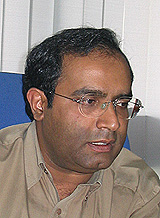 When I became a lecturer I felt that I wanted to give back to UM what I had gained from it. I wanted to use my training under these lecturers to help do what they had done in the past - to groom, to mould young minds. The good thing about being in this university is that I have the freedom to teach. I have the freedom to supervise.
I have spent some time abroad. I worked four years in Leeds University, in Japan for a short period, and I also served in Australia. I have realised one important thing. When I taught Southeast Asian politics abroad, my students were exceptionally bright but for them, this was just another course.
When I teach in Malaysia it is different. My students immediately recognise that I am telling them something different. They realise they have not heard this before. That precipitates debates in my classes. There is a lot of discussion about what they think the situation is and what the reality is. The nature of my courses tends to expose them to totally different ways of viewing problems that exist in our society. I have tried to influence my students to adopt a different orientation. That makes my teaching in UM far more meaningful to me than my experiences of having taught abroad.
I feel that when I teach here I have a greater impact on the minds of my students than when I teach abroad. This is the primary reason I have remained in this university.
I think the university can still be reformed. That is why I continue to stay here. I have worked with the (academic) union. I have also worked with the Malaysian Social Science Association. Through these two institutions - both have an academic orientation - I have tried to bring about reforms in this university. That's why I remain here because I feel that my efforts, together with those of others, can help bring about change.
How did you feel when you had to resign from UM?
I felt a deep sense of failure that my attempts to bring changes had not gone through. My deepest concern was that the decline of the university would continue. That my failure to bring about reforms would not augur well for those committed lecturers who continue to remain here.
I was, however, encouraged that news of my resignation precipitated a response that has helped bring the serious problems that exist in the university to light.
Recently there are letters in malaysiakini which criticised you of promoting yourself.
I have been fighting this cause very quietly for some time before this issue erupted. I have never sought publicity for anything that I have done. People are probably aware of my books, but not of my work in the university. I have in fact shunned the limelight. I thought that I could work quietly from within the institution by engaging management in dialogue.
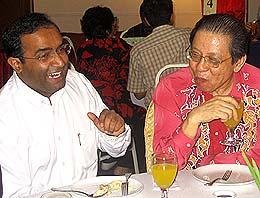 The only reason that my resignation has come to the fore is because of (Opposition Leader) Lim Kit Siang, and I am grateful to him for his help. It was not I who publicised this issue but Lim who broke this story and said to me, 'your forced resignation highlights very clearly the problems in the university and let us use what has happened to you to make the point to the government that reforms are required'.
I am surprised by the number of letters that have been written about my resignation. I had not expected this kind of thing. I think the reason people are writing in is not because of me, but because they are aware of the serious problems that exist in the universities and of the need to act immediately to address these problems. They are seizing the moment to try and take this discussion forward.
What about your family? Will they be joining you in Geneva?
I will leave first. I plan to check out the schools and set up a home there. Once that is done, my family will join me at the end of this year.
How will you solve your wife's (Dr Sharmani Patricia Gabriel) inability in getting unpaid leave from the university?
I am very concerned about my wife's problem. I hope that the management will not be vindictive because of the publicity that has come from my resignation. But I also believe that the reason why Sharmani has been informed that her intention to apply for unpaid leave to join me has been rejected is that she has spoken up about problems in the university. She has complained about the alteration of her exam grades and irregularities in the promotion exercise in her faculty (Arts and Social Sciences).
What exactly happened?
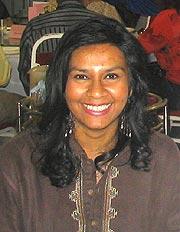 This is the sequence of events. Sharmani, who is on sabbatical, was informed that there was to be a meeting to discuss the distribution of work for the coming year. She informed the head of the (English) department that she was planning to apply for unpaid leave commencing January so they could take note of this when they were talking about the distribution of the workload. Instead, the head of department emphasized that she would not approve her unpaid leave when she make the formal application.
Now, this is not the way to handle this kind of problem in the university. What you do is you call in the lecturer to discuss the matter. This is important because there is a family, there are children involved here. Normally, the management will find a solution to the problem.
I myself went to England on unpaid leave to join my wife, who was given a scholarship to do her PhD in Leeds University. At that time, I had just joined the (Economics) faculty. I went to see my head of department. I thought he would be upset with me because I was asking for unpaid leave so soon after having joined the department. But his immediate reaction was, 'of course you have to go because your young family is involved'.
When I saw the dean and I told him that I wanted to go on unpaid leave, he was also very supportive. He wasn't too happy that I was leaving so soon after joining UM but he recognised we were talking about a family. It's common for a lecturer to be given unpaid leave.
The department said Sharmani has not submitted a formal application.
Yes, it was true then. Sharmani has now submitted a formal application for unpaid leave.
Do you think the department is reasonable in saying that your wife had not applied for leave formally and therefore it was not approved?
Sharmani had then not applied for leave. She had informed the department that she was planning to apply. But she was told that when she submits the application, it would be rejected.
Publicise CVs of promoted lecturers, UM urged
Part 1: Q&A: Varsities becoming a police state, says top academic
Tomorrow: Pak Lah has the powers to wipe out graft


