




Heat on court for denial of wage claim by illegals
More brickbats have been hurled at the Selangor Industrial Court for its decision to deny a group of Indonesian workers their claim to unpaid wages because of their illegal status.
More brickbats have been hurled at the Selangor Industrial Court for its decision to deny a group of Indonesian workers their claim to unpaid wages because of their illegal status.
Flaying the court over the matter today were the Bar Council and the Indonesian embassy in Kuala Lumpur.
Bar Council president Yeo Yang Poh said the decision was "certainly not a positive development", while the embassy termed it as a "bad precedent".
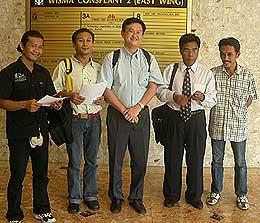 Last Thursday, the court had
dismissed
the claim by 54 Indonesian workers on the grounds that they had entered and worked in this country illegally.
Last Thursday, the court had
dismissed
the claim by 54 Indonesian workers on the grounds that they had entered and worked in this country illegally.
"The issue concerns social justice and has to go beyond legal technicality. It has to look at the issue of justice involved," said Yeo when contacted.
In the case of these workers, he said they should have been paid the due wages even if their status is questionable.
To stress his point, he cited the example of how an illegitimate child could legally claim maintenance from his or her father.
"Issues of this nature does not look solely at the legal status point but also involves moral responsibility and social justice," he said.
In view of this, Yeo said the Immigration Act and the rights of workers should be treated as separate issues.
"We should not deny them legal redress," he stressed.
Protecting irresponsible employers
The embassy said the court's decision could lead other companies to hire illegal workers and avoid paying them.
"Denying them their wages is against basic rights. Even if they had entered the country illegally, if they had worked, they should be paid," said Eka Suripto, the information department first secretary.
"Otherwise, companies might be tempted to hire illegal workers and not pay them knowing that they can get away with it later. This is simply not right."
 Eka also recalled that, during the amnesty period given to illegal workers earlier this year, Human Resources Minister Dr Fong Chan Onn (
photo
) reportedly said illegal workers who were not paid could claim the wages when they re-enter the country legally.
Eka also recalled that, during the amnesty period given to illegal workers earlier this year, Human Resources Minister Dr Fong Chan Onn (
photo
) reportedly said illegal workers who were not paid could claim the wages when they re-enter the country legally.
"This supports the argument that the workers should be given their right to wages," he said.
Commenting further on the court's decision, Eka said the individual's immigration status should not supercede his or right to wages.
While promising to continue assisting the group in their legal redress, he warned that the development would be perceived as a move to protect irresponsible employers and to ignore the responsibility of employers in hiring undocumented workers in the first place.
"When we agree that illegal workers should be brought and processed before a court of law, why are people hiring illegal workers not treated the same way?" he asked.
Act against employers
Agreeing with this argument, Malaysian Trade Union Congress deputy secretary-general Abdul Halim Mansor called on authorities to take action against the employer involved in this particular case.
However, he also pointed out that the workers should have been aware that the court's decision would not be in their favour, since they had entered and worked in this country illegally.
The 54 workers were among 90 illegal migrant workers who claimed that their employer - subcontractor Sri Mega Jaya - has shortchanged them of wages amounting to RM150,000 after working on a condominium project in Damansara Damai, Selangor, since last September.
The main contractor is Plato Construction, which is wholly-owned by MK Land Holdings - which is listed on the main board of Bursa Malaysia. MK Land has denied hiring illegal workers.
Migrant workers support group Tenaganita has also criticised the court's decision, warning it would pave the way for more abuse.


