




Msia among worst offenders of refugee rights: report
Malaysia is one of the worst offenders of refugee rights, according to the 2005 edition of the World Refugee Survey released yesterday by the US Committee for Refugees and Immigrants (USCRI).
Malaysia is one of the worst offenders of refugee rights, according to the 2005 edition of the World Refugee Survey released yesterday by the US Committee for Refugees and Immigrants (USCRI).
According to the 126-page report - which grades some 40 countries on their treatment of refugees - Malaysia, Tanzania and Iran received failing 'F' grades.
The grades were based on the assessment of the performance of host governments in four areas:
- The fairness of their asylum procedures and protections against deportation or repatriation.
The more refugees were restricted by governments in each area, the worse the grade. 'A' grades were awarded to Chad, Iraq, and the United States.
Not signatory
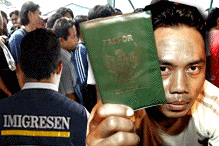 Malaysia, which is not a signatory to 1951 Refugee Convention, is home to an estimated 50,000 refugees - 20,000 of whom are Acehnese, 10,000 Burmese Rohingyas and the rest are mostly Chin Burmese and Nepalese.
"The government sent Acehnese back to Indonesia and Muslim Rohingya and Christian Chin to Thailand, which then deported some back to their original country, Myanmar (Burma)," said the report .
"Other refugees were victims of constructive refoulement, opting for deportation due to horrendous conditions in immigration detention camps."
It said that the Human Rights Commission (Suhakam) visited the Semenyih Immigration Detention Centre, which included refugees and asylum seekers, and found detainees with fresh scars and concluded that this amounted to cruel and inhuman treatment.
"Immigration detention camps were overcrowded, and detainees suffered from insufficient food and healthcare, poor sanitation, and abuse from guards, contributing to the deaths of several detainees," added the report.
Failing grades
As to specific areas of Convention compliance, USCRI gave failing grades for asylum and repatriation practices to Malaysia, China, Iran, Lebanon, Pakistan, Russia, South Africa, Thailand and US.
The best grades went to Algeria, Cote d'Ivoire, Ethiopia, Liberia and Venezuela.
On detention and confinement, 'F's were awarded to Malaysia, Bangladesh, China, Iran, Lebanon, Pakistan, Russia, Serbia, South Africa, Thailand and Yemen.
The best grades went again to Algeria and Liberia, as well as Burundi and Sierra Leone.
On the right to earn a livelihood, Malaysia, Algeria, Iran, Lebanon, Russia and Tanzania all got failing grades.
Chad, Congo, Ecuador, Iraq, Israel and the Occupied Territories, and US topped the list.
And of freedom of movement and residence, Malaysia, Algeria, Bangladesh, Ethiopia, Israel and the Occupied Territories, Kenya, Russia, Tanzania, and Thailand all flunked.
Ecuador, the European Union, Sierra Leone, Syria, the US and Venezuela were awarded an 'A'.
Basic rights denied
According to the USCRI report, seven of every 10 of the world's roughly 11.5 million refugees have been 'warehoused' for five years or more in countries that have denied them basic rights guaranteed under the 1951 Refugee Convention.
As a result, many of the world's refugees are unable to work, move freely within countries, own property, or even receive an education.
The report also marks a new phase of USCRI's year-old campaign to focus attention on the plight of warehoused refugees, those who are kept in situations of enforced idleness and dependency over protracted periods of time.
"We are failing those who need us most," said Lavinia Limon, the president of USCRI, which was formerly known as the US Committee for Refugees. "Millions of these refugees are children who are growing up to nothing."
Largest refugee population
With a total of nearly three million refugees, Palestinians constituted the world's largest refugee population. Some 1.635 million Palestinians live as refugees in the occupied West Bank and Gaza, while another 701,000 live in Syria, and 265,000 in Lebanon.
Those two countries also have the world's highest ratio of refugees to their national populations - one in 18 people living in Lebanon is a refugee; one in 26, in neighbouring Syria.
 Palestinians also have by far the oldest 'warehoused' refugee populations. In Gaza, Lebanon, and the West Bank, according to the report, the warehousing of Palestinians - defined as refugees restricted to camps or segregated settlements or otherwise deprived of basic Convention rights for more than five years - began 56 years ago.
There are now 1.65 million living in those areas under such conditions. In Egypt, Jordan, and Saudi Arabia, Palestinians have been warehoused for 37 years. There are now 454,000 warehoused Palestinians in those three countries.
The other large population - currently nearly two million - that has been most affected has been Afghans in Iran and Pakistan who have been warehoused there for 25 years.
But Eritreans in Sudan; Angolans in Zambia and Namibia; Sahrawis in Algeria, and Filipinos in Malaysia; Iraqis in Iran; Palestinians in Kuwait; Sri Lankans in India, and Burmese in Thailand; have all suffered some deprivation of their Convention rights for 20 years or more.
A total of nearly seven million refugees have been warehoused for 10 years or more.
- IPS


Are you sure you want to delete this comment?
This action cannot be undone.