
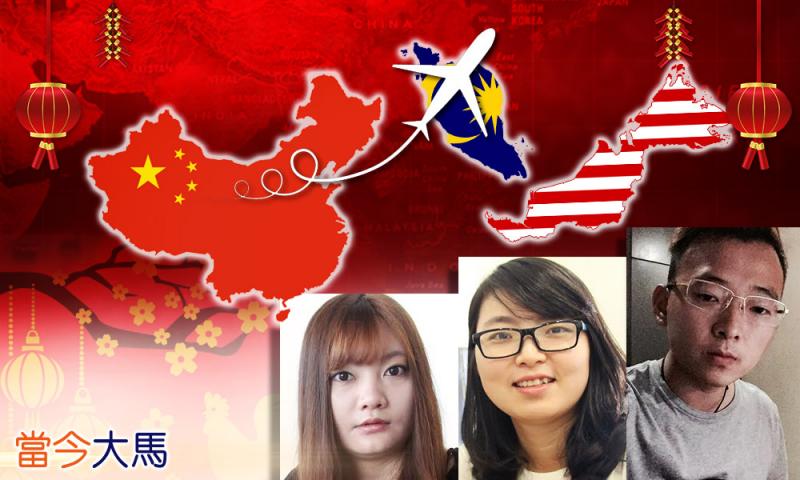
How students from China celebrate CNY in ‘eternal summer M'sia’
Unlike in Mainland China, the Lunar New Year in Malaysia is called Chinese New Year and not the Spring Festival, as it is in China, because Malaysia is a land of eternal summer.
Seasons aside, Malaysia would always experience a festival-like atmosphere and the sweeping away of the old to start anew every time during this celebration.
Due to the Chinese diaspora, many ethnic Chinese have since remained in Southeast Asia. While retaining cultural elements from China, they have, however, localised their celebration accordingly.
Currently, there are some 10,000 students from different parts of China in Malaysia. Despite distinctive customs, the Chinese New Year has brought them all together with the local Chinese in celebrating this important festival.
Their experience of celebrating Chinese New Year in a different country has given them the chance to explore a somewhat different “spring festival”.
It is through their nostalgia in celebrating the festival in their own country that they re-discover the real meaning of “Chinese New Year”.
Meet Li Sha, 24, a student at a private university. As a Sichuan native, she keeps true to her roots and simply loves spicy food.
It has been four years since Li arrived in Malaysia to pursue her Master’s degree in Business Administration. And it has also been four years since she returned home to celebrate Chinese New Year.
Celebrating the festival in Malaysia has given her a whole new experience. Every year, she would celebrate the Chinese New Year in different ways, all of which have impressed her greatly.
Unlike in Mainland China, the Lunar New Year in Malaysia is called Chinese New Year and not the Spring Festival, as it is in China, because Malaysia is a land of eternal summer.
Seasons aside, Malaysia would always experience a festival-like atmosphere and the sweeping away of the old to start anew every time during this celebration.
Due to the Chinese diaspora, many ethnic Chinese have since remained in Southeast Asia. While retaining cultural elements from China, they have, however, localised their celebration accordingly.
Currently, there are some 10,000 students from different parts of China in Malaysia. Despite distinctive customs, the Chinese New Year has brought them all together with the local Chinese in celebrating this important festival.
Their experience of celebrating Chinese New Year in a different country has given them the chance to explore a somewhat different “spring festival”.
It is through their nostalgia in celebrating the festival in their own country that they re-discover the real meaning of “Chinese New Year”.
Meet Li Sha, 24, a student at a private university. As a Sichuan native, she keeps true to her roots and simply loves spicy food.
It has been four years since Li arrived in Malaysia to pursue her Master’s degree in Business Administration. And it has also been four years since she returned home to celebrate Chinese New Year.
Celebrating the festival in Malaysia has given her a whole new experience. Every year, she would celebrate the Chinese New Year in different ways, all of which have impressed her greatly.
In early 2013, Li made a life-changing decision when she bid farewell to her hometown and flew south to this land so unfamiliar to her, all on her own.
Since then, she has not only gained knowledge and friendship, but also learnt about the different aspects of Chinese culture as observed in Malaysia.
When Li was a newcomer to Malaysia, a group of students from China invited her over to celebrate the new year.
Coming from the same country gave them a strong sense of nationalism, and she found it easy to mix well with them.
The small group of Chinese nationals pasted Chinese couplets and hung lanterns all over their rented house.
“Since all of us came from different parts of China, everyone cooked a signature dish that would represent their particular hometown.”
The living room, filled with joy and laughter, coupled with the smell of delicious food, felt like a reunion dinner. The group huddled at a table to watch China Central Television’s (CCTV) Spring Festival Gala webcast - an annual popular programme in China.
Over the years, however, the popularity of the programme has gone down the drain. Broadcast by the predominant state television, many of the country’s youths believe that the programme only shows the “righteousness of Communism”.
“In China, we always complain that the programmes are not fascinating enough. After studying abroad, I am no longer picky,” Li said, adding that she has also viewed things from a different perspective.
Despite surrounded by friends, Li could not help but feel homesick. That night after the dinner, she felt a sense of loss as she entered her room.
She missed home, she realised, and all she wanted to do was to turn on her laptop to make a video call to her parents.
“My parents squeezed in the frame of the small screen together and we exchanged New Year's blessings.
“I know they have always cared for me. Despite the thousands of miles between us, we were in one frame, just like a family photo.
“My mum later told me that my dad, a typical tough and strict man, had taken off his glasses to wipe his tears. I suddenly realised my father cared for me so much that his strict image melted away.”
Transformed into an independent adult
Nevertheless, her four years celebrating the Chinese New Year in Malaysia has turned her into a girl who no longer needs to live under the protective grasp of her parents. She has gradually transformed into an independent adult who no longer relies on her parents.
As for 20-year-old Yuhan, it has been a year since she has been in Malaysia.
Hailing from Beijing, the undergraduate at a private university still remembers vividly the good friendship she had with her neighbours at the Beijing hutongs.
And Yuhan simply cannot forget her caring neighbours' dishes, especially their dim sum.
With these in mind, she was quite happy to share about the celebrations she had in her hometown.
Beijing, Yuhan said, normally becomes an empty city whenever the Chinese New Year rolls in, as workers return home to their respective hometowns.
But households of Beijing natives would commonly paste couplets and the “Fu” character, which denotes luck and happiness.
With daffodils on the table in full bloom, the natural fresh fragrance of the flowers continues to be one of her most vivid memories of the Chinese New Year.
On the eve of the new year, everyone would rush back to their homes for the family reunion dinner, despite their busy schedules.
Family members gather and sit around the table, wearing new clothes and eating the steaming hot meals.
When the New Year bell rings, everyone would indulge in a bowl of steaming dumplings with pickled garlic. This is Yuhan’s best memory of Beijing, then.
“Nowadays, celebrating Chinese New Year is about enjoying the reunion dinner, ancestor and God worship, wearing new clothes, setting off firecrackers, visiting relatives, getting ang pow (red packets) and going to the temple.”
In Malaysia, she still follows the traditional customs of China – shopping, cooking, eating, watching the Spring Festival Gala, playing mahjong until midnight and eating dumplings.
Yuhan also invites many foreign friends who had expressed their interest in the festival for the dinner.
They try to learn the most important phrase in relation to the Chinese New Year - “Gong Xi Fa Cai”.
“Accompanied by my friends, I try not to be homesick or in low spirits.
“However, the moment I see photos of home-cooked food and family portraits posted by my friends in China, I cannot help but miss home.”
Before Yuhan came to Malaysia, all her family members went to take a family portrait and she brought it along with her. Whenever she misses her family, she would take out the photograph to look at it.
“I was a girl who always missed home so much and was entirely dependent on my parents. But I realised I have to grow up and be independent, so I chose to study abroad.”
She said she was fortunate to see how the Malaysian Chinese have preserved the Chinese culture, and at the same time developed distinctive forms, such as the 24-festival drums, lion dance, lou sang and throwing mandarin oranges to find a love match programmes.
“I still remember being taken to watch the lion dance when I was a child; nowadays it’s rare to watch such performances.
“But I can still hear the sound of the iron gong and roll of drums and I also remember the sight of the dancing lion,” Yuhan said, glad that she could still witness this in Malaysia.
Hanhan, from Guizhou, comes from a province surrounded by beautiful hills and water.
The undergraduate at a public university has been in Malaysia for more than a year and last year was the first time he celebrated the Chinese New Year abroad.
But unlike the two girls, Hanhan did not like to celebrate the new year and found it hard to understand its meaning. The only thing he would look forward to was receiving the ang pow.
Going along with his parents, doing things according to traditional customs left him feeling bored. He particularly disliked the typical questions asked by relatives and friends on exam scores, love life and salary-wise.
Hanhan initially studied at a university in Lanzhou, Gansu, for a year-and-a-half. Feeling dissatisfied with his major and learning environment, he decided to leave the university to go abroad to further his studies.
One day, while shopping at a supermarket in Malaysia, he came upon a packet of red dates and subsequently bought them for the first time.
It is because during every Chinese New Year, his mother would always ask him to eat some dates. He never knew its significance, grimacing every time he ate them, just like taking medicine.
“But that time, I finished the whole packet I bought. I still don't think it tastes good but it gave me a taste of home.”
It was then that he realised he should be back home for the Chinese New Year.
As Hanhan’s hometown is an inland mountainous area, it has retained many traditional customs until today. For example, they do not go out or spend money on the eve of the Lunar New Year.
They get up early and sweep the house, hang lanterns and paste Spring Festival couplets.
“My mum and grandmother would take the preserved meat and fish to cook for the family reunion dinner. At night, they would place an old-fashioned square table in the courtyard, with all the family members happily getting together.”
Among the many dishes on the table are pork with preserved vegetables, pork with steamed millet, preserved meat, wild goat and Chinese liquor.
“The people from my hometown are mostly traditionalists. There are a lot of customs that I don’t know, but I still remember my family would always put their tributes - pouring liquor in small glasses, burning incense sticks and lighting the candles to worship God and our ancestors,” Hanhan said.
During the Chinese New Year he experienced in Malaysia, he was invited by a local Chinese friend, which made him feel at home.
It was there that he learned the differences between the two Chinese cultures in China and in Malaysia.
“In Malaysia, there are no four seasons - it is summer all year round. They often call the Chinese New Year as Lunar New Year, instead of the Spring Festival, as it is known in China.
“I think the local Chinese here have very traditional Confucian beliefs - when visiting the home of relatives, you only need to bring two oranges and they will return two oranges to you. It is kind of like a relay competition.”
Hanhan also noted how not much is given in the ang pow, with the amounts of RM10 or RM20 being more symbolic than anything.
“In China, these amounts don’t seem impressive. But the tradition of the ang pow here is more about sincerity and blessing - this goes back to the values of the Chinese New Year.”
Having figured out the significance of the Chinese New Year in Malaysia, Hanhan says: “My stay in Malaysia is sure not a waste.”
ANDY HU, an intern with Malaysiakini, hails from Shanghai, China.


Are you sure you want to delete this comment?
This action cannot be undone.