


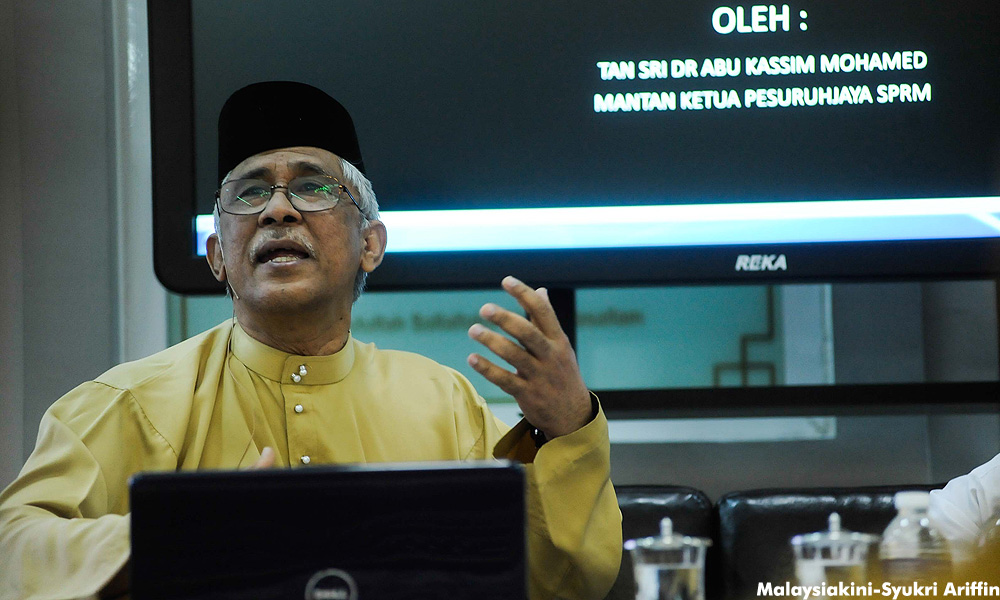

Ex-MACC chief wants non-partisan fight against graft
Former Malaysian Anti-Corruption Commission chief Abu Kassim Mohamed has urged the people to stand united against corruption, regardless of their political ideologies.
"All communities must reject political ideologies (when it comes to fighting corruption) because if corruption is used as the basis of politics, it will be difficult to resolve social issues.
"We must stand together if corruption is to be eliminated," Abu Kassim told a congregation of 100 people at Masjid Al-Ikhlas in Shah Alam yesterday...
Former Malaysian Anti-Corruption Commission chief Abu Kassim Mohamed has urged the people to stand united against corruption, regardless of their political ideologies.
"All communities must reject political ideologies (when it comes to fighting corruption) because if corruption is used as the basis of politics, it will be difficult to resolve social issues.
"We must stand together if corruption is to be eliminated," Abu Kassim told a congregation of 100 people at Masjid Al-Ikhlas in Shah Alam yesterday.
In his first public appearance since stepping down as MACC chief commissioner six months ago, Abu Kassim drew parallels to how Malaysians came together to combat the communists.
"I remember during the time of (former prime minister) Abdul Razak Hussein when he outlined the dangers of three 'Cs' after independence.
"They were communists, communalism and corruption. Why people could unite at that time and speak of the evil of communism, but not against corruption?" he said.
His talk was given after maghrib prayers last night. There was no question-and-answer session during the one-and-half-hour long event.
Abu Kassim spoke at length about the international corruption index, his experience as an enforcer at the Anti-Corruption Agency (ACA), the predecessor of MACC, as well as the scourge of corruption in general.
His retirement last year drew heavy public scrutiny as it came amid MACC's investigation into multi-billion ringgit deposits into the prime minister's personal bank accounts.
Prime Minister Najib Abdul Razak denied the money originated from state-owned investment fund 1MDB and claimed the money was a "donation" from a member of the Saudi royal family.
Abu Kassim was last August succeeded by Dzulkifli Ahmad, who had served with the Attorney-General's Chambers.
Early last year, attorney-general Mohamad Apandi Ali cleared Najib of wrongdoing and declared the case closed.
The Attorney-General's Chambers has also snubbed a request from the Switzerland's Office of the Attorney-General for assistance into the 1MDB probe.
Abu Kassim now serves as an expert consultant on integrity at the Law Faculty of Universiti Teknologi Mara.


Report this comment
Are you sure you want to delete this comment?
This action cannot be undone.