


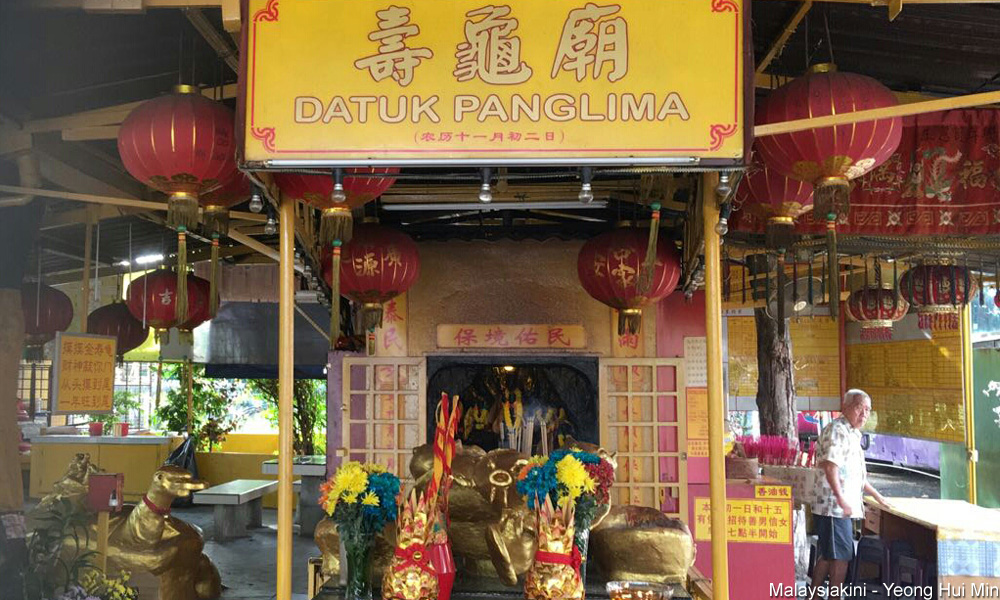

The story behind ‘Datuk Kong’ worship
The worshiping of the Taoist deity ‘Datuk Kong’ in Malaysia has sparked controversy among Malaysians recently, after a shrine with purportedly Islamic elements caused offence to some.
This concerned a ‘Datuk Kong’ shrine that had a mosque-like dome on Jalan Makyong 5E/KU5 in Bukit Raja, which was demolished by the Klang Municipal Council (MPK) on Wednesday.
Prior to its demolition, photos of the shrine with its alleged Islamic elements became viral on social media and it was perceived as an offence by many.
With regard to the incident, Malaysiakini spoke to the Federation of Taoist Associations Malaysia Klang Bandar Di-Raja branch president, Yeoh Choo Beng to understand more about the ‘Datuk Kong’.
The worshiping of the ‘Datuk Kong’ was believed to have started in the 19th century when the Chinese migrated to South-East Asia.
According to Yeoh, the ‘Datuk Kong’ was not always named as it is and the name was generated by the local Malays.
“The Chinese brought in the spirit ‘di zhu gong’ (god of the land) as they worship him and asked for protection on a foreign land.
“It is said that when the Chinese tried to explain to the local Malays about the deity, they pronounced it as ‘tok kong’, which was then interpreted as ‘Datuk Kong’ by the Malays,” said Yeoh.
Worshipped for good deeds past
With that said, Yeoh noted that the exact origin of the ‘Datuk Kong’ is not clearly recorded in the Taoist teachings, as it is not among the Taoist gods.
He said that the spirits of the ‘datuk’ who have passed on are worshipped because they have done good deeds in the past, which were appreciated by the people.
The worshiping of the Taoist deity ‘Datuk Kong’ in Malaysia has sparked controversy among Malaysians recently, after a shrine with purportedly Islamic elements caused offence to some.
This concerned a ‘Datuk Kong’ shrine that had a mosque-like dome on Jalan Makyong 5E/KU5 in Bukit Raja, which was demolished by the Klang Municipal Council (MPK) on Wednesday.
Prior to its demolition, photos of the shrine with its alleged Islamic elements became viral on social media and it was perceived as an offence by many.
With regard to the incident, Malaysiakini spoke to the Federation of Taoist Associations Malaysia Klang Bandar Di-Raja branch president, Yeoh Choo Beng to understand more about the ‘Datuk Kong’.
The worshiping of the ‘Datuk Kong’ was believed to have started in the 19th century when the Chinese migrated to South-East Asia.
According to Yeoh, the ‘Datuk Kong’ was not always named as it is and the name was generated by the local Malays.
“The Chinese brought in the spirit ‘di zhu gong’ (god of the land) as they worship him and asked for protection on a foreign land.
“It is said that when the Chinese tried to explain to the local Malays about the deity, they pronounced it as ‘tok kong’, which was then interpreted as ‘Datuk Kong’ by the Malays,” said Yeoh.
Worshipped for good deeds past
With that said, Yeoh noted that the exact origin of the ‘Datuk Kong’ is not clearly recorded in the Taoist teachings, as it is not among the Taoist gods.
He said that the spirits of the ‘datuk’ who have passed on are worshipped because they have done good deeds in the past, which were appreciated by the people.
“The local people would worship the ‘datuk’ who have done good things like helping people and doing charity in the place they live in, so there are many different ‘datuk’ with different names,” said Yeoh.
Yeoh said that the ‘Datuk Kong’ is commonly perceived as a Malay deity due to the Malay names and its Malay appearance, as the idol would feature a Malay traditional costume.
He added that Chinese versions of the ‘Datuk Kong’ also exist but are rare.
“There are Chinese ‘Datuk Kong’ that have Chinese costumes but I have only come across one so far,” he said.
Important to developers and contractors
Although the ‘Datuk Kong’ iis perceived as a Malay ‘deity’, many Chinese Taoists and developers still worship him for wealth and protection from disasters.
“In Klang, where there is a lot of development going on, many developers choose to set up a shrine at their sites to pray to the ‘Datuk Kong’ ias they would be cutting down trees and developing the land,” said Yeoh.
He also said that some contractors would have to pray to the ‘Datuk Kong’ ias it has turned into a custom as they fear unfortunate incidents if they do not do so.
He added that there are around 420 registered ‘Datuk Kong’ shrines in Klang, including smaller ones that are installed in the homes of the worshippers.
“Many shop owners also install ‘Datuk Kong’ shrines to pray for their business and for safety as well,” said Yeoh.
Although the ‘Datuk Kong’ is highly perceived by many as an important deity, Yeoh said that the worshipers should avoid setting up large shrines without permits at public places.
“We should be considerate and respect other people if we want to be respected and not misunderstood,” he said, referring to the demolition of the Muslim-like ‘Datuk Kong’ shrine in Bukit Raja.
He also urged that people should register the temples or shrines with the government before installing the shrines to avoid facing demolition.
“It is fairly easy for people to register temples or shrines before they are built as it can be done online and will be approved in one week,” said Yeoh.


Are you sure you want to delete this comment?
This action cannot be undone.